34 works in this view — arrow keys or swipe to move between them.
Dance in Art
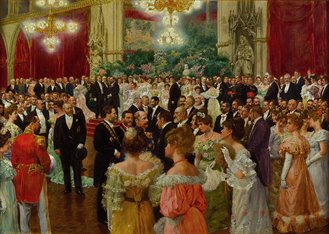
Court Ball in Vienna (detail)
Wilhelm Gause
- Era:
- 1900-1920 (Ragtime/Early Jazz)
- Rights:
- By Wilhelm Gause. In the public domain in the United States.
- Recorded as:
- public_domain
The painting documents the last flourishing of the European court ball as a living institution, capturing the Viennese Waltz in its native context and at its moment of greatest prestige. For historians of ballroom dance, it provides evidence of how couples held each other, how densely they danced, and how the waltz functioned as the organizing principle of elite social life. The work also records the material culture of early 20th-century high society—the dress, the architecture, the scale of such events—making it valuable for understanding the social framework within which formal dancing took place.
What you are looking at
A formal court ball fills an ornate palace interior, its walls and ceiling decorated in the Belle Époque style. A large, tightly packed crowd of well-dressed guests moves across a parqueted floor. Men in black tailcoats and white tie dominate the composition, their forms creating a sea of dark fabric punctuated by the pale shirt fronts and faces. Women in evening gowns—some in pale silk or satin, others in darker fabrics—move among them. The lighting is warm and diffused, suggesting gaslight or electric lamps of the period, and falls evenly across the scene. The crowd is densest in the middle distance, where couples can be seen in close proximity, suggesting active dancing or promenading. The architectural framing—tall columns, arched doorways, decorated entablature—reinforces the formality and grandeur of the setting. The painting captures a moment of social movement and interaction rather than a posed tableau.
The dancing
The dancing couples visible in the composition are in closed ballroom holds, with partners facing one another in the upright posture characteristic of early 20th-century ballroom dancing. The women's bodies incline slightly away from their partners in a characteristic frame. Arms are extended in the conventional hold—the man's right hand on the woman's back, left hand raised to hold her right hand. The women's left hands rest on the men's shoulders or upper arms. The density of the crowd and the clothing make detailed footwork impossible to discern, but the overall upright posture and the forward-and-sideways movement implied by the composition suggest the walking steps of dances such as the Waltz or the newer One Step.
The dance depicted
The scene depicts the Viennese court ball, one of the signature social events of the Austro-Hungarian imperial calendar—most likely the famous Hofball (Court Ball) held annually in Vienna. The dominant dance would have been the Waltz in its Viennese form, which required the closed ballroom hold and rotating, circular movement seen here. The One Step—a simpler, more modern dance that was gaining popularity in the early 1900s—may also be represented, as it required the same hold and was increasingly danced at formal balls alongside the waltz. The crowd composition and the formality of the setting confirm this as elite court dancing rather than public ballroom or social dance of the middle classes. The Waltz remained the supreme expression of Viennese high society through the early 20th century, and a painter depicting such a scene would have understood it as the primary dance.
How it was made
This work is an oil painting, established by the soft, blended handling of light and the subtle gradations of tone across the crowd and architectural surfaces. The technique allows Gause to suggest movement and atmosphere through loose brushwork in the background figures, while maintaining crisp detail in the foreground. The scale and finish suggest this was created as a finished exhibition work or as a commission documenting a significant court event, rather than as a preliminary study. Oil painting's capacity to build warm, luminous effects—evident in the treatment of gaslight or electric illumination—was essential to conveying the glamour and festive atmosphere of such occasions.
About this work
This is a documentary painting of the Viennese court ball, depicting the formal ballroom dancing of the Austro-Hungarian imperial court in the early 20th century. The composition captures not a single dance moment but a broader social scene—the mingling, movement, and interaction of an elite crowd engaged in the ritualized performance of the Waltz and related ballroom dances. The painting sits at the intersection of dance documentation and society portraiture; it records how the Waltz was danced in the most prestigious venue in Europe while also serving as a record of who danced there and in what dress. For dance history, it provides rare visual evidence of the scale, social arrangement, and physical conduct of court-level ballroom dancing at a moment when that tradition was reaching its end—the First World War would dissolve the Austro-Hungarian court within fifteen years.
How to look at it
Attend first to the architecture and lighting: Gause has framed the scene to emphasize the grandeur and formality of the imperial ballroom, using the arched doorways and columns to create depth and to suggest the vast scale of the event. Look next at the foreground couples and their holds: the painter has rendered the ballroom frame with anatomical accuracy, and the uniform posture and positioning of all dancing couples confirms the standardized technique of Viennese Waltz dancing. Finally, observe the crowd composition: the density of figures, the way couples move in circular paths through the throng, and the absence of spectators or seated observers—this is a room in which almost everyone present is participating in the dance, either actively or waiting for a partner. The painting freezes a moment of continuous, flowing movement rather than a climactic gesture.
The artist
Wilhelm Gause (1853–1916) was an Austrian painter, illustrator, and theatre designer who specialized in society scenes and historical pageantry. He was closely associated with Vienna's artistic establishment and was particularly known for paintings documenting court ceremonies, state occasions, and the social life of the Austro-Hungarian elite. His work combined careful observation of contemporary dress and setting with a painter's interest in light, crowd composition, and festive atmosphere. Gause's illustrations and paintings were widely reproduced and circulated, making him a primary visual chronicler of Viennese high society in this period.
The period
The painting dates to the twilight of the Austro-Hungarian court as a living cultural force. The Viennese Waltz had been the dominant ballroom dance of European aristocracy and high society for nearly a century, codified in the 1870s and 1880s by dancers and masters such as Josef Lanner and Johann Strauss II. By the early 1900s, the Waltz remained supreme at court events, but newer dances—the One Step, the Foxtrot, the newer American jazz-influenced steps—were beginning to appear at public and semi-public balls. The court ball, however, remained conservative, preserving the Waltz as its central form. The painting captures this moment of stylistic continuity at the apex of European court culture, shortly before the First World War would sweep away the dynastic courts of Europe. In the visual arts, the Belle Époque aesthetic—evident in the ornamental architecture and the delicate treatment of light—was also in its last years.
Dance in this work
Questions about this work
Is this the Vienna Opera Ball?
No. This appears to be a state court ball held in an imperial palace, not the Vienna Opera Ball, which was first held in the 1950s. The setting and social composition suggest an official court ceremony rather than a public event. Vienna held multiple formal balls annually, and the court ball was the most prestigious.
What dance are they doing—waltz or something else?
Primarily the Viennese Waltz, which was the standard ballroom dance at court events in Vienna. The closed holds, the upright posture, and the formal setting all confirm this. Some couples may also be doing the One Step, a simpler dance that was gaining acceptance at formal balls in this period, but the waltz would have been dominant.
Why are there so many people dancing at once?
Court balls were large-scale events where the entire assembled company participated in dancing in rotation. Couples would dance, then step aside to allow others to take the floor. The crowded composition captures the mingling and movement of a full ballroom rather than a single dance rotation. Such events could last many hours with continuous dancing.
When was this painted?
The catalogue record does not specify a date, but the style, dress, and subject matter suggest the 1890s or earliest 1900s. The Belle Époque architectural ornament and the gaslit or early electric lighting are consistent with this period. The painting likely commemorates an actual court ball that Gause observed or was commissioned to document.
More dance artwork