31 works in this view — arrow keys or swipe to move between them.
Dance in Art
At the Ball
Auguste-François Gorguet
- Era:
- 1900-1920 (Ragtime/Early Jazz)
- Rights:
- By Auguste-François Gorguet. In the public domain in the United States.
- Recorded as:
- public_domain
For historians of ballroom dance, this painting is evidence of how the quadrille was still the dominant formal social dance in elite circles well into the early 20th century, despite the earlier rise of the Waltz. For art historians, it exemplifies the Salon tradition of social documentation through painting, capturing not just the activity of dance but the material culture—the gowns, the interiors, the lighting—that surrounded it. The work demonstrates how dance functioned as a vehicle for displaying wealth, status, and feminine beauty in the period.
What you are looking at
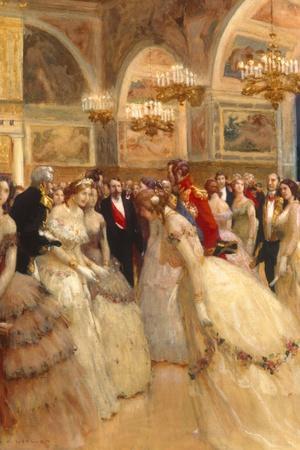
A formal ball in a grand interior lit by crystal chandeliers. The space is an ornate salon with vaulted ceilings, decorative wall panels, and classical architectural detail suggesting a palace or aristocratic mansion. In the foreground, two women in elaborate white ball gowns dominate the composition—their skirts are voluminous, adorned with ruffled tiers and ribbon trim that catches the warm light. They are in the midst of dancing or promenading, their posture upright and formal. Behind them, a crowd of fashionably dressed figures in evening wear—men in dark suits and women in gowns of white, cream, and deep jewel tones—fills the depth of the hall. The painting's loose, impressionistic technique renders the background figures as a haze of color and movement, creating a sense of the crowded, animated atmosphere of the occasion. The brushwork is fluid and atmospheric, with warm gold and cream tones dominating the palette.
The dancing
The two foreground dancers stand in an upright, formal frame typical of ballroom dance of the period. Neither figure appears to be in a closed partnered hold; instead, they seem to be dancing independently or in a procession-like formation. Their arms are either at their sides or raised lightly, and their postures suggest a gliding or processional movement rather than vigorous turning or stepping. The multiple figures in the background are similarly upright and composed, suggesting a formal social dance rather than a free or acrobatic style. The emphasis throughout is on elegance of carriage and the display of costume.
The dance depicted
This appears to be a Quadrille, the dominant ballroom dance of the mid-to-late 19th century and the formal social dance of aristocratic balls through the early 20th century. The composition—with its emphasis on formal groupings, the processional quality of movement, the elegant but restrained gestures, and the setting within a grand salon—is consistent with quadrille dancing, which involved set formations of couples moving through prescribed figures. The women's elaborate white gowns and the formal evening dress of all figures place this within the context of the Gilded Age ballroom. The painting does not suggest Waltz, despite the Romantic-era setting, because the framing lacks the close partnered hold and rotational energy characteristic of that dance; rather, it depicts the stately, choreographed social dance of formal gatherings.
How it was made
This appears to be an oil painting, executed in a late 19th-century academic style with impressionistic elements. The technique allows for atmospheric effect—the background dissolves into suggestion and light, creating depth and the sense of a crowded ballroom without depicting each figure in detail. The foreground figures are rendered with greater precision, drawing the eye and establishing the main subject. This technique of contrast between carefully rendered foreground and impressionistic background was common in Salon paintings of the period, which were intended for exhibition and sale to wealthy patrons who would recognize themselves or their social world in such scenes.
About this work
This painting depicts a formal ball in a grand aristocratic interior, capturing the height of Gilded Age social dancing. The composition centers on two women in elaborate white ball gowns moving through a quadrille, the prescribed social dance of formal evening gatherings. The painting is an example of Salon art from the late 19th or early 20th century—a genre devoted to depicting contemporary social life, particularly the leisure activities of the wealthy and fashionable. Such works served as both documentation and aspiration, recording the visual splendor of high society for viewers who moved in those circles or longed to. The work belongs to a tradition of ballroom painting stretching back through the 19th century, from Romantic-era depictions of the Waltz to Victorian scenes of courtship and social display in formal dress.
How to look at it
Attend to the painting's two registers: the careful rendering of the foreground dancers' faces, gowns, and posture conveys the specificity and individuality of the ballroom experience, while the dissolving, impressionistic background suggests the vast scale and collective nature of the occasion. Notice how the artist uses light—the chandeliers and architectural detail—to establish the palatial setting as part of the subject. The composition asks you to read the formal, upright postures and the stately spacing between figures as an expression of social order and decorum, not as constraint: the dance was understood as graceful precisely because it was controlled and choreographed. The painting's emotional register is one of elegance and aspiration rather than abandon or passion.
The artist
Auguste-François Gorguet (1862–1927) was a French academic painter who specialized in historical subjects and scenes of contemporary social life. He was a student of Gustave Boulanger and exhibited regularly at the Paris Salon. Gorguet's work was typical of late 19th-century academic practice: technically skilled, theatrically composed, and aimed at an educated bourgeois audience. His subjects ranged from historical narratives to scenes of aristocratic leisure, ballrooms, and courtship, all rendered in the smooth, carefully modeled style of academic training. Such painters served as visual chroniclers of their own era even as they aspired to historical importance.
The period
This painting dates to the Gilded Age (1870s–1900s) or the Edwardian period (1900–1910s), when the formal ball remained the centerpiece of aristocratic social life even as new dances and entertainment were beginning to appear. The quadrille, which had emerged in the 18th century and dominated ballrooms through the 19th, was still the mandatory opening dance of formal balls in France, Britain, and America. However, this period also saw the quadrille begin to fade as the Waltz, the Two-Step, and imported Latin dances gained ground. Salon painting in this era was at the height of its prestige and market value before modernism would displace it. Gorguet's painting captures a world of social ritual and visual luxury that was both current and already nostalgic—observers were aware they were witnessing the twilight of the formal ballroom tradition.
Where it lives
The work is not currently catalogued with a holding institution, accession number, or medium specification beyond the visual evidence.
Dance in this work
Questions about this work
What is a quadrille?
A quadrille is a dance for four couples arranged in a square formation, with each couple occupying one side. Performed to music in 2/4 or 6/8 time, the quadrille consists of five prescribed figures, each with specific steps and formations. It was the mandatory opening dance of formal balls from the 18th century through the early 20th century, and it remained popular in ballrooms even as the Waltz and other dances rose in fashion. The quadrille was considered suitable for all ages and social situations because it was choreographed, orderly, and did not require close physical contact between partners.
How do you identify a ballroom dance in a historical image?
Look for the hold: Waltz and modern ballroom dances feature a closed partnered hold, while quadrilles and contadanse feature either no hold or a hand-hold at arm's length. Observe the posture and direction of movement: Waltzes show rotation and circular patterns, while quadrilles show stately, linear, and processional movement. Pay attention to the setting and dress: formal evening wear and grand interiors suggest ballroom dance, while simpler settings and rural dress suggest folk or country dancing. Finally, check the historical period: the quadrille dominated formal ballrooms until the 1920s, while the Waltz rose to prominence in the early 19th century.
When did ballroom dancing in formal dress like this go out of fashion?
The formal ball and the quadrille began to decline in the 1920s with the rise of jazz, the Charleston, and more informal dance styles. However, formal ballroom dancing in white tie and ball gowns never entirely disappeared; debutante balls, state occasions, and certain aristocratic circles have maintained the tradition into the present day. The shift was not abrupt but gradual, accelerated by World War I, the cultural changes of the 1920s, and the rise of new forms of entertainment and social mixing. By the 1950s, such formal events were already understood as ceremonial rather than the primary mode of social dancing.
More dance artwork