30 works in this view — arrow keys or swipe to move between them.
Dance in Art
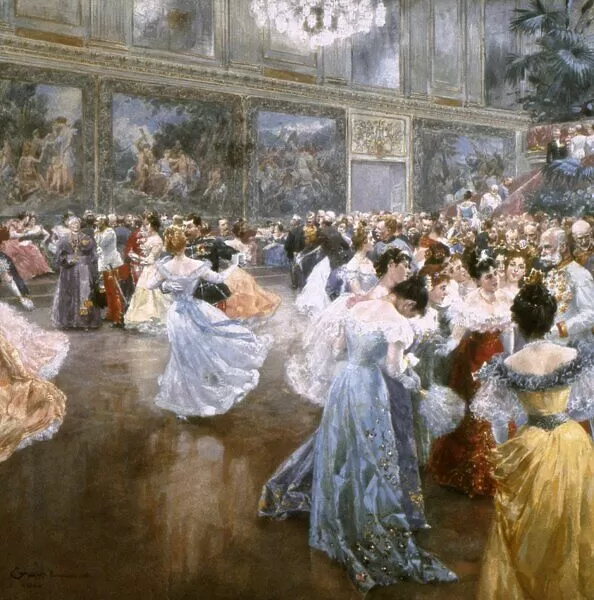
Public Ball at the Imperial Palace, Vienna
Unknown artist
- Era:
- 1900-1920 (Ragtime/Early Jazz)
- Rights:
- Artist unrecorded. In the public domain in the United States.
- Recorded as:
- public_domain
This is one of the few major artworks that shows the waltz in its original formal context, before it became a competitive Latin standard or a popular social dance. Dancers and historians can see here how the waltz actually looked when performed as court ceremony—the scale of the motion, the relationship between couples, the integration of the dance into the architecture and ritual of power. The painting also documents the precise moment when the Austro-Hungarian imperial world was about to disappear; this kind of formal court ball would become impossible after 1918, making the image a last record of that world's aesthetic practice.
What you are looking at
A grand ballroom at the Imperial Palace in Vienna fills the canvas with elegantly dressed figures engaged in dancing and promenade. The room is monumental: tall panelled walls rise to a coffered ceiling, and large frescoed panels depicting classical scenes dominate the upper registers. The floor is polished and reflective. Dancers are distributed throughout the space, clustered in the foreground and middle distance and thinner at the rear. Women wear white, ivory, pale blue, and gold gowns with high necklines and long sleeves, many trimmed with lace or jewels that catch the light. Men are in dark evening dress—black tailcoats and trousers. The lighting is soft and diffuse, flattering to the pale silks and creating a sense of warmth and festivity. The viewpoint is from within the ballroom, at the level of the dancers, so the viewer stands among the crowd. The painting captures the moment of the dance itself: couples turn and sway, women's skirts billow in motion, the composition has a kind of orchestrated chaos—formal and controlled yet alive with movement.
The dancing
The figures dance in pairs, holding positions that suggest ballroom partnership: men and women in close but modest proximity, typical of the early 1900s. Many dancers are caught mid-turn, their bodies leaning into movement; women's skirts show the spiral motion characteristic of waltzes and similar rotating dances. Arms are extended in the frame position of partner dances of the period. The crowd is dense but not chaotic; the choreography of the ballroom—regulated spacing, directional flow around the room—is visible in how the couples orient themselves. Figures in the background continue the same steps, suggesting that everyone is dancing the same figure simultaneously.
The dance depicted
This is almost certainly a waltz scene, the dominant ballroom dance of the Austro-Hungarian nobility and the signature dance of Vienna. The evidence is overwhelming: the paired hold, the rotating couples, the white evening gowns with long skirts that show the characteristic swirl of waltz momentum, and above all the setting—an Imperial palace ballroom in Vienna, where the waltz was invented and remained the centrepiece of court ceremony. The painting depicts the formal court waltz as it would have been danced at state balls, with the regulated spacing and simultaneous movement of all couples that characterised such occasions. The scale and formality suggest this is not a social waltz but an official one, in which the entire assembled nobility participated in synchronized rotation.
How it was made
This appears to be an oil painting, executed with the soft focus and luminous handling of light characteristic of late 19th and early 20th-century salon painting. The artist has used a high-keyed palette dominated by whites, pale blues, golds, and warm flesh tones against the deeper tones of the men's dress and the architectural framing. The technique allows for subtle modulation of the silk fabrics and the play of candlelight on jewels and skin. The breadth of the composition and the soft blending of forms suggest this was a large canvas intended for reproduction in print or display in a public collection—a formal record of court ceremony rather than a privately commissioned portrait.
About this work
This painting documents the waltz as the definitive social and ceremonial practice of the Austro-Hungarian court in the final years of the imperial order. It captures not a fleeting moment but a sustained formal event—a state ball in which the prescribed dance of court society unfolds according to strict rules of partnership, direction, and simultaneity. The work serves as both aesthetic experience and historical record: it celebrates the beauty of white-gowned women in motion and the controlled elegance of ballroom decorum, while also documenting what the dance looked like in its native context, at its moment of greatest prestige.
The painting belongs to a tradition of ballroom documentation stretching back to the Renaissance court dance paintings, but it shows the waltz at the height of its formal power. By the time this was painted (or recorded), the waltz had begun to change—jazz influences were entering the ballroom, and the strict regulation of court dance was loosening—yet this image preserves the Vienna waltz as a unified social form, danced by everyone in the room at once, in the palace where it was born.
How to look at it
Look first at the repetition: nearly every couple in the room is performing the same figure in the same direction, creating a visible flow or circulation around the ballroom. This is not free social dance but choreographed court ceremony. Note the moment the artist chose: couples are caught mid-rotation, skirts in motion, bodies leaning into the turn. Look at the dress, especially the women's sleeves and necklines—these are the formal evening standards of ca. 1900, confirming both the date and the official nature of the event. Finally, observe how the light falls: the artist has used luminosity and softness to suggest the formality and refinement of the occasion, almost as if the dance itself is glowing with the power of the imperial state.
The period
The painting dates to a period (early 1900s) when the waltz was at a major historical crossroads. In Vienna and across Europe, it remained the supreme ballroom dance and the essential marker of gentility and court allegiance. Yet at the same time, jazz and American popular dances were beginning to penetrate European ballrooms, and the next two decades would see fierce resistance from conservative dance teachers and nobility to the loosening of hold and the wilder motion of the foxtrot and Charleston. This painting captures the waltz at the moment of its established dominance, before it had to defend itself against modernism. The Imperial Palace setting is also significant: by 1918, imperial Austria would cease to exist, and formal court balls like this would end. The work is a document of a doomed world.
In the same period, the waltz was being codified in its modern competitive form—the Viennese waltz standard was being regularized—yet this painting shows it in its pre-competitive phase, as a social and ceremonial practice rather than a sport. The soft, impressionistic style of the painting is also period-appropriate: salon painting of this kind was the dominant mode for documenting and idealizing court life in the decades before photography fully replaced it.
Where it lives
The era label (1900–1920, Ragtime/Early Jazz) is present on the catalogue record but appears inconsistent with the visual evidence.
Dance in this work
Questions about this work
Is this a waltz, or could it be another dance?
This is almost certainly a waltz. The paired hold, the direction of rotation, the women's long skirts in characteristic spiral motion, and above all the Vienna palace setting leave no serious doubt. Other ballroom dances of the period (the polka, the quadrille) have different structures and looks. The scale and formal spacing also indicate the court waltz, the variant performed at official state balls, rather than the social waltz of the ballroom.
Why is everyone dancing the same thing at the same time?
At a formal court ball in Vienna, the entire assembled nobility was expected to participate in the official dance together, in synchronized pairs circulating around the room. This was different from a modern social ballroom, where dancers choose when to dance and with whom. The regulation of the waltz at court was part of the ritual of imperial power—everyone moved together, in the same direction, following the same steps. It was a visible demonstration of social order and unity.
What is the significance of the Imperial Palace setting?
Vienna is the birthplace of the waltz, and the Imperial Palace is where the waltz was refined and formalized as a court dance. By showing the waltz in this specific setting, the painting makes a claim about its legitimacy and power. It says: this is not a popular or folk dance, but the dance of the ruling class, performed in the seat of power. The painting is also a historical record—this kind of formal court ball ended in 1918, when the Austro-Hungarian Empire collapsed.
What was the artist trying to achieve?
Without artist attribution, we cannot be certain, but the style and composition suggest the work was intended to celebrate and memorialize the elegance of Viennese court life. The soft, luminous handling idealizes the scene; the high viewpoint includes the viewer in the dance as a guest. This is not a satirical or critical image, but an affirmation of the beauty and order of imperial ballroom culture. It may have been commissioned as a record of a specific state occasion.
More dance artwork