29 works in this view — arrow keys or swipe to move between them.
Dance in Art
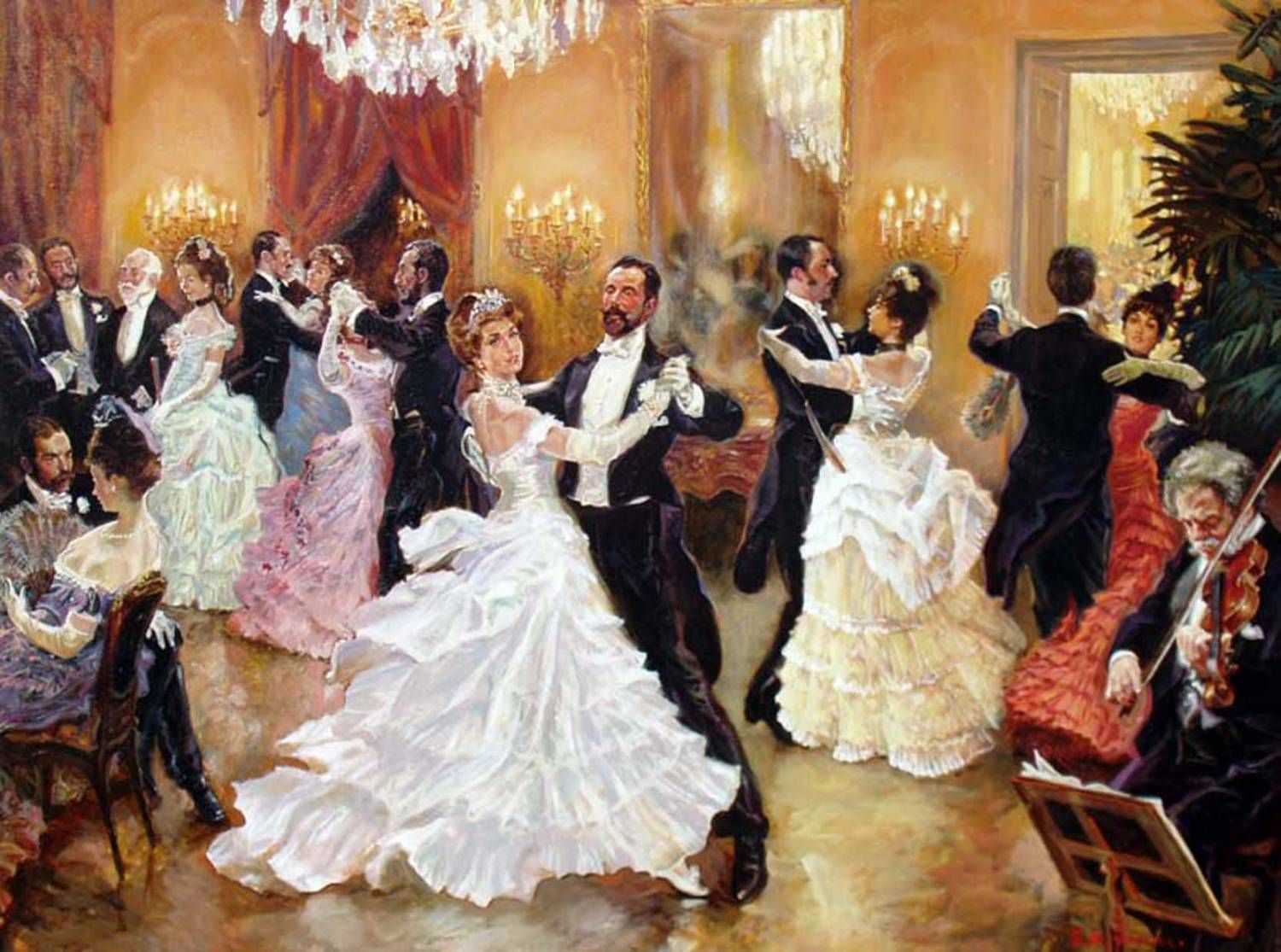
Court Ball in Vienna (full composition)
Wilhelm Gause
- Era:
- 1900-1920 (Ragtime/Early Jazz)
- Rights:
- By Wilhelm Gause. In the public domain in the United States.
- Recorded as:
- public_domain
This work documents the Viennese waltz at the moment of its greatest cultural prestige, showing not just the step but the entire social apparatus that surrounded it—the room, the dress, the gender dynamics, the role of spectatorship. For anyone studying ballroom dance history, social dance as ritual, or the relationship between dance and class in the 19th century, this painting is a primary source. It also reveals how artists of the period understood dance: not as isolated movement but as a total social scene.
What you are looking at
A formal ball in an opulent Viennese palace, captured at the moment when dancing is in full swing across a grand reception room. The composition is alive with movement: in the foreground, a woman in a white ball gown with a sweeping train dances with a man in black tailcoat; to the left and right, other couples are engaged in the waltz, their bodies leaning into the characteristic frame of the period. The setting is one of imperial grandeur—gilded wall panels, crystal chandeliers casting warm light, heavy red curtains framing tall windows, and potted palms at the room's edges. The color palette is dominated by warm golds and creams, set against the dark formality of the men's dress. Observers line the walls and sit in chairs, watching the dancers. The artist has chosen a moment of orchestrated elegance: multiple couples at different stages of the same dance, creating a sense of continuous, rhythmic motion across the space.
The dancing
The dancers are in closed ballroom hold throughout—man's right hand at the woman's back, her left hand resting on his shoulder, their outside hands joined at frame height. The bodies lean together with the upper torso tilted forward slightly, characteristic of the Viennese waltz. The women's arms are relaxed and extended, their skirts caught mid-swirl, with train hems visible at ankle level. The men are upright but engaged, their weight centered and moving through the lower body. The perspective shows dancers at multiple depths—some near, some middle-ground, some distant—all executing the same closed-hold rotational movement. The overall impression is of practiced, synchronized elegance rather than individual expression.
The dance depicted
This depicts the Viennese waltz as it was danced in elite Austro-Hungarian court and ballroom society in the late 19th and early 20th century. The closed hold, the continuous rotation visible in the women's skirts, and the formal context all confirm this identification. The Viennese waltz was the dominant social dance of Vienna's imperial social calendar, and this scene captures its role as a marker of civilization and refinement. The presence of multiple couples executing the same movement in a formal setting shows the waltz as a structured social protocol rather than a matter of individual choice—couples danced in a specific way, in a specific space, before a specific audience of observers who did not participate.
How it was made
This appears to be an oil painting on canvas, executed in a loose, impressionistic style that emphasizes light and movement over precise detail. The brushwork is painterly—particularly in the rendering of fabric, light on the chandeliers, and the warm tonality of the room—and creates a sense of atmospheric shimmer and immediacy. The soft focus on figures in the background and the detailed rendering of foreground dancers suggests a deliberate depth of field, as if the artist were translating photographic composition into paint. This technique allows the viewer to feel present in the moment rather than observing from a fixed, theatrical distance. The style suggests a work intended for an educated, affluent audience familiar with both ballroom culture and contemporary painting practice.
About this work
This is a scene of Austro-Hungarian court or high-society ballroom life, likely from the 1890s–1910s, depicting the Viennese waltz at its cultural apex. The work celebrates the waltz not as a step or a technique but as a complete social performance—the setting, the dress, the formality, the presence of observers, and the synchronized movement of multiple couples all reinforcing each other. For a dance historian, this painting is valuable precisely because it shows the waltz embedded in its original context of power, class, and ritual. It is not a dance lesson or a moment of spontaneous pleasure; it is the enactment of a social order through bodily movement.
The painting belongs to a tradition of ballroom genre painting that flourished in Vienna and German-speaking Europe from the mid-19th century onward. Works like this were commissioned by or created for audiences who danced in these spaces and wished to see themselves and their pleasures immortalized. The image circulated through reproduction, spreading an idealized vision of Viennese ballroom culture throughout Europe and beyond.
How to look at it
Pay attention to the depth of field and the way the artist has arranged bodies at different distances to create a sense of continuous dance across the entire room. Notice how every couple is in the identical closed hold and how the swirl of the women's skirts indicates the rotational direction and pace. Observe the distinction between the dancers (animated, engaged, in motion) and the watchers (seated, still, observing)—this division was part of the social choreography of the ball. Look at the light: the chandeliers and wall sconces create pools of warm illumination that focus attention on the dancers' faces and the white of the women's gowns. The painting is asking you to admire not just the beauty of the individuals but the order and harmony created by their synchronized movement.
The artist
Wilhelm Gause (1853–1916) was an Austrian painter and illustrator specializing in society scenes, ball scenes, and scenes of Austro-Hungarian court life. He was prolific in capturing the leisure and social occasions of Vienna's elite, and his work was widely reproduced in illustrated journals and collected as high-quality prints. Gause had a gift for rendering light, fabric, and the complex composition required to show many figures in a unified space. His paintings were commercial successes, appealing to audiences who recognized themselves or their social aspirations in his idealized yet detailed scenes. He was part of a generation of illustrative painters whose work bridged fine art and popular culture.
The period
This painting dates from the height of the Viennese waltz's cultural dominance, during a period when Vienna was the capital of a vast multinational empire and its ballrooms were centers of political and social power. The 1890s–1910s were also a period of intense nostalgia for an imagined pre-modern elegance even as the modern era accelerated around it. The waltz itself had evolved from a folk dance into a sophisticated, regulated ballroom form with specific techniques and protocols. Simultaneously, artists and intellectuals were beginning to document and romanticize social customs in the face of rapid social change. Genre paintings of ball scenes served partly as a record of a way of life that, even then, felt threatened by modernity. The painting also reflects the rise of illustrated journalism and the expansion of a visual culture aimed at middle-class audiences who consumed images of elite society.
Dance in this work
Questions about this work
Is this a specific event or a generic ball scene?
The painting appears to be a genre scene rather than a documentary record of a particular ball. However, it is based on actual Vienna ballroom culture and would have been recognizable to contemporary viewers as a faithful representation of how elite Viennese balls actually looked and functioned. The setting, dress, and protocols are historically accurate, even if the specific occasion is not identified.
What is the social role of the people sitting and watching?
Observers at balls served multiple functions: they were often people not currently dancing (older guests, those resting, unmarried women awaiting a partner), but their presence also served as witness and validation of the event. Being seen at a ball and seeing others was part of the social performance. The separation between dancers and watchers reinforced hierarchies of age, gender, marital status, and energy.
How does the artist show movement in a still image?
Gause uses several techniques: the swirl of the women's skirts caught mid-turn, the forward lean of the bodies in closed hold, the positioning of multiple couples at different points in the rotation, and the soft, loose brushwork that suggests motion rather than freezing it. The composition itself spirals around the room, encouraging the viewer's eye to follow the dancers' path.
What does the dress tell us about the period?
The women wear floor-length ball gowns with structured bodices, narrow waists, and full skirts—consistent with 1890s–1910s fashion. The men wear white-tie dress (black tailcoat, white waistcoat and shirt front). This was mandatory formal dress for court and elite balls. The uniformity of dress was itself a sign of participation in a specific social code.
More dance artwork