27 works in this view — arrow keys or swipe to move between them.
Dance in Art
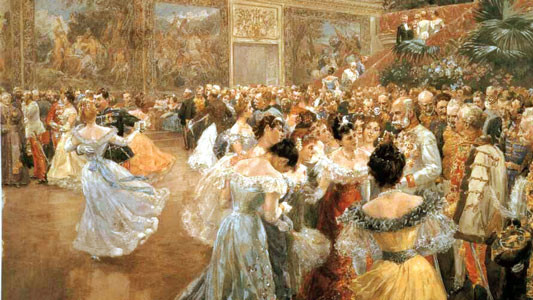
Court Ball in Vienna (dance floor crop)
Wilhelm Gause
- Era:
- 1900-1920 (Ragtime/Early Jazz)
- Rights:
- By Wilhelm Gause. In the public domain in the United States.
- Recorded as:
- public_domain
This painting is a primary visual document of how the Viennese Waltz was actually danced and practiced in its native context, by its original community. It shows not the stylized theatrical version or the modern competitive form, but the living social practice of Vienna's ballroom culture at the end of the Austro-Hungarian Empire. For dancers and historians, it offers invaluable evidence of body mechanics, costume, spatial density, and social convention that ballroom technique surveys often gloss over.
What you are looking at
A grand ballroom filled with hundreds of elegantly dressed guests in what appears to be fin-de-siècle Vienna. The composition is crowded and atmospheric, with warm golden-brown tonalities suggesting gaslight or candlelight. In the foreground, multiple couples dance: women wear white or pale gowns with high necklines and elaborate sleeves typical of the 1900s–1910s, while men are in dark formal dress (tailcoats, dress uniforms with insignia, some in military regalia). The dance floor itself occupies the lower third of the composition, with dancers distributed across it in various positions of motion. Behind them, the ballroom stretches deep into the canvas, with ornate architectural details—paneled walls, decorative doorways, potted plants—visible through the crowd. The scene captures a moment of collective social dance rather than a single focal point: couples are at different phases of movement, some turning, others progressing forward, creating a sense of continuous, rhythmic motion across the floor.
The dancing
The couples visible in the foreground and middle ground display the characteristic closed hold and upright carriage of Viennese ballroom dance circa 1900–1915. Men's arms are raised and extended; women are positioned at their sides with arms lightly placed. The body positions are nearly vertical, with minimal hip movement and an emphasis on traveling steps across the floor. Several couples are shown mid-turn or mid-rotation, with skirts caught mid-swirl—the rippling fabrics of the women's gowns suggesting continuous circular or rotating movement. The density of dancers and the repetition of the hold across multiple couples emphasizes the social and formal nature of the dance: this is not virtuosic or theatrical display, but rather the standardized technique of ballroom dancing as practiced by Vienna's social elite.
The dance depicted
This is almost certainly a depiction of the Viennese Waltz, the dominant ballroom dance of Vienna's gilded age and a central feature of its court and upper-class social life. The historical context, the dress, the architectural setting (identified as Vienna in the title), and the visible choreography—the closed hold, the rising and falling carriage, the turning action—all confirm this. The Viennese Waltz was danced in 3/4 time with a characteristic rotation that appears throughout the canvas. The work documents not a performance but a social event: the artist has captured the Waltz as lived practice among Vienna's aristocratic and upper-bourgeois society, where proficiency in the dance was a social requirement. The sheer scale of the gathering suggests an official court ball or comparable state occasion.
How it was made
The work is executed in a mixed technique suggestive of gouache or watercolor heightened with pastels or chalk, applied with loose, impressionistic brushwork. The artist has used a warm, limited palette—ochres, browns, pale greens, and whites—to create atmospheric depth and the warm glow of interior lighting. The technique is suited to capturing large crowds and the sense of movement through rapid, summary handling of individual figures rather than precise rendering: distant dancers are indicated with a few strokes, while foreground figures receive more modeling. This approach is characteristic of late-19th and early-20th-century German and Austrian illustration and decorative painting, and suggests the work was made for reproduction or exhibition as a record of a specific social event or as a study of contemporary Viennese life.
About this work
Wilhelm Gause was a prominent Austrian painter, illustrator, and graphic artist (1853–1908) known for his depictions of Vienna's social and cultural life in the fin-de-siècle period. He excelled at large-scale crowd scenes and was particularly celebrated for his ability to capture the energy and elegance of Viennese society at public and private events. This work, titled *Court Ball in Vienna*, is a characteristic example: it documents the Viennese Waltz as the central practice of Vienna's ballroom culture at the turn of the 20th century. The painting belongs to a tradition of European art that treated ballroom dancing and courtly social gatherings as worthy subjects for serious artistic attention—a recognition that dance was not merely entertainment but a key expression of social order, refinement, and national identity. For Gause, such scenes were also celebrations of Vienna itself, at a moment when the city remained confident in its cultural supremacy.
How to look at it
Approach this as a document of social choreography rather than individual virtuosity. The artist does not isolate dancers; instead, he distributes them across the canvas to show the Waltz as a collective, repetitive, rule-governed activity. Notice how the couples' positions create a rhythmic pattern—a visual equivalent of musical time. The pale gowns and dark tailcoats create alternating vertical accents that reinforce this sense of measure and order. Look at the foreground closely: the swirling skirts and the angle of the couples' bodies should convey the characteristic rising-falling, turning motion of the Viennese Waltz. The depth of the scene—crowded yet not chaotic—shows how the dance was managed spatially: despite hundreds of people, the ballroom accommodated continuous rotation without collision.
The artist
Wilhelm Gause (1853–1908) was an Austrian painter, illustrator, and lithographer based in Vienna. He was celebrated for his large-scale compositions depicting Viennese society, court events, public ceremonies, and theatrical subjects. His work bridged fine art and commercial illustration; he contributed regularly to illustrated periodicals and created posters, decorative panels, and paintings for public and private display. Gause's palette and style evolved within the framework of late-19th-century Austro-German Impressionism and Symbolism, though his primary strength lay in narrative social scenes rendered with both grandeur and atmospheric sensitivity. His scenes of balls, processions, and public gatherings were widely reproduced and exhibited, making him one of the most visible chroniclers of Vienna's belle époque.
The period
The Viennese Waltz was the dominant social dance of the Austrian aristocracy and upper classes throughout the 19th century and into the 20th. By the 1880s–1910s, when Gause was most active, the Waltz had become a symbol of Viennese identity and cultural prestige. Johann Strauss II had elevated it to the status of high art, and dancing it correctly was a social necessity for anyone of rank. However, by the early 1900s—the period of this work—Vienna's cultural hegemony was beginning to fracture: newer dances from the Americas (the Tango, the Foxtrot) were entering European ballrooms, and World War I would soon shatter the old social order entirely. Gause's paintings of Viennese balls thus acquire a retrospective poignancy: they document a world in its final confident moment. In visual art, the depiction of ballroom dancing had long been a staple of European court and social painting; Gause was working within a tradition that included Hogarth, Gainsborough, and countless salon painters. But his technique—loose, impressionistic, crowd-focused—is distinctly modern.
Where it lives
The exact provenance, date of creation, current medium, and holding institution are not recorded. The painting is identified as a crop of a larger *Court Ball in Vienna* composition, suggesting it may have been part of a documented Viennese event or a composite allegorical work.
Dance in this work
Questions about this work
Is this a real ball or an imaginary scene?
The title and the specificity of the setting suggest Gause may have been documenting or commemorating an actual court ball or state occasion in Vienna, a common commission for society painters of the period. However, whether this depicts a specific historical event or is a more general celebration of Viennese ballroom culture cannot be determined from the image alone. The work functions as both: a record of a particular moment and a type-scene of Viennese social dancing.
Why are there so many people and does that affect how they dance?
The crowding is authentic to Viennese court and upper-class balls, which were major social events drawing hundreds of guests. The Viennese Waltz was designed to be danced in such conditions; the rising-and-falling action and the controlled rotation allowed couples to dance together while navigating a crowded floor. The artist shows this spatial management as part of the social skill and discipline the dance required.
What is the difference between this Waltz and modern competitive ballroom?
The Viennese Waltz depicted here is the social form: continuous, flowing, less accented than the modern International Standard version. The rotations are tighter and faster, the movement more restrained, and there is no separation between couples or dramatic posturing. It is a dance of social participation, not display.
Who was Wilhelm Gause and why did he paint so many balls?
Gause (1853–1908) was Vienna's most celebrated painter of high society. He was in high demand for documenting court events, theater scenes, and public ceremonies. Painting balls allowed him to showcase his technical skill at rendering large crowds, fabric, light, and complex spatial composition, and it kept him financially secure and socially visible.
More dance artwork