26 works in this view — arrow keys or swipe to move between them.
Dance in Art
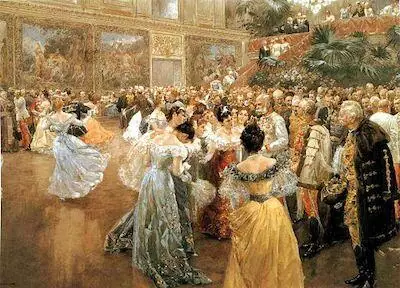
Court Ball in Vienna (wide angle)
Wilhelm Gause
- Era:
- 1900-1920 (Ragtime/Early Jazz)
- Rights:
- By Wilhelm Gause. In the public domain in the United States.
- Recorded as:
- public_domain
This image is essential evidence for understanding how the Viennese Waltz and court ballroom culture were visualized and transmitted to a mass audience in the early 20th century. Gause's ballroom scenes were not marginal genre paintings; they were celebrated salon works and were among the most widely reproduced images of ballroom dance from this era, making them a primary source for how contemporary viewers understood elite dancing and court ceremony.
What you are looking at
A grand ballroom filled with hundreds of elegantly dressed figures occupies a vast, ornately decorated interior. The room is rendered in warm golden tones, with elaborate wall panels and frescoed decoration visible above. In the foreground, couples in formal dress move across a polished floor; the nearest figures wear gowns of pale silk and satin, with the women's skirts rendered in soft whites, creams, and pale yellows. Men wear dark tailcoats and formal dress. The composition is crowded but ordered, with figures arranged in loose clusters and lines that suggest simultaneous dances or a crowd assembled for formal social dancing. The lighting is soft and atmospheric, creating a sense of the gathered throng rather than depicting individual dancers sharply. The perspective recedes into the distance, where more figures populate the space, suggesting a ballroom of considerable grandeur. The overall mood is one of decorous festivity—the formal social dance of a royal or imperial court.
The dancing
The bodies are upright and composed in the manner of formal ballroom etiquette. Where couples are distinguishable, they stand in closed or near-closed proximity, with partners facing or oriented toward one another. The arms of the visible figures are held in positions consistent with ballroom frame—men's right arms extended to the woman's waist or mid-back, women's left arms on the man's shoulder or arm. The skirts of the women's gowns are full and floor-length, and several show the characteristic movement of a waltz or similar turning dance, with fabric caught in mid-swirl. The posture throughout is erect and controlled; there is no suggestion of rapid footwork or acrobatic movement. The density of figures makes individual footwork difficult to assess, but the overall impression is of restrained, dignified motion.
The dance depicted
This is almost certainly a depiction of ballroom dancing at a royal or imperial court, most likely Viennese in context given the title and the artist's Austrian background. The Viennese Waltz or Court Waltz is the primary candidate, given the era (early 20th century), the formal court setting, the full skirts in motion, and the closed-hold positioning of the couples visible in the foreground. The waltz was the dominant dance of the Austro-Hungarian court and nobility, and by the Gilded Age and early 1900s it remained the centerpiece of formal state balls. The composition suggests not a single dance but rather a ballroom in active use, with multiple couples engaged simultaneously—a characteristic of formal court balls where the waltz was the default social dance. The scale and formality point to an official state occasion.
How it was made
The work appears to be an oil painting, executed in a loose, impressionistic style characteristic of late 19th and early 20th century salon painting. The artist has rendered the scene with soft focus in the middle and background, concentrating detail and clearer definition in the foreground figures. This technique conveys the sensory experience of a crowded ballroom—a glittering, atmospheric whole rather than a documentary record of individuals. The brushwork is fluid and allows the warm palette of golds, creams, and soft jewel tones to blend and shimmer, which would have been highly suitable for reproduction in popular illustrated journals and books of the period. The scale and finish suggest this was created for public exhibition and reproduction, making it both an artwork and a cultural document of elite social life.
About this work
Wilhelm Gause was one of the most celebrated painters of Austro-Hungarian court life and society scenes, and this work exemplifies his signature subject matter and approach: the pageantry of formal court balls rendered on a grand scale with meticulous attention to dress, light, and the orchestrated elegance of imperial social ritual. The painting captures the apotheosis of the Viennese ballroom tradition at the moment of its greatest visibility in European high society. It is both a factual record of how the ballroom functioned—the architecture, the dress code, the spatial arrangement of dancers—and a romanticized celebration of that culture. Gause's work was widely reproduced and exhibited, and images like this circulated in both fine art and popular contexts, shaping the visual memory of the Belle Époque ballroom.
How to look at it
Attend first to the density and arrangement of the figures—this is not a portrait of a single dance but rather a visualization of the ballroom as a space organized by choreographic convention and social hierarchy. Notice how the artist has used soft focus and atmospheric perspective to suggest scale and grandeur. Look closely at the few couples in sharp focus in the foreground, where the waltz frame and the movement of the skirts become legible. The painting is also a document of fashion: the silhouettes, the fabrics, the jewelry, and the formal tailcoats are as much the subject as the dance itself. This conflation of dress and dance is typical of how ballroom culture was celebrated in this period.
The artist
Wilhelm Gause (1853–1916) was an Austrian painter of Austro-Hungarian court society, known almost exclusively for his large-scale depictions of imperial balls, court ceremonies, and social gatherings of the elite. He was a society painter in the most literal sense, enjoying imperial patronage and exhibiting regularly at Vienna's major salons. His ballroom scenes were commercially successful and widely reproduced in contemporary publications, making him one of the definers of how the Austro-Hungarian court imagined and presented itself visually in the decades before World War I.
The period
This work dates from the final decades of the Austro-Hungarian Empire, when Vienna remained the capital of ballroom culture and the waltz was at the height of its social prestige. The early 1900s saw an intense nostalgia for the formality and ceremony of court balls, even as that world was becoming increasingly anachronistic. Concurrently, the impressionist and academic salon traditions in which Gause worked were reaching their apogee; large decorative social scenes were hugely popular among collectors and in public exhibition. The waltz, though born in the late 18th century, achieved its greatest cultural visibility and official celebration during this Gilded Age moment, before World War I dismantled the imperial court system.
Where it lives
No accession number, current location, or full provenance is recorded in the available catalogue data.
Dance in this work
Questions about this work
What dance is this actually showing?
The most likely candidate is the Viennese Waltz or Court Waltz, the dominant ballroom dance of Austria-Hungary and the dance most associated with formal imperial balls. The closed-hold positioning, the full skirts in motion, and the formal court setting all point to the waltz. However, Gause has depicted multiple couples dancing simultaneously, so the ballroom may also include other formal dances of the period.
When was this painted, and how can you tell?
The catalogue record dates it to 1900–1920 (the Ragtime/Early Jazz era), which is plausible based on the style of women's dress, the impressionistic technique, and Gause's working period. The large, high-waisted gowns with full skirts are characteristic of Edwardian fashion (roughly 1901–1910), suggesting the work was most likely painted in the early 1900s, though this cannot be confirmed without documentation.
Why did painters like Gause paint so many ballroom scenes?
Ballroom scenes were commercially and socially valuable for multiple reasons. They attracted wealthy patrons who wanted images celebrating their social status and participation in court life. They were also widely reproduced as prints and in illustrated journals, making them valuable to publishers and popular with the middle class. For artists, they offered the appeal of depicting large numbers of figures, rich fabrics and jewels, and the spectacle of imperial ceremony—all prestigious subjects in academic art.
Is this a historical document or a romantic fantasy?
Both. Gause's ballroom scenes accurately record the architecture, dress, and spatial arrangement of actual court balls—they are fact-based in that sense. However, the soft focus, atmospheric lighting, and soft palette romanticize the scene, emphasizing elegance and beauty rather than documentary clarity. The painting celebrates the ballroom tradition rather than coldly recording it.
More dance artwork