37 works in this view — arrow keys or swipe to move between them.
Dance in Art · 1889
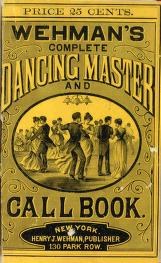
Wehman's complete dancing master and call book: containing a full and complete description of all th
Unknown artist
- Era:
- Late 1800s (Victorian Ballroom)
- Source:
- Library of Congress
- Rights:
- Public domain — free to use, share and adapt.
- Recorded as:
- public_domain
This work documents the machinery of Victorian ballroom culture: how dancing was taught, sold, and standardized for the American middle class. It shows that by the 1880s, ballroom dancing was sufficiently systematized and popular to support a commercial market in printed instruction. The image tells us that dance instruction aimed to create a coherent visual ideal—formal dress, closed body position, mixed-gender pairing, social decorum—that was as important as the steps themselves.
What you are looking at
This is the illustrated cover of a dance instruction manual from 1889. The composition is structured as a title page with ornamental typography and a central vignette showing seven figures in Victorian dress arranged in a ballroom scene. The figures occupy the middle ground against a plain background, their clothing rendered in period detail: the women wear bustled gowns with fitted bodices and full skirts; the men are in formal tailcoats and trousers. The central group appears to be mid-dance, with figures in various positions suggesting movement and social interaction. The scene is framed by decorative borders typical of late 19th-century printed materials. The title "Wehman's Complete Dancing Master and Call Book" appears prominently at the top in bold letters, with a price of 25 cents marked in the upper left corner.
The dancing
The seven figures show the mixed-gender pairs and formations typical of ballroom dancing. The bodies are positioned in what appears to be a quadrille or similar set dance, with dancers arranged to suggest both individual couples and group formation. The women's arms are variously raised and extended; the men stand upright in formal posture. The full skirts of the gowns dominate the silhouettes, constraining the dancers' movement to the arm, torso, and head—characteristic of the corseted ballroom dancing of the period. The spacing suggests dancers maintaining the closed holds and frame distance required by Victorian ballroom etiquette.
The dance depicted
This is a manual for Victorian ballroom dancing, most likely covering the standard dances of the 1880s–1890s: waltzes, polkas, quadrilles, and other figure dances taught through printed instructions. The frontispiece illustration demonstrates the social context rather than instructing in technique; it shows well-dressed people engaged in respectable parlour dancing. The term "call book" in the title indicates it includes both written descriptions and the calls or commands (typically sung or spoken by a caller) that guided dancers through set figures, particularly quadrilles, which required coordination among multiple couples.
How it was made
This is a printed cover, most likely produced by wood engraving or steel engraving, hand-coloured or left in black and white; the Museum of Congress held copies in both states. The decorative border, typography, and vignette are typical of commercial job printing from the Gilded Age. The price point (25 cents) and format indicate mass circulation: this was affordable instruction for middle-class Americans. The technique allowed rapid reproduction and wide distribution of standardized dance instruction.
About this work
Wehman's Dancing Master is a commercial dance instruction manual from the height of the Victorian ballroom era, designed for the American middle-class market. The cover presents an idealized image of ballroom society—formally dressed couples in graceful social dance—as both advertisement and pedagogical model. It belongs in a dance archive as evidence of how ballroom dancing was commodified, packaged, and taught in the late 19th century, and how dance instruction was visualized for a mass audience. The "call book" format reveals the structure of social dancing: it was not free improvisation but a system of learned figures called out by a designated leader, requiring both memorization and coordination among multiple dancers.
How to look at it
Focus on the positions and dress rather than on narrative or individual expression. The seven figures are not shown in a frozen moment of climax or spectacle, but in a steady-state social formation: they are demonstrating propriety and readiness rather than virtuosity. Notice how the women's voluminous skirts dominate the visual field—they are not facilitating footwork visibility, but rather presenting social status and modesty. The men are largely vertical and upright, framing the women. This is the visual grammar of respectable ballroom dancing: order, symmetry, gender complementarity, and restraint.
The artist
The artist is not recorded. The work was published by Henry J. Wehman, a New York music and dance publisher active in the late 19th century who produced numerous affordable instruction manuals and songbooks. Wehman specialized in making popular arts accessible through cheap printing; the Wehman imprint was known for practical, commercial publications aimed at urban working and middle-class readers.
The period
In the 1880s and 1890s, ballroom dancing was at the height of its popularity in America and Europe. The waltz, polka, quadrille, and cotillion were the dominant social dances, danced at balls, soirées, and private parties among the respectable classes. Instruction in dancing was considered essential to genteel upbringing, and published manuals proliferated. This was also the era in which dance instruction shifted from private masters to mass-market print, making techniques available to people who could not afford private lessons. The aesthetic ideal shown on this cover—the bustle, the closed hold, the formal frame—defines the entire era of Victorian ballroom dance.
Where it lives
The work is held in the Library of Congress collection. It represents the category of commercial printed materials—ephemeral instruction manuals and popular guides—that were produced in vast quantities during the late 19th century and are now historically valuable as documents of everyday dance practice and pedagogy.
Dance in this work
Questions about this work
What is a 'call book'?
A call book contains the spoken or sung commands that a caller would use to guide dancers through set figures, particularly in quadrilles and cotillions. Unlike modern ballroom dancing, which relies on partner communication, Victorian set dancing required a leader to call out positions and transitions so that multiple couples could execute complicated formations in synchrony. The manual would include both written choreography and transcriptions of the calls themselves.
Who bought this book?
The 25-cent price point indicates the book was marketed to the broad middle class: young people preparing for social occasions, teachers offering group classes, and people who could not afford private dance instruction. The formal content (proper ballroom dances, genteel frames) suggests the buyer wanted to learn respectable social dancing, not theatre or performance.
Why are the women's skirts so large?
The full bustle and skirt were the fashionable silhouette of the 1880s and were worn over multiple layers of petticoats and crinoline. They were not designed for ease of movement; dancers had to work within their constraint. The visual prominence of the skirt also served a social function: it signaled respectability and modesty by constraining and defining the female body within strict boundaries.
Is this an engraving or a lithograph?
From the image alone it is difficult to be certain, but the crisp lines, decorative border, and style of reproduction suggest wood or steel engraving, which was the standard technique for commercial dance instruction covers of this period. Lithography was more common for finer art prints and theatrical posters.
More dance artwork