49 works in this view — arrow keys or swipe to move between them.
Dance in Art · 2019
Oriental dance
Unknown artist
- Medium:
- Source:
- New York Public Library
- Rights:
- Public domain — free to use, share and adapt.
- Recorded as:
- public_domain
For dancers and historians, this image shows how branle and related Renaissance court dances were actually performed—with high energy, visible footwork, and full-bodied engagement, not the restrained formality sometimes assumed from written dance manuals. The compositional choice to show audience members at varying distances and attitudes (some rapt, some distracted) is a rare honest moment in dance imagery, revealing the social contexts in which dance was consumed and its role in establishing courtly hierarchy and taste.
What you are looking at
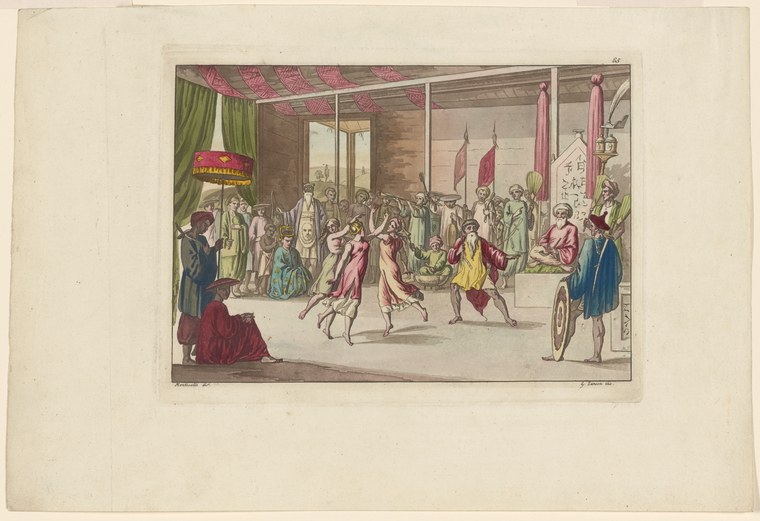
This is a colored engraving depicting an indoor courtly entertainment, likely from the 16th or 17th century. The scene is set in a columned hall with draped pink and green fabrics overhead and hanging banners. At the center, three figures execute a lively group dance while a large assembly of courtiers watches from the sides. The dancers wear loose, flowing tunics in contrasting colors—red, yellow, and pink—that billow as they move. The onlookers are richly dressed in period costume, with several seated figures prominent in the foreground (notably one in deep red velvet on the left), while others stand in clusters along the walls. The light appears even and bright, suggesting midday or well-lit interior space. The composition emphasizes the spectacle: the dance is framed as entertainment for an audience, with clear hierarchies of participation and viewing.
The dancing
Three central dancers, evenly spaced, execute what appears to be a synchronized group movement. Their bodies are active and animated, with limbs extended in a manner suggesting rapid footwork and high energy. The dancers' legs are visible and in motion; their torsos twist and sway within the loose garments. The nearest dancer (left) has one leg extended backward in a lunge or hop-like position, while companions mirror similar dynamic stances. Their arms are raised and extended, suggesting hand-joining or gesture-based choreography typical of Renaissance forms. The scale and spacing suggest this may be a branle or similar group processional, though the individual vigor of the movements and the three-part grouping is unusual.
The dance depicted
This appears to depict a Renaissance court dance, most likely a branle or related form from the 16th century based on the costume, setting, and the communal, lively character of the movement. The three dancers execute the kind of animated, horizontal traveling steps and arm gestures consistent with branle variants—which were among the most popular court dances of the period. The presence of an attentive courtly audience and the formality of the columned hall confirm this as a court entertainment rather than popular or vernacular dancing. The garments and the energy level suggest this may be depicting one of the more vigorous branle variants (such as branle gay or branle double), rather than the stately pavane or galliard that typically dominated formal court ceremonies. However, without visible musical instruments, inscribed text, or more specific costume markers, the exact form cannot be determined with high confidence.
How it was made
This is a hand-colored engraving, as indicated by the fine line work and careful cross-hatching visible in the architectural elements and drapery, overlaid with period watercolor or gouache in pink, green, yellow, red, and flesh tones. The technique of hand coloring suggests this was a popular reproductive print intended for wide circulation among the educated classes—more affordable than an oil painting but more attractive than a plain engraving. The precision of the line work and the skill in rendering perspective, fabric folds, and facial features suggests this was made by a trained printmaker, likely in the 16th or early 17th century. The print format and hand-coloring practice indicate this was a commercial product made for collectors of dance imagery, court life imagery, and prints of fashionable entertainments.
About this work
This hand-colored engraving documents a moment of courtly recreation in Renaissance Europe, capturing three dancers mid-performance before an assembled audience of nobility. The work combines documentary interest (the rendering of period dress, architectural setting, and courtly protocol) with artistic interest in capturing dynamic movement and social hierarchy on a single sheet. It belongs in a dance history collection as evidence of how Renaissance court dance was understood, represented, and valued—not as a static sequence of positions but as vigorous, public entertainment that displayed status and artistic accomplishment. The print circulated among people who did not attend court but wished to imagine or understand courtly life, making it a window into both the actual practices and the fantasy of Renaissance dance culture.
How to look at it
Attend first to the three dancers' legs and feet: the artist has taken care to show them in varying positions—stepping, extending, turning—which reveals an understanding of how footwork operates in fast group dances. The extended arms and the dancers' relative spacing suggest coordination without rigid formation, characteristic of improvised or semi-improvised social dance. Notice too the audience members' eyes and postures: some are engaged, some distracted, some in conversation—a realistic detail that distinguishes this from purely idealized court imagery. The bright, even lighting and the careful perspective lines draw the eye naturally to the dancing figures while confirming that this is meant to be a factual representation of an actual kind of event, not a mythological or allegorical fantasy.
The artist
The artist is not recorded in the catalogue. Based on the style, technique, and content, this is a Northern European print, most likely from the German-speaking regions or Low Countries, produced in the 16th or early 17th century. The composition and subject matter suggest this may be from a series or collection of courtly amusements, possibly related to dance instruction or the documentation of court fashion. Many such prints were made by commercial printshops and were distributed widely; attribution to individual engravers is often lost.
The period
This work dates to the era when the branle and pavane dominated European court dance (approximately 1550–1620). During this period, dance was a compulsory skill for nobility and a central form of court entertainment, described in detail in manuals by Thoinot Arbeau, Fabrizio Caroso, and others. In the visual arts, Renaissance printmakers increasingly documented court life, fashion, and entertainment as popular subjects for collectors. The confidence in rendering movement and the emphasis on spectacle (rather than moral allegory) reflects a broader humanist interest in observing and celebrating human activity for its own sake. The hand-coloring tradition was at its height during this period, before economic pressures and industrialization led to cheaper, uncolored prints.
Where it lives
This work is held in the New York Public Library collection, catalogued as a print from the institution's collection of historical dance and court imagery. It is identified in the catalogue as a print of unknown artist and date, though visual evidence strongly suggests a 16th or early 17th-century origin.
Dance in this work
Questions about this work
How do I know this is a Renaissance branle and not some other dance?
The evidence is cumulative: the courtly indoor setting, the period costume and hairstyles, the grouping of three dancers in apparent unison, the lively energy level, and the absence of the formal couple-based structures of the pavane or galliard. Branles were group dances for mixed numbers of people and were by far the most popular entertainment dance of the period. However, without inscribed text or musical instruments visible, certainty is not possible.
Were Renaissance dances really this energetic?
Yes. While manuals emphasize controlled technique and geometric patterns, contemporary accounts and images like this confirm that branles in particular were fast, vigorous, and physically demanding. The written manuals preserve slow dances and formal court pieces; this print shows the livelier social entertainments that occupied more of actual dancing time.
Who are all these people watching?
They are members of the court—nobility and their attendants. Dance in this period was both participation and spectacle. Not everyone present would dance; many attended to observe, to be seen, and to participate socially. The hierarchies visible in the print (seated vs. standing, central vs. peripheral) reflect the actual structure of court society.
Is this a real event or an imaginary scene?
It is a generic representation of the kind of event that did occur—not a documentation of a specific historical moment, but rather a type-image showing how such entertainments were conducted. The artist has rendered the scene with sufficient specific detail (the banners, the columns, the fabric, the varied costumes) to claim fidelity to real courtly practice.
More dance artwork