29 works in this view — arrow keys or swipe to move between them.
Dance in Art
Ballroom scenes
Unknown artist
- Medium:
- Dance:
- Ballroom
- Source:
- New York Public Library
- Rights:
- Public domain — free to use, share and adapt.
- Recorded as:
- public_domain
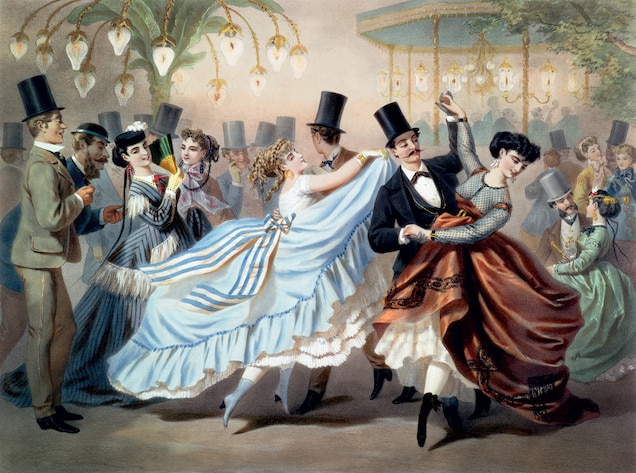
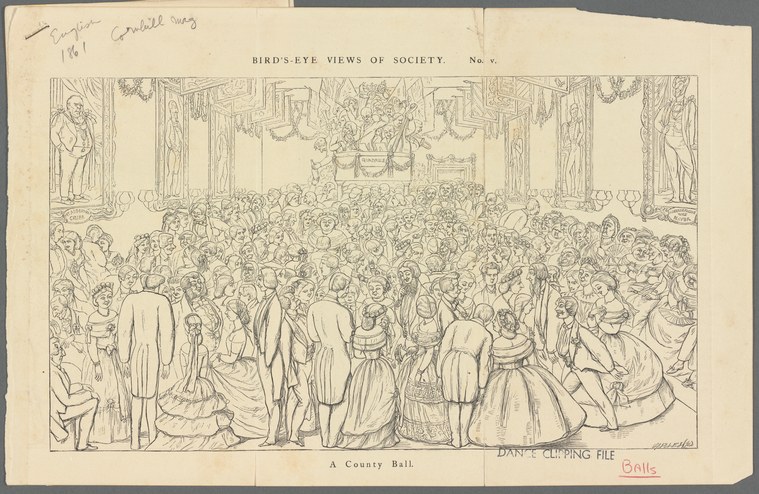
For dancers and historians, this image is a rare contemporaneous record of how people actually moved and held themselves in a formal ballroom setting of the period. It shows the physical constraints imposed by dress, the formality of posture and frame, and the social organization of dancing—the presence of many couples, the mix of dancers and non-dancers, the role of the ballroom as a space for multiple kinds of interaction. It is also an artifact of how the ballroom was perceived and represented in popular visual culture.
What you are looking at
This engraving depicts a crowded county ball in an interior space marked by tall classical columns and elaborate hanging decorations. The scene is densely packed with figures in formal 19th-century dress—the women in full skirts with tight bodices, the men in tailcoats and trousers. Several couples are clearly dancing in the center foreground, while many others stand or move about the periphery, creating the impression of a live, bustling social event. The composition draws the eye upward through the columned architecture to figures stationed at upper left and right, perhaps musicians or observers, lending depth to the crowded ballroom. The artist has rendered the chaos of simultaneous movement and conversation with a fluid line that suggests both the formal structure of the dance and the informal mingling that surrounded it.
The dancing
The central dancing figures are shown in closed position, with partners facing one another at a distance suggesting a formal held dance rather than a contact dance. The women's full skirts are in motion—one is caught mid-swirl, fabric splaying outward—indicating turning or pivoting. The men stand upright in the rigid posture typical of the period's formal ballroom carriage. Arms are held at the side or extended into the dance frame, and the overall impression is of restrained, structured movement constrained by tight corseting and heavy fabrics. The weight distribution and stiffness of the figures reflects the physical reality of dancing in such dress.
The dance depicted
This is almost certainly a Regency or early Victorian-era formal ballroom dance, most likely a country dance (cotillion), quadrille, or waltz—all of which were central to county balls of the mid-to-late 19th century. The title specifies 'A County Ball,' which places this in the English provincial social calendar. The formal closed positions and the presence of multiple couples suggest either a quadrille (a four-couple formation) or a country dance (a longways set). The crowded, mixed nature of the event—with dancing, standing, and socializing all happening simultaneously—is authentically rendered and reflects the actual character of such assemblies, where dance was one element of an evening's social performance.
How it was made
This is a pen-and-ink engraving or etching, executed with fine lines that create texture and shadow through hatching and cross-hatching. The technique allowed the artist to achieve dense detail and a sense of collective movement through the repetition of similar figure types and poses. The fine-line medium suggests this was a commercial print, likely created for publication in a periodical or as a standalone satirical or observational print. The loose, expressive linework—particularly in the rendering of fabric and the suggestion of motion—indicates an artist comfortable with the technique and aiming to convey liveliness rather than precise anatomical study.
About this work
This engraving documents the formal ballroom culture of 19th-century English provincial society, specifically the county ball—an annual or seasonal social event where local gentry gathered to dance and socialize. The work is valuable as a record of actual ballroom practice: the dress, the spatial organization, the mix of active dancers and social observers, and the formal postures and holds that governed movement. It sits at the intersection of social history and dance documentation, capturing not the idealized or theatrical representation of dance but its everyday practice in polite society. The artist's choice to render the crowded, busy reality of the event—rather than isolating a single couple or moment—tells us something important about how ballroom dancing functioned as a social rather than purely aesthetic practice.
How to look at it
The viewer should focus on the postures of the dancing couples in the foreground—notice the distance between partners, the stiffness of the carriage, the way the men's bodies remain nearly motionless while the women's full skirts create the impression of turning. Observe also the social organization of the space: the presence of non-dancing figures around the edges, the formal architectural setting, the sense of a scheduled, governed activity. The artist's choice to include so many simultaneous figures and activities, rather than concentrating on a single couple, is itself informative—it captures the reality that ballroom dancing was as much about being seen, about the performance of gentility in a crowd, as it was about the movement itself.
The period
This engraving was produced during the height of the Victorian era's formalized ballroom culture. The mid-to-late 19th century saw the codification of specific ballroom dances (quadrille, waltz, polka, mazurka) and their regulation through written instruction manuals. County balls were key sites for the performance of genteel femininity and masculine propriety, and they were frequently depicted in popular prints, satirical journals, and novels. The engraving's style and subject matter suggest it may have been published in a periodical such as *Punch* or a similar publication that documented and often gently mocked the social conventions of the day.
Where it lives
The work is held in the New York Public Library collection. It is a print, likely from a periodical or popular publication, and is catalogued under the title 'Ballroom scenes' with a note identifying it as 'A County Ball.' The collection source and the style suggest this is a page from a 19th-century publication or a separately issued satirical or social-documentary print.
Dance in this work
Questions about this work
What dance are they doing?
Most likely a country dance, cotillion, or quadrille—all common at county balls in the 19th century. The presence of multiple couples and the formal closed positions are consistent with all three. The engraving does not show enough detail of the footwork or floor patterns to identify the specific dance with certainty, but the context and composition suggest one of these formal, set dances rather than a waltz or individual couple dances.
Why are the women's skirts so full?
Women's formal dress in the mid-to-late 19th century featured full skirts supported by multiple petticoats and, during some periods, crinolines or bustles. These created dramatic silhouettes and were essential to fashionable appearance. They also constrained movement and made certain kinds of motion—particularly turning—visually prominent, which is partly why the artist has emphasized the swirling skirts of the dancing women.
What is a county ball?
A county ball was an annual or seasonal social event held in a provincial English town, organized by local gentry and attended by the respectable families of the county. It was a formal occasion, typically including multiple sets of dances, and served important social functions: it marked the social calendar, facilitated courtship and marriage prospects, and displayed the wealth and gentility of attendees. County balls were a fixture of English social life from the 18th century well into the 20th.
More Ballroom artwork