30 works in this view — arrow keys or swipe to move between them.
Dance in Art
Ballroom dancing
Unknown artist
- Medium:
- Dance:
- Ballroom
- Source:
- New York Public Library
- Rights:
- Public domain — free to use, share and adapt.
- Recorded as:
- public_domain
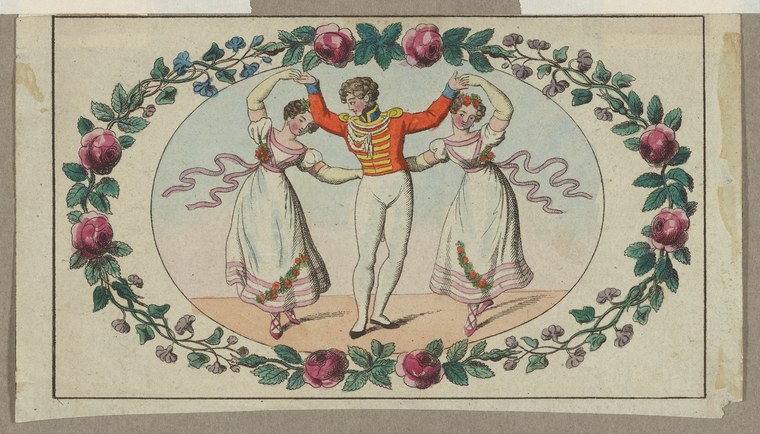
This print provides visual evidence of how ballroom figures were taught, performed, and imagined during the Regency era—a moment when English country dance, quadrille, and waltz were beginning to merge. For dancers and dance historians, the image is a rare window into the actual carriage and arm vocabulary of the period, offering more specific information than most written sources. The print also documents the genre of dance instruction itself: these images were the primary medium through which ballroom dance was disseminated to the middle class.
What you are looking at
A hand-colored engraving of three figures in a moment of social dance, set within an ornamental oval frame of flowering vines and pomegranates. The central male figure wears a bright red-orange jacket with gold trim and white breeches, his arms raised and extended outward to either side. Flanking him are two female figures in pale muslin or linen dresses with pink ribbon or hem details and small decorative bands at the ankle; both have their arms raised in loose arcs, their shawls or scarves trailing in lavender ribbons that float above their shoulders. The composition suggests a snapshot of movement—the women appear to be in a turning or revolving motion around the male dancer. The ground is minimal, suggested by a single line beneath the figures' feet. The print is executed in the delicate hand-coloring technique typical of late eighteenth-century popular dance imagery, with careful attention to the fabric and trim of the clothing.
The dancing
Three dancers in an open, celebratory frame. The male dancer occupies the center with both arms raised to shoulder height or above, palms open, weight seemingly on the balls of his feet. The two women stand on either side of him, their bodies angled slightly inward toward him, their arms also raised in a lighter, more lyrical line. The women's scarves or shawls lift and billow, suggesting rotational movement or waltz-like turns. There is no closed hold; the dancers maintain a social distance while clearly partnered and moving in relationship to one another. The poses suggest a moment of upward lift and lightness rather than weighted stepping.
The dance depicted
This appears to depict a moment from Regency or early 19th-century English country dance or quadrille tradition, most likely a figure or movement from a set dance involving three dancers. The open, celebratory arm positions and the evident turning motion of the women suggest a waltz-influenced moment or a transitional figure between verses. The dress—high-waisted muslin and tailored jacket—and the social ballroom setting point to the early 1800s, when mixed-group country dances and quadrilles incorporated waltz-like rotations and more theatrical arm movement. The presence of three dancers suggests a variant or a moment within a larger choreographed sequence, possibly from a contradance or cotillion figure. Without documentary evidence, the specific dance cannot be named with confidence, but the visual language is unambiguously ballroom and almost certainly European, likely English or Continental.
How it was made
A hand-colored engraving, executed with fine cross-hatching for shading and outline work typical of late eighteenth-century commercial dance prints. The hand-coloring—applied to the jacket, ribbons, flesh tones, and floral wreath—indicates this was a popular publication meant for middle-class households, dance masters, and ballroom instruction. The technique of engraving plus hand-color allowed for sharp detail in the dress and an appealing, finished quality that encouraged study and imitation. The ornamental frame of flowers and fruit suggests this was issued as a standalone decorative print, possibly as one of a series, and likely intended to hang in a parlor or dance studio as both instruction and entertainment.
About this work
This is a ballroom dance print from the early 19th century, depicting a moment of social dancing among three figures in Regency-era dress. The engraving records not just the fashion but the vocabulary of genteel ballroom movement—the lifted frame, the open arms, the sense of collaborative rotational motion among partners. Such prints were central to the circulation of dance knowledge before video or photography; they served as both instruction and aspirational images of polite society in motion. The work belongs in a dance gallery because it documents a real pedagogical tradition and because the artist has captured something genuine about the feel of early 19th-century ballroom dance: its formality, its sociability, and its emphasis on vertical line and grace.
How to look at it
Look first at the arms and shoulders: they are held high and open, in a posture of lightness and celebration quite different from the stiff formality of much 18th-century dance imagery. Notice how the women's scarves float—this is not accidental decoration but a marker of rotational movement and elevation. Observe the absence of hand-holding or closed holds; the dancers relate through shared space and synchronized arm gesture rather than through contact. The ornamental frame draws the viewer's eye to the figures at the center and asserts the status of ballroom dance as a refined and worthy subject for art. Finally, consider that this is a moment frozen mid-movement—the artist has chosen a peak of lightness and grace, not a heavy-footed step, suggesting where the aesthetic value of the dance was believed to lie.
The period
This print dates to the early 19th century, a period of major transition in European ballroom dance. The waltz, newly imported from German-speaking regions, was beginning to influence the structure and arm vocabulary of traditional English country dances and quadrilles. At the same time, hand-colored dance prints flooded the market in London and Paris, serving both as instruction manuals and as fashionable parlor decoration. The Regency era (roughly 1811–1820) saw a particular explosion of such imagery, as ballroom dancing became an essential marker of respectability and genteel status. The print reflects the cultural moment when dance instruction shifted from private masters to a combination of personal teaching and mass-produced visual guides.
Where it lives
The work is held in the New York Public Library collection. It is a commercial dance print of the type that was widely circulated and collected in the early 19th century; many copies exist in public and private collections. The NYPL holding is consistent with its mission to preserve material culture and visual records of social history.
Dance in this work
Questions about this work
What dance is this showing?
The specific dance cannot be named with certainty from the image alone. However, the composition—three dancers, open arm positions, and evident turning motion—suggests a figure or moment from Regency-era English country dance, quadrille, or an early waltz variant. The open frame and celebratory gesture suggest this is a high point or transition moment within a larger choreographed sequence rather than a basic walking step.
Why are the women's shawls floating like that?
The floating scarves indicate rotational movement—likely waltzing turns or spins characteristic of early 19th-century ballroom dance. They also serve an aesthetic function, emphasizing the verticality and grace of the movement. For the print maker, they also add visual interest and help convey the sense of motion to a static image.
How was this print made?
It is a hand-colored engraving. The artist first engraved the design into a metal plate using a burin; impressions were then printed and colored by hand with watercolor or gouache. This technique allowed for multiple copies with individual variation in the coloring, making it an affordable but still somewhat luxurious object—ideal for sale to middle-class households and dance studios.
What was the purpose of prints like this?
Dance prints served multiple purposes: as instruction aids for learning new figures and fashionable steps; as records of current dance fashion; as decorative objects for the parlor or drawing room; and as cultural statements about what counted as refined, modern, and desirable. They were often sold individually or in series and were a primary way that ballroom dance knowledge circulated before the age of photography.
More Ballroom artwork