49 works in this view — arrow keys or swipe to move between them.
Dance in Art
Robert der Teufel
Unknown artist
- Collection:
- Prints depicting dance
- Source:
- New York Public Library
- Rights:
- Public domain — free to use, share and adapt.
- Recorded as:
- Public Domain
This work documents the visual and character language of Romantic ballet at the height of its cultural dominance, when opera-ballets drew the largest audiences in Europe. It preserves not the steps but the costuming, hierarchy, and narrative identity of a production whose influence shaped ballet for decades—and it shows that 19th-century dancers, like opera singers, were costume-bearers and character-players, not merely bodies in motion.
What you are looking at
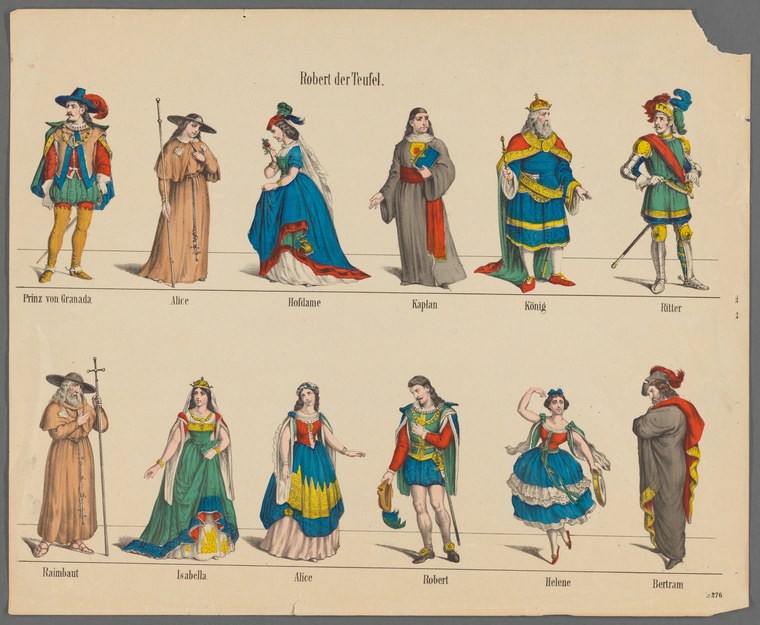
This is a hand-colored engraving showing twelve costumed figures arranged in two rows of six, each identified by name in German script beneath. The upper row presents Prince von Granada in ornate Renaissance dress with feathered hat and jeweled doublet; Alice in a long hooded cloak; Hottaine in blue silk gown with red sleeves and elaborate headdress; Kaplan in grey tunic and red mantle; König in striped blue and yellow robes with crown; and Ritter in green and gold armor holding a sword. The lower row shows Rainskaut as a bearded pilgrim in brown habit with staff; Isabella in green gown with yellow underskirt and jeweled belt; Alice (repeated) in elaborate costume; Robert in blue doublet and hose; Helene in full skirt with blue overskirt and yellow trim; and Bertram in dark cloak with red and yellow lining. The figures are arranged as costume studies on a plain pale background, each posed individually or in pairs, suggesting characters from a theatrical narrative rather than a narrative action scene. The engraving style is precise and linear, with hand-coloring applied in rich jewel tones—crimsons, blues, golds, and greens—creating a pageantry of courtly display.
The dancing
These are presentational costume figures rather than active dancers. Each stands or poses with formal bearing appropriate to their character and rank. Several hold attributes—swords, staffs, ceremonial objects—that establish their roles. The dress overwhelmingly favors the voluminous skirts, fitted doublets, feathered hats, and layered silhouettes of German Renaissance court fashion. No two figures share the same posture; each is a distinct portrait-like study. While some figures face forward, others turn to profile, and a few tilt or pivot slightly, the overall effect is heraldic display rather than coordinated movement.
The dance depicted
This is a costume and character sheet for the opera or theatrical production *Robert der Teufel* (Robert the Devil), likely the famous ballet-opera libretto by Eugène Scribe that premiered in Paris in 1831 and became hugely popular across European houses in the 19th century. The twelve figures represent principal characters: the protagonist Robert, Isabella (the female lead), Alice (his adoptive mother), Bertram (a demon), and courtiers and nobles. These are not dancers captured mid-performance, but costumed actors and singers in their stage identities, arranged for publication or reference. The work documents theatrical fashion and character type more than it documents the choreography or movement vocabulary of any specific dance style.
How it was made
This is a hand-colored engraving (the technique is readable from the linear hatching visible in shadow areas and the precision of the line work). The base print was produced by engraving a copper plate with a fine stylus, then printed from the inked plate; hand-coloring was applied afterward in watercolor or gouache, allowing for the bright jewel tones and variation visible here. This medium was standard for theatrical costume prints in the 19th century, especially for major operatic productions. Such prints circulated widely among theaters, dancers, and the opera-going public across Europe and America, serving both as records of celebrated productions and as promotional material. The engraving allowed multiple impressions to be pulled and colored, making it far more accessible than a unique oil painting.
About this work
This is a theatrical costume print—likely from the 1830s–1850s—documenting the characters of *Robert der Teufel*, the enormously influential Romantic-era opera-ballet that blended music, spectacle, and virtuoso dancing. It functions as a repertory record and a celebrity document: these are the costumes and characters that audiences paid to see, worn by the stars of European opera houses. The image belongs in a dance collection not because it depicts dance technique or choreography, but because it preserves the visual and conceptual world—the character types, the fashion, the spectacle—within which Romantic ballet existed and was consumed. *Robert the Devil* was central to the consolidation of Romantic ballet as a genre, and this print is evidence of how its theatrical identity circulated and was remembered.
How to look at it
Read this as a roster rather than a scene: each figure is labeled, and the print functions as a key to the character types and their visual identities. Notice how hierarchy is expressed through costume—the prince and nobles in jeweled silks and furs, the demon Bertram in dark cloth, the pilgrim Rainskaut in monastic brown. Attend to the precision of the hand-coloring: the variations in tone, the way gold leaf or metallic pigment may have been used for ornament, the care lavished on every jewel and plume. This was a luxury object, expensive to produce and own, aimed at opera-goers who wanted to take home an image of the spectacle they had witnessed.
The period
This print dates to the era of Romantic ballet's greatest prestige (circa 1831–1860), when works like *La Sylphide* and *Giselle* established ballet as a narrative art form driven by female soloists in supernatural or tragic roles. *Robert der Teufel*, which premiered at the Académie Royale de Musique in Paris in 1831 with a libretto by Eugène Scribe and choreography by Filippo Taglioni, exemplified the fusion of opera and ballet that characterized the Romantic stage. It featured the era's most celebrated ballerina, Marie Taglioni, and was revived repeatedly across European cities. The work's supernatural narrative—the demon Bertram tempting the virtuous Robert—was quintessentially Romantic in theme. This costume print circulated as theatrical ephemera documenting the production's visual splendor and star power, reaching audiences who might never attend a live performance.
Where it lives
The print is held by the New York Public Library in its collection of theatrical prints and costume studies. It belongs to a large body of 19th-century European operatic and dance ephemera—posters, sheet music covers, costume prints, playbills—that documented the visual culture of Romantic-era theater.
Dance in this work
Questions about this work
Is this a ballet or an opera?
*Robert der Teufel* was both: a five-act opera-ballet (opéra-ballet) with a sung libretto and elaborate choreographed dance sequences, typically performed at the Académie Royale de Musique in Paris. This print documents the costumes worn by both singers and dancers in the principal roles. The genre was common in early 19th-century French musical theater.
Who actually wore these costumes?
The most famous performer was Marie Taglioni as the female lead, Isabella, in the Paris premiere and subsequent revivals. Other casts changed with each production across different European theaters. This print likely documents a specific historic production, but without a dated inscription, the exact year and performers cannot be confirmed from the image alone.
Why are there two Alices?
In Scribe's libretto, Alice appears in multiple contexts—as Robert's adoptive mother and in other scenes or role variants. Different productions may have doubled or tripled certain roles, or the print may show alternative costume configurations for the same character.
Is there dance in this work?
Yes; the original 1831 production included celebrated ensemble ballet sequences and a solo for the lead ballerina. However, this print is a costume document, not a choreographic record. It tells us what the dancers wore, not how they moved.
More dance artwork





