26 works in this view — arrow keys or swipe to move between them.
Dance in Art
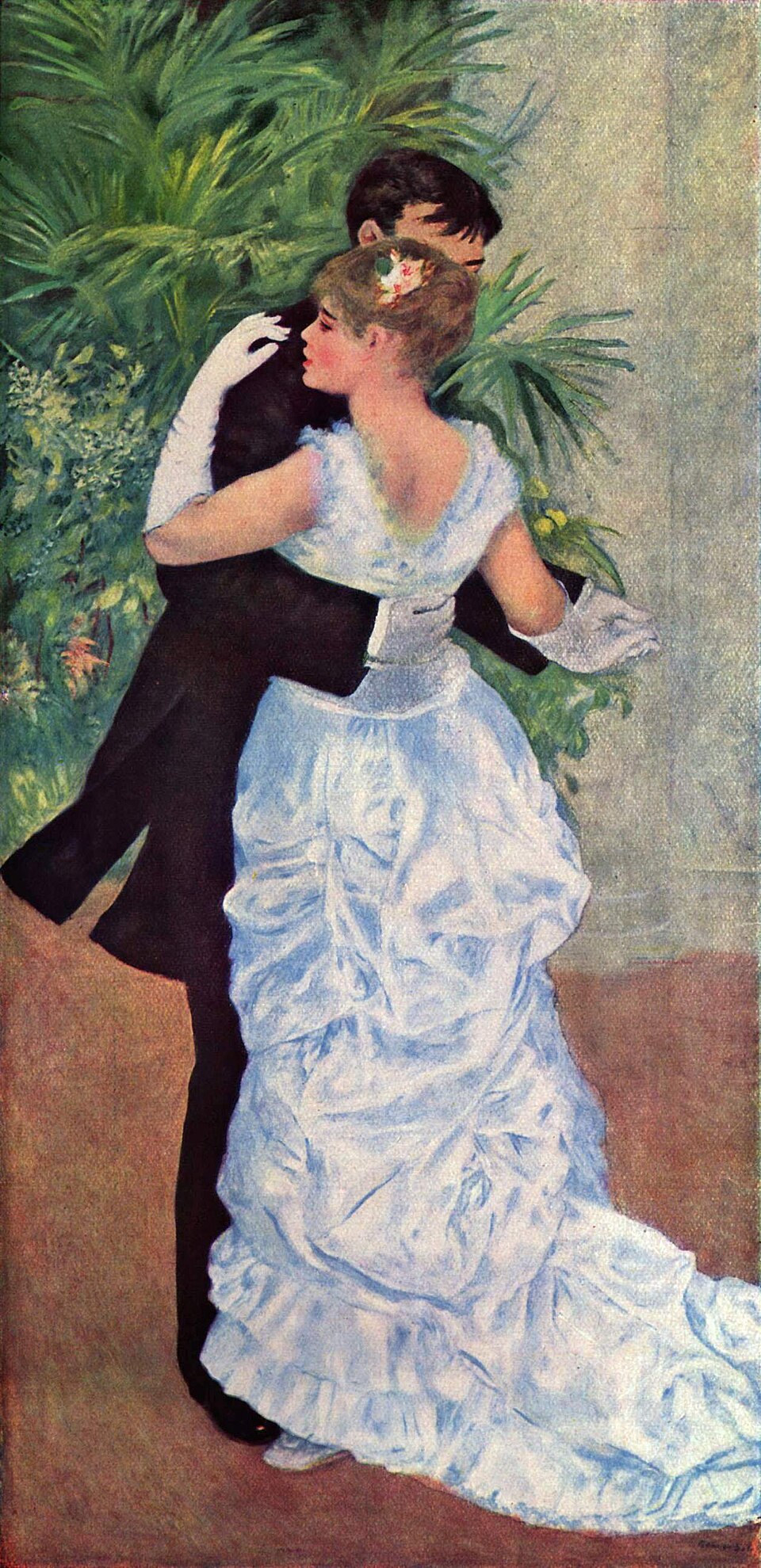
Dance in the City
Pierre-Auguste Renoir
- Medium:
- oil on canvas
- Era:
- Late 1800s (Victorian Ballroom)
- Source:
- Wikimedia Commons
- Rights:
- Public domain — free to use, share and adapt.
- Recorded as:
- public_domain
This work is crucial evidence for understanding how the late-Victorian upper classes experienced and imagined ballroom dancing. It shows the waltz not as a folk form or a spectacle, but as a refined social practice embedded in domestic luxury. The painting also demonstrates how dance—usually ephemeral and difficult to preserve—was captured and circulated through fine art, making it legible to historians a century later.
What you are looking at
A formally dressed couple dances in an elegant interior garden setting, rendered in oil with warm earth tones and soft greens. The man, in black tailcoat and white collar, clasps the woman from behind as she turns in a graceful arc, her pale blue ball gown with white accents billowing around her. The woman's head is turned toward her partner, her expression intimate and serene. Behind them, potted tropical plants—likely palms or ferns—create a lush backdrop against a neutral wall, suggesting a conservatory or garden room of a wealthy urban residence. The floor is a warm terracotta, and the overall light is soft and diffused, emphasizing the refinement and privacy of the moment. The composition captures a turning movement mid-waltz, with the couple's bodies aligned in the characteristic closed frame of late-Victorian ballroom dance.
The dancing
The dancers hold in a closed ballroom position: the man's right arm supports the woman's back at her waist, his left arm extended to hold her right hand. The woman's left arm rests on his shoulder. Both bodies are inclined slightly forward in the direction of travel, with the woman's right leg crossing over her left in a turning step—the heel of her extended leg visible beneath her skirt. Their frame is compact and controlled, the woman's torso leading while her head tilts back toward her partner's face. This is the posture of a couple waltzing in the formal European manner, executing a turn with the man as the directing partner.
The dance depicted
This is a waltz, almost certainly performed in the Viennese or Parisian style that dominated ballrooms in the 1880s. The scene depicts social ballroom dancing among the urban elite—the formal dress, the private garden setting, and the controlled technique all indicate this is haute société dancing, not public ball or performance. The waltz was by this date the dominant couple dance at formal evening events, and the turn captured here was its signature figure. The image documents not choreography but the etiquette and physical culture of the ballroom: the closed hold, the restrained frame, the intimate proximity sanctioned by the dance itself.
How it was made
This is an oil painting on canvas. The technique is representational but not photographic; the artist has stylized form and softened edges to emphasize grace and movement. The warm palette—ochres, soft greens, pale blues—creates an atmosphere of comfort and refinement rather than documentary precision. The brushwork allows the luxurious fabrics to read as texture and flow; the woman's skirt is rendered with particular attention to the play of light on silk and the subtle patterns of the weave. As an oil, this work was likely a commissioned portrait or decorative panel for a private collection, intended for display in a fashionable home.
About this work
This painting captures the waltz at the height of its social dominance, in the private ballroom setting where it was most commonly danced. The work documents a specific moment in dance history—not a public performance or formal competition, but the everyday luxury of social dancing among the wealthy—and treats that moment with the seriousness and formal composition usually reserved for history painting or portraiture. The image shows us not just what the waltz looked like, but how it was valued: as an expression of grace, courtship, and social standing. The intimate framing and the attention to dress and setting tell us that for this audience, ballroom dancing was a central ritual of urban life.
How to look at it
Attend to the turn: the artist has chosen the moment when the woman's body is most fully extended and her face most visible—the peak of grace rather than a mechanical pivot. Notice the alignment of the two bodies and how the frame is managed; this is not a romantic embrace but a controlled partnership in which the man leads and the woman follows. The setting—the private garden, the potted exotics, the warm light—is not mere backdrop but essential to the meaning: this is dancing in a protected, refined space, the opposite of the public ballroom or the street. The painting asks you to admire not just the beauty of the dancers but the beauty of the dance itself as a social form.
The artist
Pierre-Auguste Renoir (1841–1919) was a founding figure of Impressionism and a master of figure painting, particularly of leisure and social life. His work often depicted the pleasures of modern urban and suburban society—picnics, boating, dancing, and intimate domestic moments. Renoir was drawn to scenes of beauty and refinement and had a particular gift for rendering fabric, light, and the human face. Though he worked in a broadly Impressionist idiom, his compositions remained classical and carefully structured. He painted several ballroom and garden scenes, and his work on dance and courtship is among his most celebrated.
The period
The 1880s were the height of the waltz's prestige in Western European ballrooms. The dance had been fashionable for some seventy years, but by the 1880s it had become so dominant that it was almost synonymous with ballroom dancing itself. This was the era of the Viennese ball, of the grande salle de bal in Paris, and of the waltz as the marker of civilization and good breeding. At the same time, new dances—the two-step, the polka—were beginning to compete for space. In painting, there was a widespread interest in scenes of modern leisure and courtship; Renoir and his peers were documenting the rituals of a society in the process of remaking itself. The garden setting, with its tropical plants, signals wealth and modernity—such conservatories were status symbols in Paris and London.
Where it lives
The work is catalogued as oil on canvas from 1883, sourced from Wikimedia Commons. The current holding collection is not recorded. The painting is often recognized as Renoir's *Dance in the City* (or *Danse à la Ville*), part of a pair with *Dance at Bougival* (*Danse à la Campagne*), which depicts a similar couple dancing outdoors in a rural setting. The pairing suggests the work was conceived as a comparison of urban and rural leisure.
Dance in this work
Questions about this work
Is this a specific couple or a generic scene?
Almost certainly generic. Renoir's ballroom paintings rarely depict identified individuals; they are idealized scenes of elegant life intended to appeal to a bourgeois audience. The painting captures the type of the fashionable couple, not a portrait of a particular pair.
What dance is this, exactly?
A waltz, most likely performed in the Viennese or Parisian manner. The closed position, the turn, and the frame are all characteristic of the waltz in the 1880s. Without seeing the feet more clearly or having musical notation, we cannot say whether this is a particular regional variant, but the formality and the setting suggest the refined salon waltz of the urban elite.
Why is the woman's head tilted back like that?
This is a characteristic posture of the waltz as danced in this period, especially during a turn. It allowed the woman to maintain balance while her partner led her through the rotational movement. It was also a sign of grace and abandon—the woman's trust in the man's lead was expressed through her relaxed neck and head. Renoir exaggerates this slightly for effect, to emphasize the elegance of the pose.
What is the significance of the garden setting?
The tropical plants and the conservatory-like space signal wealth and modernity. Such private gardens were status symbols, and the ability to dance in such a setting—rather than in a public ballroom—marked the couple as members of the upper class. The setting also softens the formality of the dance; it suggests courtship and intimacy rather than strict observance of ballroom etiquette.
More dance artwork