27 works in this view — arrow keys or swipe to move between them.
Dance in Art
The Devonshire minuet
Unknown artist
- Medium:
- Engraving
- Dance:
- Minuet
- Era:
- 1700s (Enlightenment/Minuet Era)
- Source:
- New York Public Library
- Rights:
- Public domain — free to use, share and adapt.
- Recorded as:
- public_domain
The image preserves a named variant of a dance that was already archaic when the print was made, suggesting how dance instruction and prestige worked in the Regency period: named dances circulated as prints and became markers of belonging to a fashionable set. The couple's careful distance and formal bearing show the minuet's essential character—a dance of display and restraint, performed for witnesses rather than as a social expression of partnership.
What you are looking at
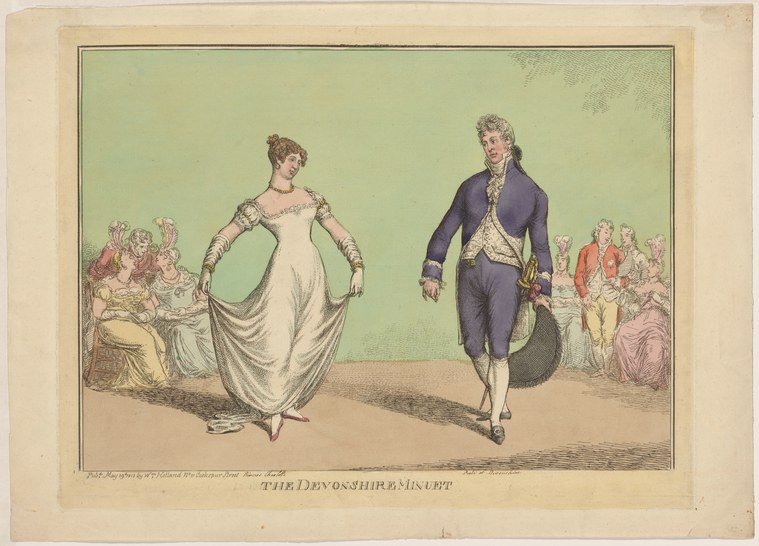
A colored engraving depicts a fashionable couple performing the minuet in an ornate interior or ballroom setting. The man, dressed in a dark purple coat with gold brocade trim and holding his hat, stands in profile advancing toward the woman. The woman, in a high-waisted Empire-style white gown with puffed sleeves and long gloves, faces him with one arm extended. Both adopt the upright posture and formal frame characteristic of early 19th-century ballroom dance. Spectators—other couples and fashionable observers—cluster in groups on either side of the dancing pair, seated and standing in attitudes of observation and conversation. The composition is spare and theatrical: the dancers occupy the center ground, well-lit against a pale green background, while the audience fills the lateral margins. The title at the bottom reads "THE DEVONSHIRE MINUET."
The dancing
The couple maintains considerable distance and formality. The man's posture is erect and commanding, his left arm bent and his right leg advanced in a walking attitude. The woman stands with her weight centered, her arms held away from her body in the open frame typical of minuet dancing—no contact between the partners. Both dancers wear the long gloves and formal evening dress of the period. Their positions suggest a moment early in the figure, during the approach or promenade phase of the minuet, before any turning or closer engagement.
The dance depicted
This is a minuet, a courtly dance that was the centerpiece of European ballroom practice from the 17th century through the early 19th century. By the date of this print—likely 1800–1820, given the fashion and engraving style—the minuet had begun to fade from fashionable use, superseded by the waltz and cotillion, though it remained an accomplishment of genteel education. The Devonshire minuet was a regional or named variant, suggesting either a local specialty or a figure popularized by a notable family or dance master. The image captures the minuet in its late courtly phase: formal, restrained, and executed by an audience of peers.
How it was made
This is a hand-colored engraving, a reproductive print technique that allowed multiple copies of the same composition to be distributed to a wide market. The line work is clean and precise, the color application—the green background, the purple coat, the white gown, the flesh tones—applied by hand or stencil after printing. The technique was economical and well-suited to fashion and dance instruction, allowing middle-class and aspiring gentry households to acquire images of correct deportment and fashionable dress. The quality of the coloring and printing suggests a commercial London or London-adjacent producer, likely issued as a print for sale individually or in a series.
About this work
This engraving documents a named variant of the minuet—the most formal and conservative ballroom dance of its era—at a moment when the form was entering its final decades of fashionable practice. The image is both a record of how the dance was performed and a statement about who performed it: the well-dressed couple at center, watched approvingly by their peers. The Devonshire minuet's specificness (named dances were often associated with particular families, places, or teachers) suggests this print may have served both as a souvenir and as instruction in a particular figure or style. For dancers and historians, it is evidence of the minuet's persistence in elite circles well into the 1800s, even as new dances were displacing it from the center of ballroom culture.
How to look at it
Attend to the distance between the dancers and the formality of their carriage. The minuet is a dance of approach and separation, not embrace; the empty space between the man and woman is part of the dance's grammar. Notice also the audience: the minuet was inherently a watched dance, performed to demonstrate accomplishment and status to one's peers. The artist has captured the moment of approach, the opening of the figure, when the dancers' posture and focus are most controlled and most visible to observers.
The artist
The artist is not recorded. The work is a commercial print, likely produced in London or a provincial center, and distributed through the print market that flourished in Britain from the 1780s onward. Such prints were often based on drawings by fashionable illustrators but published and sold by print dealers, whose names appear in the imprint rather than the artist's.
The period
The minuet reached the height of its codification and prestige in the 18th century, taught in dance schools across Europe and serving as the essential accomplishment of courtly education. By 1800, it had begun to seem antiquated: the waltz, with its closer embrace and rotational energy, and the cotillion, with its democratic figures for multiple couples, were becoming the dominant ballroom forms. Yet the minuet retained symbolic value as a marker of gentility and correct training. Regency-era prints like this often documented dances that were already historicized, serving both as nostalgic records and as proof of the owner's acquaintance with refined tradition.
Where it lives
The work is held in the New York Public Library collection. It is catalogued as an engraving from the 18th or early 19th century, part of the library's extensive holdings of prints documenting fashion, manners, and social dance.
Dance in this work
Questions about this work
What is the Devonshire minuet?
It was a named variant or figure of the minuet, likely known by that name because it was associated with the Devonshire family, a particular region, or a celebrated dance master. Named minuets circulated in the 18th and early 19th centuries, often as prints or in dance manuals. This print is evidence of its existence, but the specific figure or its origins are now difficult to recover.
Why are the dancers so far apart?
The minuet is fundamentally a dance of display and restraint, performed in an upright posture with open arms and considerable distance between partners. Unlike later dances such as the waltz, the minuet does not involve a closed frame or embrace. The separation you see is not a failure of partnership but the essential character of the dance.
Who would have danced the minuet in 1800?
By 1800, the minuet was no longer the primary ballroom dance, but it remained part of the education of gentry and aspiring middle-class families. It was taught as an accomplishment, a marker of good breeding and training. This print may have served as both a record of a fashionable variant and instruction for those learning the form.
How was this print made and distributed?
This is a hand-colored engraving, a technique in which an image is incised into a copper plate, printed, and then colored by hand or stencil. Such prints were made in quantity and sold individually or in series through print dealers and booksellers, making them relatively affordable documents of fashion and social practice.
More Minuet artwork