49 works in this view — arrow keys or swipe to move between them.
Dance in Art
The dance
Unknown artist
- Medium:
- Source:
- New York Public Library
- Rights:
- Public domain — free to use, share and adapt.
- Recorded as:
- public_domain
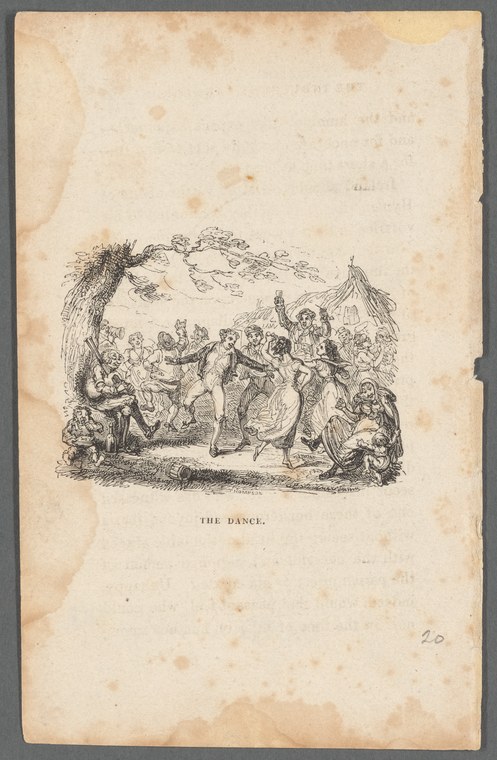
This engraving is rare evidence of how ordinary people danced in social settings before dance was professionalized and codified. It shows the body positions, costumes, and gender relations embedded in 18th-century social dance, and it documents the festive gathering itself as a cultural practice. For historians of dance and social manners, this is primary source material that complements the written dancing manuals of the period.
What you are looking at
A crowded outdoor dance scene depicted in a detailed engraving, likely from the 18th or 19th century. The composition shows a gathering of elegantly dressed figures—men in coats and breeches, women in full skirts—arranged in a loose circle or gathering around what appears to be the central action. A large tree with spreading branches dominates the upper left, providing a natural canopy over the scene. The figures are distributed across the foreground and middle ground with varying degrees of engagement: some actively dancing or partnered, others watching or conversing. The setting suggests a rural or village fête rather than a formal ballroom, with a tent visible on the right side. The line work is characteristic of an engraving or etching, with fine cross-hatching creating depth and shadow throughout the composition. The overall mood is one of convivial leisure and festive celebration.
The dancing
Multiple couples are visible in various partnered positions. In the center-left, figures appear to be executing a turning movement with arms raised and bodies in motion. The women wear the full skirts and corseted silhouettes of the period, which billow and catch the suggestion of movement. Several figures maintain what appears to be a closed or semi-closed ballroom hold, characteristic of formal social dance. The artist has captured varied moments of participation—some dancers are actively stepping or turning, while others stand in conversation or observation. The poses suggest a relatively stately, measured choreography rather than vigorous footwork, with controlled upper-body movement and extended arm positions typical of 18th-century courtly dance.
The dance depicted
This appears to depict a social or festive country dance of the 18th century, most likely a minuet, cotillion, or country-dance gathering. The mixed outdoor setting, the gathering of partners in couples, and the formal but not balletic postures suggest a communal social dance rather than a theatrical performance. The presence of both active dancers and spectators, combined with the relaxed rural setting beneath the tree, indicates this may document an actual social custom of the period—dances held at village celebrations, harvests, or holidays. The composition captures a moment of festive participation that was central to both rural and town social life in the Georgian era.
How it was made
This is an engraving or etching, evidenced by the fine parallel lines, cross-hatching, and precise stippled tones throughout. The technique allows for delicate detail in costume and facial expression while maintaining clear compositional structure. The print shows signs of wear and age consistent with an 18th or early 19th-century work—discoloration and foxing are visible throughout. As a print, this would have had multiple impressions and thus wider circulation than a painting, suggesting it was created for a market audience interested in scenes of social manners and popular entertainments. The medium and subject matter indicate this was likely a commercial illustration or satirical commentary on fashionable life.
About this work
This engraving documents a festive outdoor dance gathering, capturing the social practices and costumes of the 18th century. The scene shows partners engaged in formal but convivial dancing beneath a spreading tree, surrounded by onlookers and pavilion structures. It belongs in a gallery of dance art as an historical record of how ordinary people danced, celebrated, and socialized in this era—not the theatrical spectacle of stage ballet, but the participatory community dances that constituted the majority of dance experience. The work is valuable precisely because it shows dance as social fact rather than artistic performance, documenting the actual dress, partnering conventions, and public spaces of the period.
How to look at it
Notice the tree framing the scene and the distribution of figures—the artist has chosen a moment of general festivity rather than a single dramatic couple, emphasizing the communal and social aspect of dance. Observe the women's skirts and how they are rendered in motion; the artist understood that full skirts in movement are central to the visual effect of 18th-century dance. Look at the range of body positions: some figures are actively turning, others are walking in line, others are watching—this variety suggests the sequential, processional nature of country dances and cotillions rather than the simultaneous choreography of later ballroom dances.
The period
In the 18th century, social dance—minuets, cotillions, country-dances, and contredanses—was a core skill for the educated classes and a central feature of social gatherings at all levels of society. The formalization of dance technique was underway: French dancing masters published detailed treatises on the proper execution of steps and positions. Simultaneously, print culture was expanding the circulation of images of fashionable life, including scenes of dancing, which served both as entertainment and as documentation of social codes. This engraving sits at the intersection of these developments: it records actual social practice while also circulating an idealized vision of genteel leisure and courtship.
Where it lives
This print is held in the New York Public Library collection. It is part of a broader tradition of commercial engravings documenting scenes of fashionable and popular life in the 18th and 19th centuries.
Dance in this work
Questions about this work
What kind of dance is this?
The formal dress, outdoor setting, and partnering suggest a social dance from the 18th century—likely a minuet, cotillion, or country-dance. These were participatory dances performed at celebrations and social gatherings, not theatrical performances. The composition shows the typical mix of active dancers and onlookers that characterized such events.
Why is this outdoors?
Village celebrations, harvest festivals, and holiday gatherings often took place in open air. The spreading tree and tent visible in the composition suggest this was a festive occasion designed to accommodate many people. Outdoor dancing was also common in summer social life.
How do we know how people actually danced then?
Prints like this, combined with written dancing manuals from the period, give us a record of historical practice. While prints often idealized their subjects, they were also based on observation of actual social life. This engraving likely documents recognizable conventions of dress, posture, and partnering that would have been familiar to its original viewers.
Why were spectators important to these dances?
Social dances of the 18th century were as much about display and courtship as about movement itself. Spectators watched, waited their turn to dance, and served as witnesses to social interactions. The presence of onlookers was integral to the social meaning of the dance.
More dance artwork