49 works in this view — arrow keys or swipe to move between them.
Dance in Art · 2019
Dance cartoons
Unknown artist
- Source:
- New York Public Library
- Rights:
- Public domain — free to use, share and adapt.
- Recorded as:
- public_domain
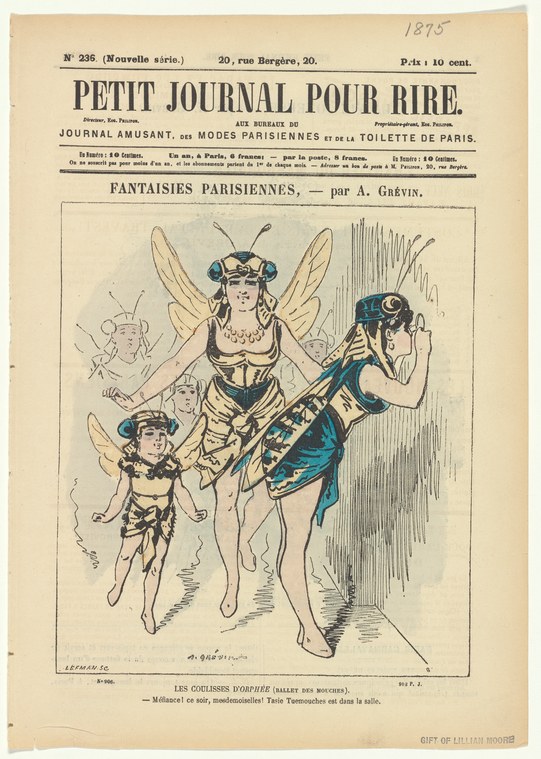
This image reveals how ballet was consumed and contested in the popular imagination: not as high art aspiring to transcendence, but as a target of ridicule. The caricature's anatomical distortions and insect transformation show that the Romantic ideal of weightless, ethereal movement—marketed to audiences as supernatural and transcendent—was already perceived as absurd enough to parody in a mainstream weekly. For historians of dance and visual culture, it documents the gap between what ballet claimed to express and how ordinary urban readers and viewers actually experienced it.
What you are looking at
A French satirical cartoon from *Petit Journal pour Rire*, a humor weekly from the 1870s. Three winged fairy or insect-like figures are shown in mid-leap against a hatched background. At left, a tiny winged creature with an insectoid head gestures wildly. In the center, a larger female figure with transparent wings, a jeweled headdress, and a fitted bodice executes an elevated jump or flight pose, one leg bent, arms raised in expansive arcs. At right, a third winged dancer in a blue costume with similar anatomical exaggeration performs an energetic lunging step. The figures' proportions are grotesquely distorted—elongated limbs, oversized joints, bulging musculature—in the manner of caricature. The composition captures a moment of frantic, airborne movement; the title beneath translates as "Collisions in Orbit (Ballet of the Mosquitoes)," suggesting this satirizes both aerial ballet and contemporary entomological fascination. The line work is bold and expressive, with selective hand-coloring in blue.
The dancing
The three figures employ exaggerated, balletic port de bras—arms lifted and extended in sweeping arcs—combined with elevated jumps or leaps. The central figure's pose is closest to recognizable ballet vocabulary: a high arabesque or attitude, with one leg raised behind or to the side and the torso extended. The others adopt lunging, flying attitudes that parody the weightlessness implied by Romantic-era ballet fantasy. All three display hyperextended joints and distorted musculature typical of caricature; they are anatomically impossible in ways that underscore the mockery. The spacing suggests a frieze or procession of dancers frozen mid-flight.
The dance depicted
This is a parody of Romantic-era ballet—specifically, of the aerial fantasy ballets popular in mid-to-late 19th-century Paris, where sylphs, sprites, and ethereal creatures dominated the stage. The title's reference to "mosquitoes" transforms the elegant fairy of ballet into an insect, a commonplace inversion of satire. The artistic vocabulary—wings, elevated positions, supernatural grace—mimics the iconography of Romantic ballet, but the grotesque anatomy and frenetic energy mock both the aesthetic and, implicitly, the performers and audiences who celebrated it. The satire targets the convention itself: the pretense that human bodies could embody weightless, otherworldly movement.
How it was made
This is a wood engraving or engraved illustration with hand-applied watercolor or gouache, typical of the commercial printing process for illustrated periodicals in the 1870s. The primary image is rendered in fine black line work, creating sharp contrasts and allowing for reproduction at small scale; the selective coloring in blue appears to have been applied after printing, a common economy for cheaper publications. The technique—rapid, expressive line combined with limited color—was suited to weekly circulation and broad audiences. The style echoes the work of contemporary French caricaturists like Honoré Daumier and Cham, who used similar methods for political and social satire.
About this work
A satirical engraving from a French humor magazine of the 1870s, parodying the ethereal, aerial fantasies of Romantic-era ballet by reimagining ballet sylphs as grotesquely distorted mosquitoes in mid-flight. The work belongs to a tradition of caricature that used dance imagery—particularly the ballet idiom of weightlessness and fantasy—as a vehicle for mocking both artistic pretension and contemporary aesthetic fashions. The artist demonstrates intimate knowledge of ballet's visual conventions while inverting them through exaggeration and absurdist subject matter. For dancers and theater historians, the work documents how ballet was perceived and lampooned in the urban press, revealing anxieties about artifice, gender, and spectacle that underlay 19th-century dance culture.
How to look at it
Attend first to the bodies: notice how the artist has borrowed the vocabulary of ballet—lifted arms, raised legs, the impression of weightlessness—but rendered it grotesquely impossible through distorted joints and exaggerated musculature. The anatomical impossibility is the satire's point. Second, observe the title and the insect attributes (wings, heads): the joke depends on your recognition of ballet conventions and your willingness to see them inverted. Third, consider the medium and context: this is a disposable weekly cartoon, not a monumental artwork, yet it exposes the fragility of the aesthetic claims that ballet made—the pretense of transcendence is rendered as mere spectacle the moment it is caricatured.
The artist
The engraving is attributed in the catalogue to A. Grévin, a prominent French caricaturist, printmaker, and sculptor of the mid-19th century. Grévin was known for sharp social and political satire distributed through illustrated periodicals; he later founded the Musée Grévin, a wax museum in Paris that remains an institution today. His work in *Petit Journal pour Rire* and similar publications was characterized by grotesque exaggeration, inventive visual puns, and commentary on contemporary fashion, theater, and morals. The attribution supports the reading of this work as intentional artistic satire rather than naive illustration.
The period
The 1870s in Paris saw the tail end of the Romantic ballet era, when works like *La Sylphide* and *Giselle* (by then 40+ years old) were still performed but increasingly contested by new aesthetics. The cancan and music-hall dancing were rising in popularity and moral concern; the classical ballet was simultaneously becoming more technical and more ornamental. Satirical periodicals like *Petit Journal pour Rire* (founded 1848) thrived during the Second Empire and early Third Republic, using dance, theater, and fashion as mirrors for social critique. The 1870s also coincided with growing interest in entomology and natural history as subjects of both scientific inquiry and popular fascination—making the mosquito a fitting vehicle for visual puns. This cartoon sits at a moment when ballet was becoming historicized and mockable, no longer the cutting edge of theatrical fashion.
Where it lives
The work is held in the New York Public Library collection and originates from *Petit Journal pour Rire*, issue no. 236 (nouvelle série), published from the journal's offices at 20 rue Bergère, Paris, priced at 10 centimes. *Petit Journal pour Rire* was a weekly humor magazine aimed at middle-class Parisian readers, discontinued in the late 1870s. The work is one of thousands of such illustrations produced for mass circulation; its survival reflects the institutional collecting practices of major research libraries.
Dance in this work
Questions about this work
Is this actually about ballet, or is it just a silly cartoon about bugs?
It is both. The satire works because the artist uses genuine ballet vocabulary—the lifted arms, the elevated leaps, the ethereal poses—and then places them on insect bodies with distorted anatomies. The joke assumes readers recognized ballet's visual conventions well enough to understand the inversion. The mosquito title makes the mockery explicit: what ballet celebrated as weightless grace is reduced to the jerky, frantic movement of an insect.
Who was Grévin, and why would he parody ballet?
A. Grévin was a leading caricaturist and satirist of mid-19th-century Paris, working primarily for illustrated periodicals. His job was to mock contemporary fashion, politics, and theater for middle-class audiences. Ballet, with its pretensions to transcendence and its association with luxury and spectacle, was prime material for satire. Grévin's work typically targeted artistic pretension and social absurdity.
What does the title 'Les Collisions d'Orbite' mean?
The title translates as 'Collisions in Orbit' or 'Orbital Collisions.' It suggests the chaos of multiple bodies moving erratically through space—in this case, mosquitoes colliding mid-flight. The subtitle 'Ballet des Moustiques' makes it clear this is ballet presented as insect chaos: graceful, ordered movement inverted into frantic, accident-prone motion.
More dance artwork