49 works in this view — arrow keys or swipe to move between them.
Dance in Art
Les noces de Pelée et de Thétis
Unknown artist
- Collection:
- Prints depicting dance
- Source:
- New York Public Library
- Rights:
- Public domain — free to use, share and adapt.
- Recorded as:
- Public Domain
This engraving preserves evidence of how Renaissance and Baroque artists and patrons imagined classical mythology as the occasion for grand, formally staged celebrations—occasions where dance was a central feature. The work documents not individual dances but the culture in which elaborate ballet narratives were created and performed.
What you are looking at
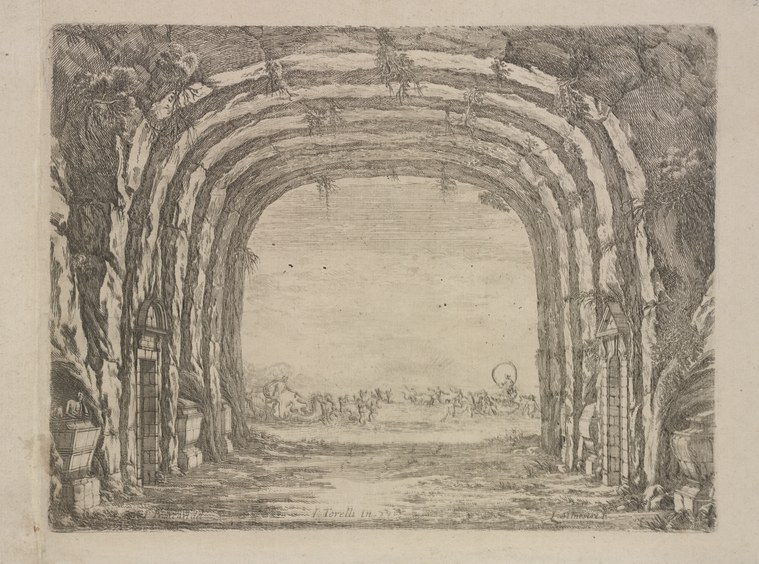
A grand architectural setting frames an expansive mythological scene. The composition is structured as a deep vista: a massive vaulted arcade of stone arches recedes sharply toward a distant plain where dozens of figures gather. The foreground is dark and shadowed, dominated by the imposing architecture; the middle distance shows the light-flooded gathering; the far background opens to sky and landscape. The gathering appears to be a ceremonial procession or assembly, with figures visible as small forms distributed across the plain. The whole scene suggests a wedding feast or grand celebration—the subject is Peleus and Thetis's marriage from Greek myth. The engraving technique renders the stone with careful cross-hatching to suggest volume and shadow, while the distant figures remain schematic, suggesting the scale and grandeur of the occasion rather than individual movement.
The dancing
The distant figures are rendered too small for precise movement analysis. What is visible suggests formal assembly rather than active dancing—groups stand, some appear to process or stand in formation. The scale and composition privilege the architectural setting over bodily detail. No clear dance frame, holds, or footwork are legible at this distance and in this medium.
The dance depicted
The title identifies this as the wedding of Peleus and Thetis, a foundational Greek myth. The subject was favored in Renaissance and Baroque court spectacle, where elaborate wedding celebrations incorporated dance, music, and theatrical machinery. If dancing occurs here, it is likely court dance or ceremonial movement—the gathering suggests formal celebration rather than specific recognizable choreography. The engraving does not permit identification of a particular dance style; the work documents the *occasion* of dance rather than the dance itself.
How it was made
This is an engraving (identified visually from the parallel-line hatching, the formal composition, and the signature of technique). The print medium and the date notation suggest publication as a broadsheet or collection plate. Engraving allowed wide distribution and made this image of a grand mythological subject accessible beyond the original performance or patron's circle. The technique's precision and the care spent on the architectural setting indicate an expensive production, likely for a noble or court audience.
About this work
This engraving documents the wedding of Peleus and Thetis, a classical subject that became a vehicle for Renaissance and Baroque court spectacle. The work frames the mythological feast within monumental architecture, emphasizing the grandeur and formality of the occasion. Rather than depicting specific dance steps or recognizable choreography, it records the assembled celebration itself—the moment when mythological figures gathered for a legendary wedding feast that would be recreated on stage with dance, music, and theatrical machinery.
The work belongs in a gallery of dance imagery because it represents a crucial intersection: the mythological subjects that drove court ballet, the architectural settings in which dance was performed, and the print culture through which images of elaborate spectacle were circulated. Dance was integral to such celebrations, even when the engraving's scale and distance do not allow its detailed representation.
How to look at it
Attend to the architectural framing: the artist has organized the entire composition around the contrast between the dark, solid, measured arcade in the foreground and the bright, open gathering in the distance. This staging mirrors the theatrical settings of court spectacles. The small figures in the distant plain are intentionally distanced and schematic—the viewer is positioned outside the celebration, witnessing its grandeur and formality rather than its detail. The engraving technique, with its uniform application of line and shadow, emphasizes formal order and ceremony rather than individual movement or gesture.
The artist
The artist is not recorded in the catalogue. The technique, style, and composition suggest a mid-to-late 16th or 17th-century engraver trained in the Northern European tradition, likely working in the Low Countries or Italy where classical subjects and architectural settings were favored.
The period
The subject belongs to the height of court spectacle and court ballet in Renaissance and early Baroque Europe. The wedding of Peleus and Thetis was a popular theme in intermezzos, court ballets, and theatrical entertainments, especially in Italy and France. Such celebrations were occasions for the display of elaborate machinery, music, dance, and costume. The engraving medium suggests this work was made for circulation among learned patrons and artists interested in classical subject matter and stage design. By the 16th and 17th centuries, printed images of theatrical spectacles and court entertainments had become important documents of cultural life.
Where it lives
This engraving is held in the New York Public Library's collection of prints depicting dance. The work is part of a larger tradition of prints documenting or commemorating theatrical and courtly spectacles.
Dance in this work
Questions about this work
Is anyone actually dancing in this image?
The figures in the distant gathering are too small and schematic to confirm specific dancing, but the subject—a legendary wedding feast—would certainly have included dance in the original mythological narrative and in any court spectacle it inspired. The engraving documents the occasion rather than the choreography.
Why is the architecture so dominant?
The monumental arcade frames and ennobles the gathering, emphasizing the formality and grandeur of the occasion. In Renaissance and Baroque court spectacles, elaborate architecture and stage machinery were integral to the performance and were often as remarkable as the dance itself.
Who were Peleus and Thetis?
In Greek mythology, Peleus was a mortal hero and Thetis a sea nymph. Their wedding was attended by the gods and became a legendary occasion. It was a favorite subject for Renaissance and Baroque court entertainments, which recreated such mythological events as elaborate spectacles with music, dance, and stage design.
More dance artwork





