27 works in this view — arrow keys or swipe to move between them.
Dance in Art
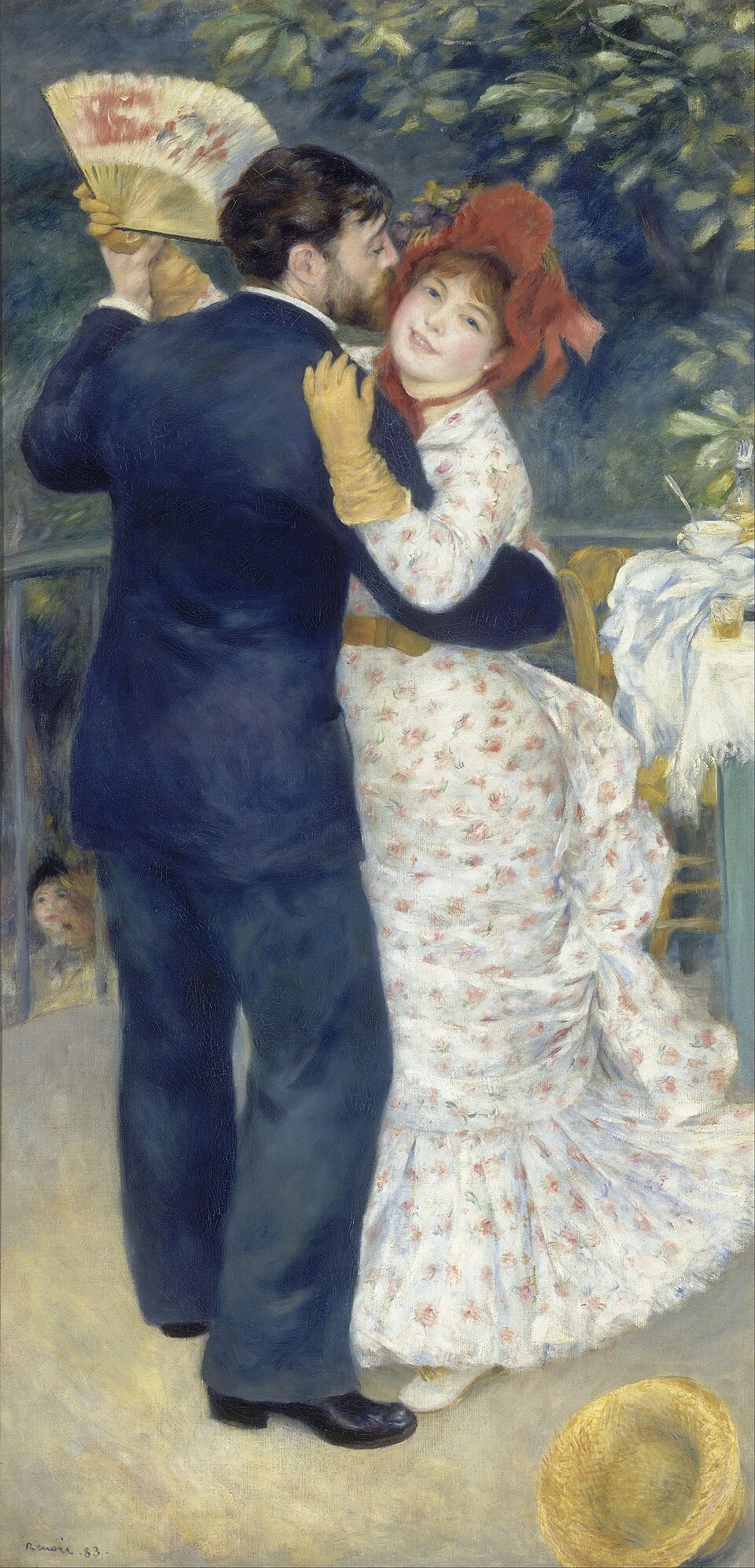
Dance in the Country
Pierre-Auguste Renoir
- Medium:
- oil on canvas
- Era:
- Late 1800s (Victorian Ballroom)
- Source:
- Wikimedia Commons
- Rights:
- Public domain — free to use, share and adapt.
- Recorded as:
- public_domain
This work is essential for understanding how ballroom dance was visualized and valued in the late nineteenth century: as an expression of courtship, refinement, and emotional interiority rather than technical display. For dancers and historians, it documents the closed hold, posture, and social protocols of Gilded Age waltz with the authority of lived observation—Renoir painted from life among the circles he depicted.
What you are looking at
A well-dressed couple dances outdoors in dappled sunlight, their bodies caught mid-movement against foliage. The man, in formal dark jacket with a yellow collar or accent, holds the woman close at waist and hand; she wears a white dress patterned with small pink roses and a matching red hat tied with ribbon. The setting is intimate and pastoral—a garden or leafy bower—with a straw hat and what appears to be a tea service on a white cloth nearby, suggesting a private countryside gathering. The brushwork is soft and impressionistic, with warm golden light filtering through leaves above. A small child's face appears in shadow at the left edge. The mood is one of refined leisure and romantic closeness rather than public spectacle.
The dancing
The couple adopts a closed ballroom hold with the man's right hand at the woman's waist and their outside hands joined; their bodies are angled toward each other in conversation as much as in motion. The woman's weight appears shifted, her skirts swept by movement. Both figures are upright and controlled, suggesting trained dancers rather than folk participants. The positioning and embrace are characteristic of late-nineteenth-century salon or ballroom dancing, with the formality of posture preserved even in an outdoor, leisured setting.
The dance depicted
This depicts social ballroom dancing of the Gilded Age—most likely a Waltz given the period, the closed hold, the outdoor summer setting, and the romantic tenor of the scene. The painting shows the dance as intimate social performance for a select audience rather than public entertainment. The woman's dress and the man's formal jacket indicate this is dancers of means at a private celebration. The artist captures the peculiar quality of this era's dance: technically trained, emotionally expressive, and framed as courtship.
How it was made
Oil on canvas in the Impressionist manner. The soft focus, visible brushwork, and diffused light are characteristic of plein-air or en plein-air-inspired technique, allowing the artist to capture movement and momentary effect rather than precise detail. The palette is warm and naturalistic with particular attention to fabrics—the play of light on the woman's dress and the man's dark coat. This is a work designed for display in a salon or collector's home, not mass reproduction, and speaks to an educated audience familiar with both ballroom protocol and modern painting.
About this work
This is one of three paintings in which Renoir depicted dance across different social registers: this country waltz pairs with urban ballroom scenes to explore how dance functioned as a marker of refinement, romance, and social position in the 1880s. The work is recognisable as part of Renoir's sustained engagement with leisure, courtship, and the body in motion during the height of French Impressionism. It presents dancing not as spectacle but as a private language between two people—the man and woman so absorbed in each other that other figures and even the artist recede. The countryside setting and the soft evening light give the dance a dreamlike, almost nostalgic quality, as if Renoir were already mourning a social world he was documenting.
How to look at it
Watch the woman's skirt and the set of the man's shoulders: they are caught in the suspended moment between steps, bodies tilted into the spiral of the waltz. The artist has chosen not the climax of a turn but a moment of connection and conversation—the dance is as much about the exchange of glances as about footwork. The soft focus on the background and the careful framing of the couple within dappled light ask the viewer to share the dancers' absorption in each other. Notice too how the formality of dress and hold contrast with the informality of the setting—this is how leisure was performed in this period.
The artist
Pierre-Auguste Renoir (1841–1919) was a founding figure of Impressionism who remained committed to figure painting and social subjects throughout his career. In the early 1880s, when this work was made, he was at the height of his powers and moved in circles of artists, musicians, and affluent Parisians. His paintings of dance and leisure are not incidental to his practice—they address the core Impressionist concern with modern life, light, and the fugitive moment. Renoir painted dancers and dance settings repeatedly, treating the subject with affection and without irony.
The period
The 1880s saw the waltz firmly established as the dominant social dance of European and North American elites, having secured its position over the previous two decades against conservative moralists who condemned its closeness and speed. By this date, the waltz was also increasingly codified by dance teachers and becoming the subject of instructional literature. Simultaneously, Impressionism was consolidating into a recognizable movement and moving into the market; scenes of leisure and courtship were among the genre's most marketable subjects. The painting sits at the intersection of these developments: a moment when the waltz was both socially secure and artistically fashionable as a motif.
Where it lives
The work is documented as oil on canvas from 1883. The current holding collection is not recorded in the source catalogue; the image is held in Wikimedia Commons, suggesting it is in a public collection but one not specified in the available metadata.
Dance in this work
Questions about this work
What dance is this?
This is a waltz, the social dance of the European aristocracy and upper middle class in the nineteenth century. The closed hold, the upright posture, and the turn suggested by the woman's swept skirt are all characteristic of waltz technique. The outdoor summer setting indicates this is a private, leisured version of the dance rather than a ballroom performance.
Is this a real couple or models?
Renoir painted from life and often worked with models and friends. The identities of these figures are not documented in the available catalogue record, but the quality of observation suggests Renoir was painting people he knew or studied closely.
Why paint a dance outdoors?
By the 1880s, the waltz had moved beyond ballrooms into summer gardens, country estates, and seaside resorts as part of the leisure culture of the affluent. Painting the waltz outdoors allowed Renoir to explore his central concerns: the play of light on fabric and skin, the poetry of modern leisure, and the waltz as a form of courtship and social ritual.
Is this part of a series?
Yes. Renoir painted at least three major works depicting dance in different settings during this period—urban ballrooms and country gatherings. Together they explore dance as a marker of social class and romantic feeling across different registers of society.
More dance artwork