49 works in this view — arrow keys or swipe to move between them.
Dance in Art
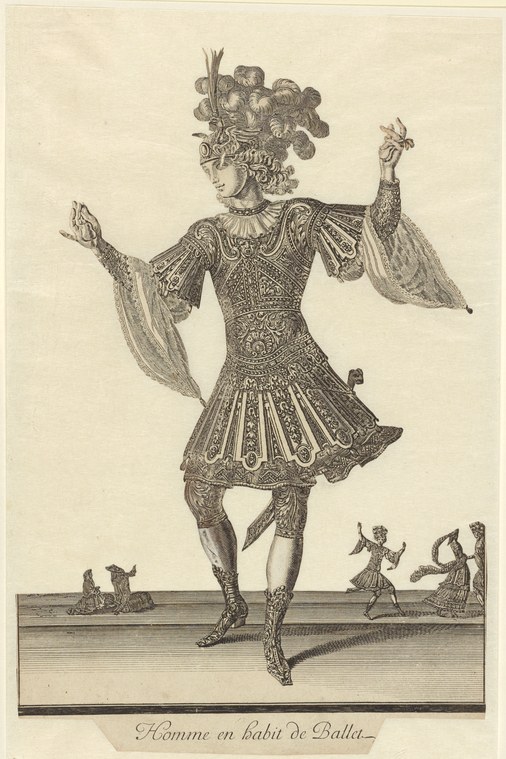
Homme en habit de ballet
Unknown artist
- Collection:
- Prints depicting dance
- Source:
- New York Public Library
- Rights:
- Public domain — free to use, share and adapt.
- Recorded as:
- Public Domain
This work is essential evidence for understanding how male dancers dressed, moved, and presented themselves in professional ballet at the moment when the form was consolidating in the early 18th century. It demonstrates the relationship between elaborate court costume and the emerging theatrical vocabulary of ballet, showing how the ornamental and formal were inseparable from the physical demands of the dance. For historians of fashion, theatre design, and dance practice, it is a primary document of exceptional clarity and precision.
What you are looking at
A single figure dominates the composition, posed in theatrical stance against a plain ground line. The dancer wears an elaborate costume of the late 17th or early 18th century: a close-fitting, ornately patterned tunic or justaucorps with vertical pleating at the skirt, decorated sleeves that sweep outward and downward, and what appears to be ornamental leg coverings or hose. The headdress is architectural and imposing—a tall arrangement of curled hair or a hairpiece adorned with feathers, standing well above the head. The dancer's pose is one of display: the weight appears shifted onto one leg, the arms extended outward in an open, presenting gesture, the torso upright and proud. Two small attendant figures appear in the background at right, much diminished in scale, suggesting either a theatrical scene or a documentation of court performance. The entire composition is rendered in fine line engraving against a cream or off-white ground, with careful cross-hatching to suggest the texture and ornament of the costume.
The dancing
The primary figure stands in a classical contrapposto stance with weight on the back leg, creating an S-curve through the body. Both arms are held away from the body at approximately shoulder height or slightly lower, palms facing forward or outward in a gesture of presentation rather than active movement. The legs are extended, one planted firmly and one slightly advanced, but there is no clear indication of active footwork or elevation. The posture is formal and static rather than caught mid-movement; this is a posed portrait of a dancer in costume rather than a captured moment of choreography. The scale and isolation of the primary figure, with attendant figures tiny and marginal, emphasizes display and costume over interaction.
The dance depicted
The inscription 'Homme en habit de ballet' (Man in ballet dress) identifies this as a representation of male ballet costume from the late 17th or early 18th century. The figure is most likely a professional dancer or ballet master of the French court tradition, depicted in formal stage dress rather than performing a specific step or movement. The costume—particularly the close-fitting tunic with structured pleating, the decorative hose, and the elaborate headdress—is consistent with the habits worn by male dancers in Louis XIV's ballets de cour and the early decades of professional ballet that followed. The pose suggests the formal, upright carriage demanded by the ballet vocabulary of this period, but the image documents costume and presentation rather than choreographic content.
How it was made
This is a line engraving, executed with fine, even striations of cross-hatching to create tonal variation and suggest fabric texture. The technique allows precise rendering of ornamental detail—every pleat, every curl of the headdress, every decorative pattern of the costume is legible. Engravings of this kind were relatively inexpensive to print and circulate compared to hand-painted works, making them ideal for documenting and disseminating images of court dress and professional costume. The inscription in script below the figure suggests this is part of a series or album of costume studies, likely intended for reference by dancers, tailors, or admirers of court dance.
About this work
This engraving documents the formal costume of a professional male ballet dancer in the early 18th century, rendered as a posed portrait in a studio or print tradition rather than a scene of performance. It is one of a series of costume studies—a format that was common in printmaking of the period, particularly in documenting the elaborate dress of court and professional dance. The work belongs to the visual archive of ballet de cour and its aftermath, when ballet was still evolving from aristocratic pastime into professional theatrical practice. The image is valuable as a precise record of what men wore when they danced, what their carriage was expected to be, and how their costume was understood as an integral part of their professional identity.
The engraving also documents a moment in the history of dance representation itself: the shift from narrative or scenic depictions of dances (which show the action) toward documentary studies of costume, character type, and formal display (which show the apparatus of performance). This image sits at the intersection of costume history, dance history, and the history of theatrical documentation.
How to look at it
Look first at the costume and ask what it tells you about the dancer's body and carriage. The tunic is cut to show the silhouette; the hose and shoes (with their visible heels) suggest the lower leg was on display and important to the dancer's line. The arms are posed in an open, presenting gesture typical of formal social and theatrical dance of the period—not the closed, controlled arm positions of later ballet, but a more courtly openness. The headdress is so tall and so elaborately constructed that you should ask how the dancer moved in it: it speaks to a dance that valued formal presentation and display over acrobatic movement. Finally, note the scale and placement of the attendant figures: they suggest this is an image of a professional dancer, not an aristocratic amateur, and that the costume and the body wearing it are themselves the subject of documentation.
The period
This engraving dates to the late 17th or early 18th century, when ballet was in rapid transition. Louis XIV's reign had established ballet as a formal court practice with its own vocabulary and professional dancers; by the early 18th century, ballet was beginning to move out of the court and into the public theatre. Male dancers at this time were expected to combine the formal, upright carriage of aristocratic deportment with the emerging physical demands of codified ballet technique. The costume shown—with its fitted tunic, decorative hose, heeled shoes, and elaborate headdress—was the standard formal dress of a ballet dancer, whether performing at court or in the theatre. The fashion of the costume itself (the pleat style, the sleeve design, the headdress) places the image in the early 18th century rather than the mid-17th century.
Where it lives
This work is held in the New York Public Library's collection of prints depicting dance. It is an archival print, part of the Library's broader efforts to document dance iconography across media and centuries.
Dance in this work
Questions about this work
What is a 'habit de ballet' and why does the title say it?
The term 'habit de ballet' (literally 'ballet dress' or 'ballet costume') was used to describe the formal costume worn by professional dancers in the 17th and 18th centuries. The inscription 'Homme en habit de ballet' identifies this as a record of what a man wore when he danced professionally. It is a technical term, not a description of the figure's social status, though the costume itself was expensive and marked the wearer as someone of rank or profession.
Is this a specific dancer or a generic costume study?
There is no inscription identifying an individual dancer, so this appears to be a generic study of proper male ballet dress and carriage rather than a portrait of a named performer. It was likely intended as a reference document for dancers, costume makers, or an illustrated record of theatre practice. However, the precision and care of the engraving suggest it was made from life or from a detailed description provided by someone with direct knowledge of professional dance.
What period is this costume from?
The style of the costume—particularly the pleated tunic, the decorative hose, the heeled shoe, and the elaborate feathered headdress—places this in the early 18th century, likely between 1700 and 1730. This was the period immediately following Louis XIV's death, when professional ballet was establishing itself as a theatrical form in Paris and beyond.
How does this costume compare to modern ballet dress?
This costume is fundamentally different from modern ballet wear. It is heavy, ornate, and designed to display status and elegance rather than the dancer's legs and line. There are no tights or pointe shoes (which came much later). The emphasis is on the upper body, the decorative hose, and the elaborate headdress. The dance performed in this costume would have been much more formal and courtly in bearing than the athletic, turned-out vocabulary we associate with ballet today.
More dance artwork





