31 works in this view — arrow keys or swipe to move between them.
Dance in Art · 2019
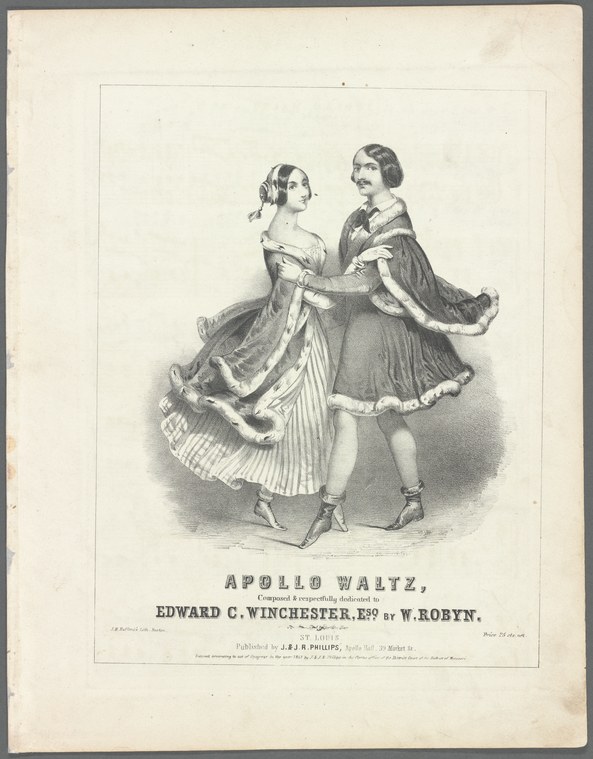
Apollo waltz
Unknown artist
- Medium:
- Lithograph
- Dance:
- Waltz
- Era:
- Early 1800s (Waltz Revolution)
- Source:
- New York Public Library
- Rights:
- Public domain — free to use, share and adapt.
- Recorded as:
- public_domain
This print is direct evidence of how the waltz was actually danced in the 1820s-1830s, before the hold and technique became standardized into what is now called 'Viennese Waltz.' It shows a stage between the old country-dance tradition and the modern ballroom form, and documents the partnership and turning action that made the waltz revolutionary. For historians of dance, Regency society, and the material culture of ballroom instruction, it is a primary source of exceptional clarity.
What you are looking at
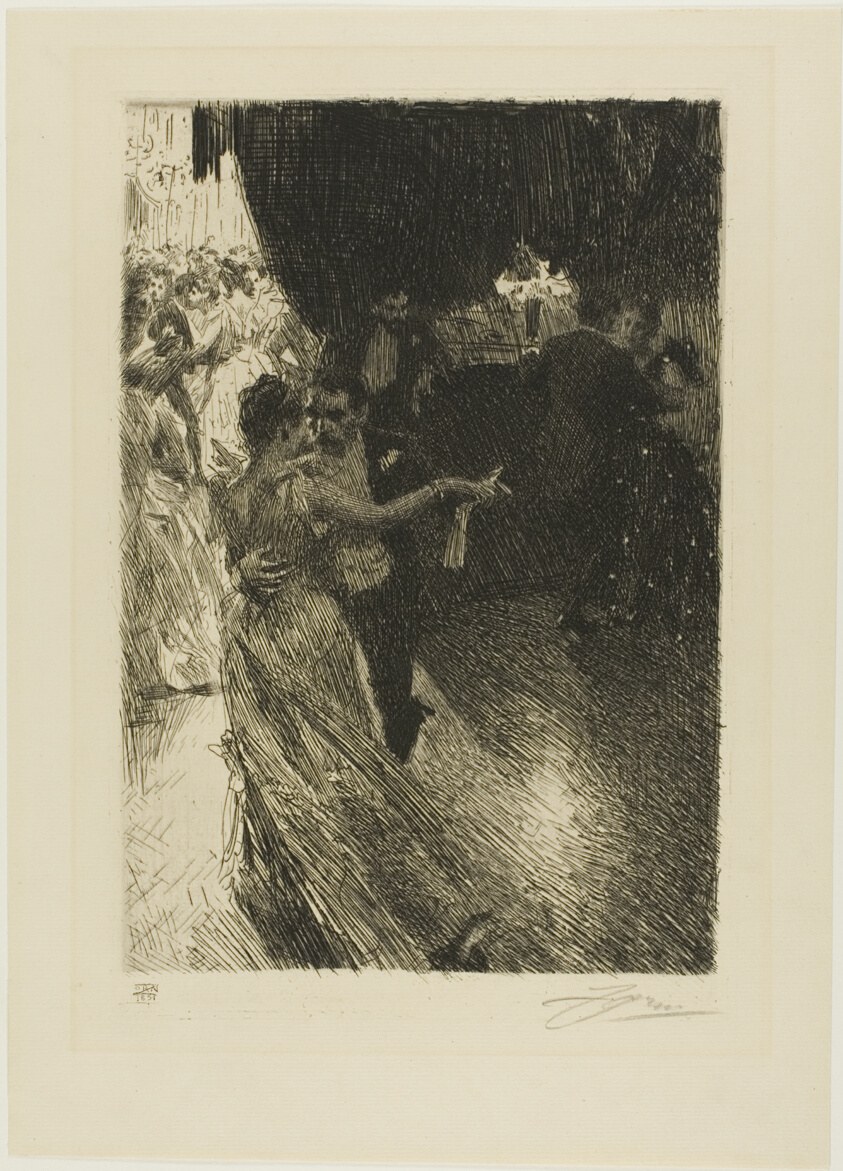
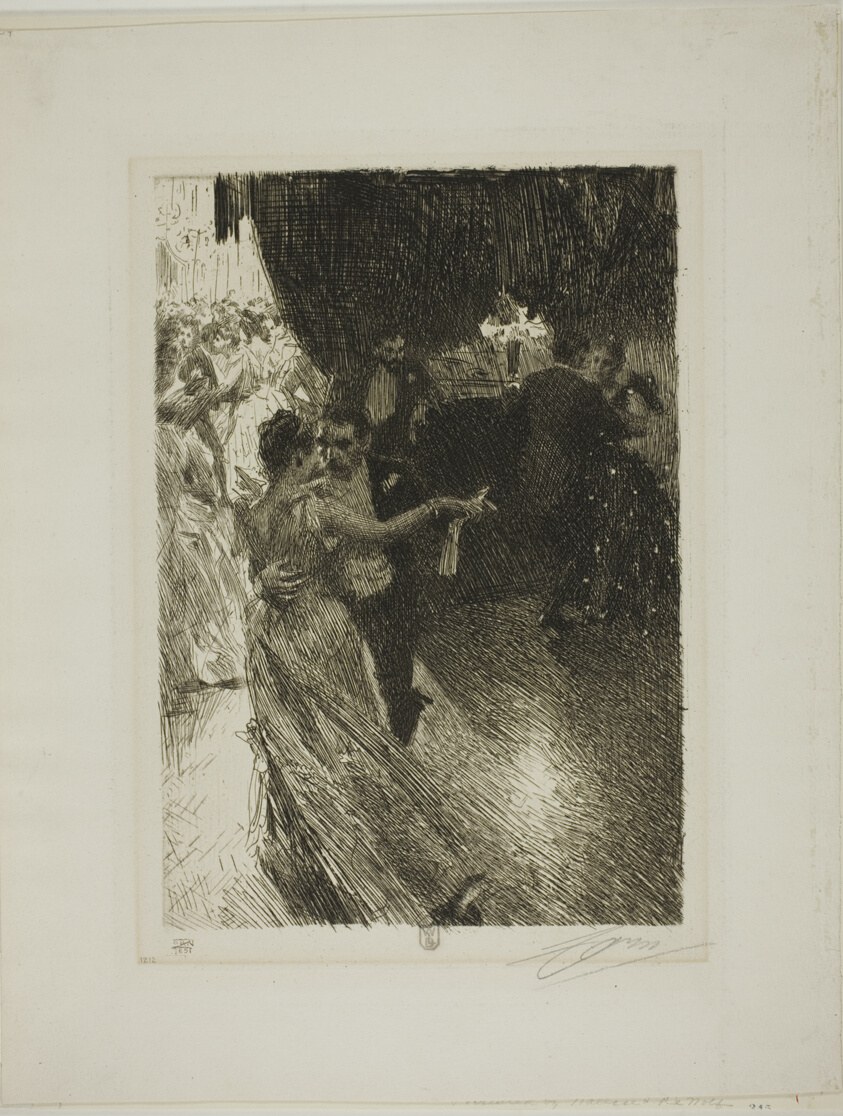
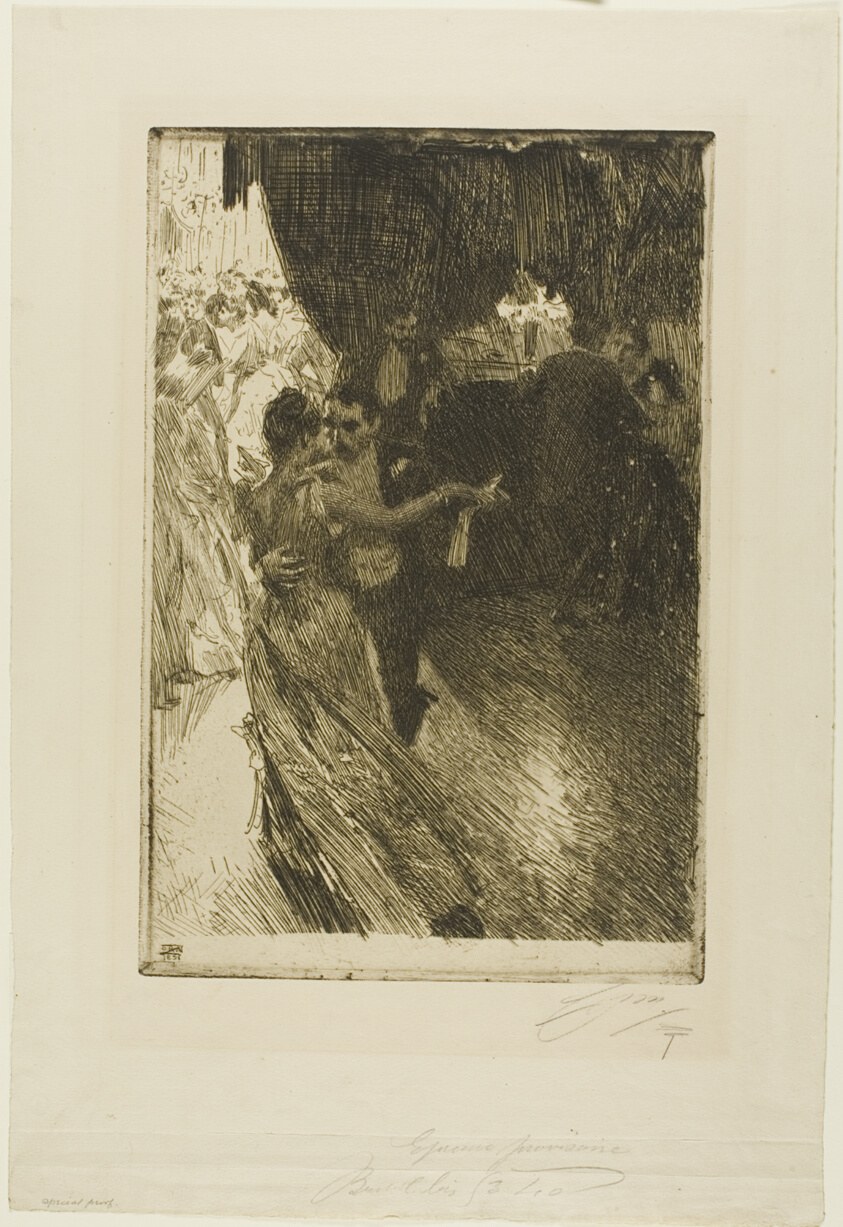
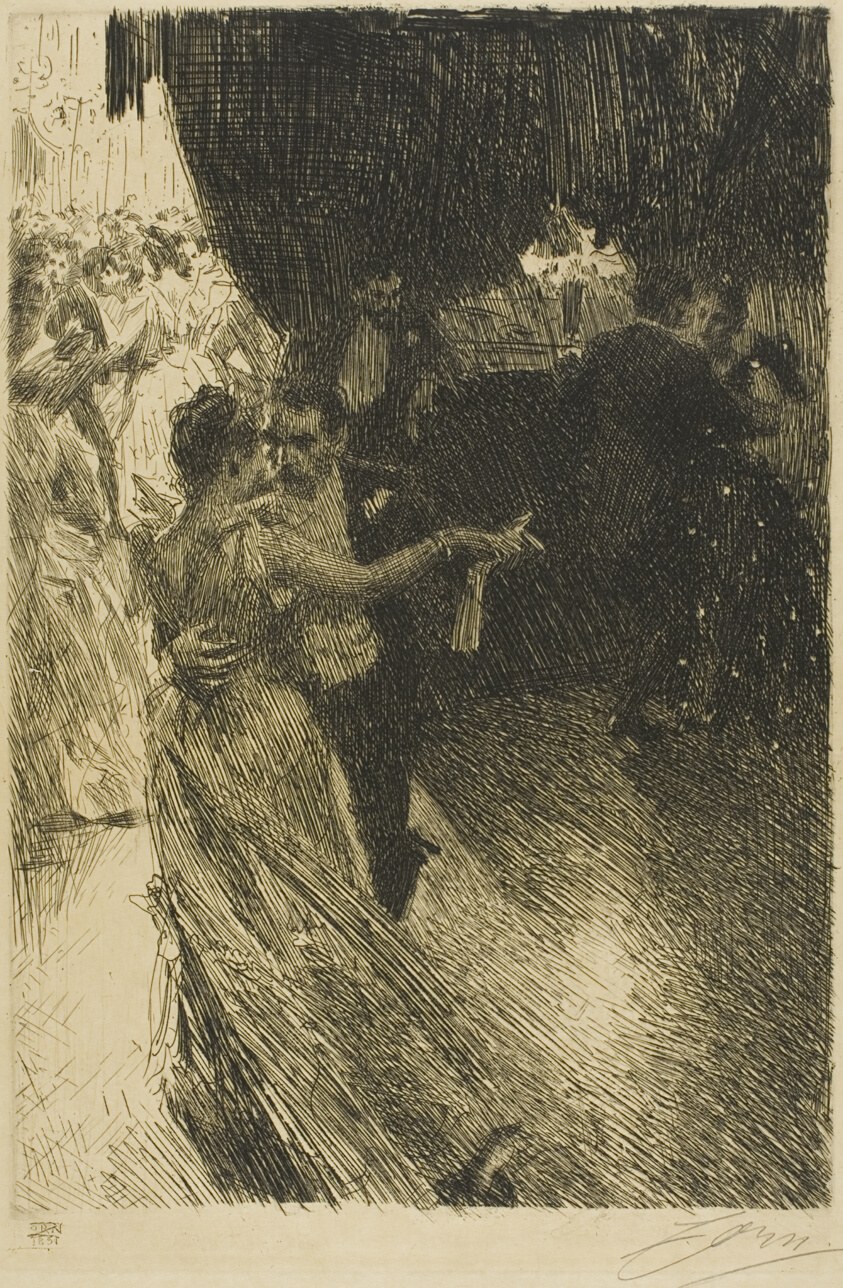
A lithographic print showing two female dancers in a moment of social dance, likely from a ballroom or theatrical context. The figure on the left wears a pale dress with a fitted bodice and voluminous skirt featuring horizontal pleating or fluting; her hair is arranged in the romantic period style with ringlets and ornament. She is turned in profile or three-quarter view, her body angled dynamically. The figure on the right, dressed in a darker gown with draped sleeves, leans toward her partner with evident engagement. Both dancers wear heeled slippers and their positioning suggests the turning, embracing action characteristic of couple dances of the 1820s-1830s. The composition is intimate and frontal, set against a plain background that emphasizes the figures. The lithographic technique renders the fabrics with delicate shading, the pleating of skirts with particular care.
The dancing
Both figures stand in close proximity in a turned, partnered position. The left-hand dancer's weight appears shifted onto her rear foot as her skirt swings outward in a turning action; the right-hand dancer faces her with arms raised in contact. The embrace is at the level of the shoulder and arm rather than the waist—characteristic of some early-19th-century couple dances. Both dancers' posture is upright and poised, with the line of the body held in the ballroom manner. The footwork is not clearly visible but the heeled slippers and the swinging action of the skirt suggest movement through turning.
The dance depicted
The title and composition strongly indicate this is a waltz, the social partner dance that revolutionized European ballrooms in the 1820s and beyond. The turning action, the partnered close hold (though not yet the later standard closed position), the heeled slippers, and the ballroom dress place this within the waltz revolution of the early 19th century. The inscription credits composition and arrangement to Edward C. Winchester and W. Robyn, suggesting this is a published dance print—likely promoting a specific choreographed version or demonstrating the steps to a fashionable audience. The term 'Apollo Waltz' may indicate a named variation or performance version rather than the basic waltz form.
How it was made
This is a lithograph, a printing technique that allowed rapid reproduction and wide circulation of dance imagery in the early 19th century. Lithographs could capture the fluid grace of movement more delicately than woodcuts and could be produced in larger numbers than engravings, making them the dominant medium for fashionable dance prints of this era. The technique is evident in the soft tonal gradations of the fabrics, the fine detail of the pleating, and the subtle modeling of the figures. Published by J. & J. P. Phillips in London, this print would have been accessible to the dancing public as both instruction and souvenir.
About this work
The Apollo Waltz is a lithographic dance print from the early 19th century, a period when the waltz was transforming European social dance from a disreputable novelty into the dominant couple dance of the ballroom. It demonstrates the dress, partnering style, and movement quality of the waltz as performed in Regency and early Victorian society. The print is a working document of dance history—not simply a representation of the dance but a tool for learning and promoting it, credited to two dance arrangers and published through commercial channels that made fashionable dance accessible to a broad middle-class audience. It belongs in a gallery of dance art because it captures both the physical reality of how the waltz was performed and the cultural appetite for dance instruction and entertainment that characterized the period.
How to look at it
Observe the turning action frozen in the swinging skirt and the partners' angled bodies—the artist has caught the moment mid-turn, which emphasizes the dynamic, rotational character of the waltz. Notice how the lithographer has rendered the texture of the pleated skirt with particular care, using fine parallel lines to suggest both the fabric's structure and its movement. Look at the arm position and proximity of the partners: this is closer than a minuet but not yet the fully closed hold of later ballroom waltz. The inscription identifies this as a specific named version ('Apollo Waltz') arranged by known professionals, so read it as a commercial product designed to be learned from—a step-by-step guide to fashionable dancing rather than a portrait of spontaneous movement.
The artist
The print is credited to Edward C. Winchester (composer/arranger) and W. Robyn, whose names appear on the title page. Both were professional dance musicians and choreographers working in London during the height of the waltz craze. Their role was to arrange and promote fashionable dances—often composing new pieces or variations on popular forms and publishing them with didactic imagery for the paying public. Little is known of their individual practices, but their work exemplifies the commercial dance publishing industry that flourished in London during this period.
The period
The waltz arrived in England from Vienna and Germany in the 1810s and sparked both enthusiasm and moral panic: it was danced in closed hold, which was considered shockingly intimate for a public ballroom. By the 1820s, when this print was likely made, the waltz had become fashionable among the upper and rising middle classes, and a thriving industry of dance prints, instruction books, and arranged music emerged to teach and promote it. Simultaneously, Romantic ballet was developing in Paris and London, bringing new standards of female grace and ethereal movement. The print captures the waltz at a moment when it was both revolutionary and newly respectable—the elegant dress and refined presentation here contrast sharply with earlier satirical images of the 'indecent' waltz.
Where it lives
This lithograph is held by the New York Public Library and was published by J. & J. P. Phillips of Soho, London, a commercial music and dance publisher active in the early 19th century. The print is part of the broader tradition of London ballroom prints that served as instruction manuals and fashion documents for the dancing public.
Dance in this work
Questions about this work
How is this different from a modern waltz?
The hold is looser and higher, the posture more upright, and the turning action less continuous. The Viennese Waltz you see in competitions today was standardized later in the 19th century. This image shows an earlier, less codified version of the form, closer to how the waltz actually looked when it first became fashionable.
Why is this called the 'Apollo Waltz'?
Named variations and themed versions of popular dances were common in the 19th century. 'Apollo' may reference classical elegance or it may simply have been a marketing name designed to make the dance seem noble and fashionable. Such names helped publishers sell multiple versions of essentially the same basic form.
Who would have owned or used a print like this?
Dancing masters would have used it for teaching clients; aspiring dancers and music-playing young women would have bought or borrowed it from commercial libraries; ballroom attendees would have used it to learn the latest fashionable steps at home. It was a mass-market product aimed at the middle classes.
More Waltz artwork