49 works in this view — arrow keys or swipe to move between them.
Dance in Art
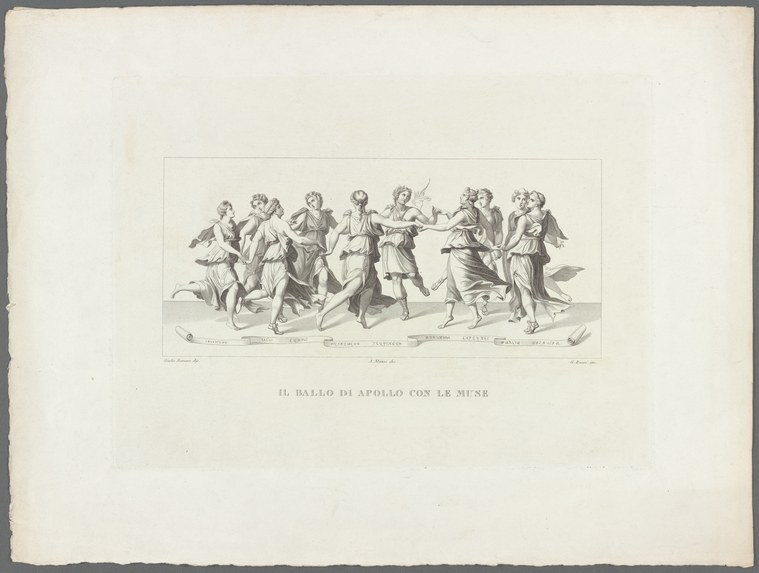
Il ballo di Apollo con le Muse
Unknown artist
- Collection:
- Prints depicting dance
- Source:
- New York Public Library
- Rights:
- Public domain — free to use, share and adapt.
- Recorded as:
- Public Domain
This print documents the visual vocabulary of neoclassical ballet at a moment when the art form was becoming codified and when choreographers were explicitly returning to classical sources for legitimacy and aesthetic guidance. It shows how Apollo and the Muses—a subject with deep roots in Renaissance pageantry—was reimagined as a barefoot, drapery-based group dance, establishing visual and kinetic conventions that would persist in ballet for generations. For historians of dance, it offers rare direct evidence of how mythological subjects were staged and how the human body was arranged and dressed to evoke classical antiquity.
What you are looking at
Nine figures in classical drapery dance in a frieze-like arrangement across the composition. They occupy a shallow stage defined by a light ground line and simple architectural framing—a rectangular border suggesting a Renaissance or neoclassical print. The figures are barefoot or in light sandals, their bodies arranged in a loose procession that curves gently across the width of the image. Some face toward the viewer; others turn in profile or three-quarter view. Their drapery—light, flowing, often off-shoulder or loosely pinned—suggests both classical antiquity and the neoclassical revival style of the 18th century. The central figures are more densely grouped; those at the edges extend outward in a more open formation. No props, instruments, or architectural detail beyond the border frame the scene. The composition emphasizes rhythmic movement and the play of bodies in space rather than narrative action.
The dancing
The nine dancers display varied but coordinated poses. Several stand with weight shifted, one leg supporting while the other extends lightly; one or two appear mid-step or in a small leap. Arm positions are characteristically classical—raised, extended, or folded across the body in graceful curves. The figures nearest the center are closest in proximity, suggesting a formal grouping or figure, while those at the edges move with more individual flourish. None of the bodies suggest the rigid alignment of court dance; instead, the postures are fluid and the spacing irregular, implying a choreography based on harmony of movement rather than mechanical precision.
The dance depicted
The title names this as a dance of Apollo with the Muses—a subject drawn from classical mythology and a common theme in neoclassical art and ballet of the 18th century. The nine female figures almost certainly represent the nine Muses; Apollo is not clearly identifiable in the group, though the central gathering may imply his presence. This type of mythological group dance was characteristic of the ballet de cour tradition and its later neoclassical descendants, performed in aristocratic settings and on court stages. The style of movement—barefoot, drapery-based, emphasizing line and graceful extension—suggests the early development of what would become ballet technique, but rendered here in a more purely classical, less technically codified manner. The work likely documents or idealizes a choreographed scene rather than capturing an actual performance.
How it was made
This is an engraving or etching, identifiable by the fine parallel lines used to create shading and the characteristic bite and delicacy of the line work. The technique allowed for precise detail in the drapery folds and the careful rendering of nine distinct figures in spatial relationship. The composition was likely produced for circulation as a print—affordable, reproducible, and widely distributed among educated audiences interested in classical subjects and courtly spectacle. The minimal background and emphasis on the frieze-like arrangement of figures suggests it was designed to be legible at moderate scale and to serve as a record of a choreographed scene or as an idealized representation of a classical subject.
About this work
This engraving depicts a neoclassical group dance representing Apollo and the Muses, executed by nine barefoot figures in classical drapery arranged in a shallow frieze across the composition. The work belongs to the tradition of mythological subject matter in neoclassical art and to the history of ballet and court dance in the 18th century, particularly the tendency to stage classical scenes as danced spectacles. The style of the print, the subject matter, and the barefoot, flowing aesthetic of the movement all point to a date and cultural context in the late 18th or early 19th century, when neoclassical ballet was at its height and printmaking was a primary means of circulating images of choreographic innovation. The work is both a record of artistic and choreographic taste and an example of how classical mythology was translated into embodied performance.
How to look at it
Observe the careful arrangement of nine bodies across the width of the composition: notice how each figure is distinct in pose and orientation, yet they are unified by their shared drapery, their bare feet, and the gentle curve of their collective movement. Look at the quality of line in the arms and legs—how the engraver has captured the classical ideal of elongated limbs and graceful extension. Note that the central figures are more closely grouped and densely worked, suggesting a focal point, while the figures at the edges are more lightly defined, creating a sense of motion dispersing outward. The frieze-like arrangement is typical of neoclassical composition; it suggests that this is not a narrative moment but rather a formal tableau—a moment of stillness or gentle motion in which the beauty and harmony of the group is paramount.
The period
The late 18th and early 19th centuries saw a sustained turn toward classical antiquity in all the arts, driven by renewed interest in Greco-Roman culture and by Enlightenment aesthetics. In dance, this manifested as a move away from the heavily codified and ornamental style of Baroque court dance toward a more 'natural,' flowing style emphasizing extended line, barefoot movement, and classical drapery. Choreographers like Jean-Georges Noverre and Carlo Blasis championed a reform of ballet technique and aesthetic, grounding it explicitly in classical principles. Simultaneously, neoclassical painters and sculptors were producing works on mythological subjects; printmakers circulated these images widely, and dancers adopted the visual language of neoclassical art—simple drapery, bare feet, idealized bodies arranged in harmonious groups. Apollo and the Muses was a perennial subject in this context, appearing in paintings, sculptures, and choreographed scenes.
Where it lives
This engraving is part of the NYPL's collection of prints depicting dance. It survives as a single sheet, likely one of many prints circulated in the late 18th or early 19th century documenting choreographic scenes and mythological subjects.
Dance in this work
Questions about this work
Who is Apollo in this image?
Apollo is not clearly identifiable as a distinct figure. The title indicates his presence, and he may be implied in the central male or androgynous figure, or he may be understood as the presiding deity of the group rather than as a literally depicted character. In many neoclassical representations of Apollo and the Muses, Apollo is positioned at the center or slightly apart, commanding the group; here the composition is ambiguous enough to allow for both readings.
What is the difference between this and a painting?
This is a print—an engraving made by incising lines into a metal plate and then inking and printing the plate onto paper. This technique allowed for multiple copies to be made and distributed, making it cheaper and more accessible than a unique painting. Prints were the primary way that images of art, dance, and classical subjects circulated among educated audiences in the 18th century.
Why are the dancers barefoot?
Barefoot dancing was a hallmark of neoclassical aesthetics and of the reform of ballet in the late 18th century. Choreographers and artists sought to imitate what they believed to be the practice of ancient Greek and Roman dancers, visible in classical sculpture and vase painting. Bare feet also emphasized the dancer's direct contact with the earth and contributed to the visual ideal of natural grace and classical simplicity.
Is this a record of an actual performance?
It may be. Neoclassical ballet scenes were performed in courts and theaters, and this print may document a specific choreographed work or may be an idealized representation inspired by such performances. Without more information about the print's origin and date, it is impossible to say whether it records a particular staging or represents an imagined classical scene.
More dance artwork





