49 works in this view — arrow keys or swipe to move between them.
Dance in Art
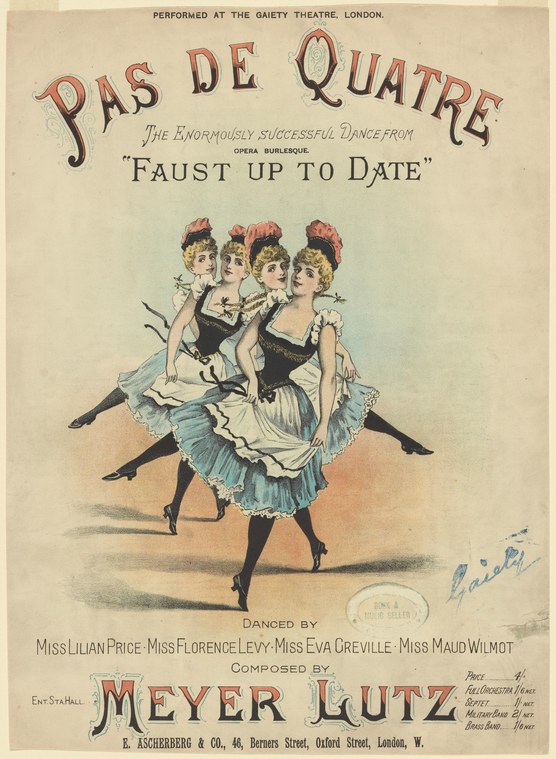
Pas de quatre, the enormously successful dance from opera burlesque Faust up to date; danced by Miss Lilian Price, Miss Florence Levy, Miss Eva Greville, Miss Maud Wilmot; composed by Meyer Lutz
Unknown artist
- Collection:
- Prints depicting dance
- Source:
- New York Public Library
- Rights:
- Public domain — free to use, share and adapt.
- Recorded as:
- Public Domain
This image documents a form of theatrical dance—music-hall comedy and operatic burlesque—that was hugely popular in the 1880s–90s but left little record beyond such commercial prints. It shows how ensemble comedy dance functioned: four named performers, matched costuming, playful high kicks and groupwork rather than classical technique. Understanding this tradition is essential to tracing the genealogy of modern musical theatre, chorus work, and theatrical dance as a form of entertainment rather than 'art'.
What you are looking at
A color lithographic cover for sheet music or theatrical programme, printed in London. Four young women in matching black corsets with white ruffled skirts and petticoats are posed together in a single composed group. They wear their hair up in the fashion of the 1880s–90s, decorated with feathers or ornaments. All four are in mid-movement or posed with raised legs and dynamic posture, suggesting the moment of a vigorous dance step. The setting is abstract—a neutral ground with minimal perspective—and the composition frames them tightly, filling the upper half of the page. The typography below identifies the performers by name and credits Meyer Lutz as composer. The printing is crisp and the color separation clean, with flesh tones, black costume details, and the blue-white of the skirts rendered distinctly.
The dancing
Four dancers occupy the frame in close formation, their bodies angled and overlapping. At least two have raised legs in a high kick or extension; their posture is weightless and lifted, typical of theatrical dance of the period. The frame of the bodies is loose and playful rather than balletic—there is no suggestion of turned-out legs or the formal carriage of classical technique. Their arms are relaxed and gesture naturalistically rather than following a strict line. The group composition emphasizes energy and ensemble play over formal symmetry, with each figure distinct in action and dress.
The dance depicted
This is a dance from the opera burlesque *Faust up to Date*, performed at the Gaiety Theatre in London. The *pas de quatre* is a theatrical ensemble piece, not a classical ballet form in the Romantic tradition. The four dancers named—Lilian Price, Florence Levy, Eva Greville, and Maud Wilmot—were likely principal performers at the Gaiety, which specialized in comic opera and musical theatre. The style visible here is music-hall or theatrical dance: energetic, accessible, and designed for broad entertainment rather than virtuosity. The composition emphasizes the ensemble and their character rather than technical display.
How it was made
This is a color lithograph, a commercial printing technique that allowed rapid, high-quality reproduction of theatrical advertising. The image was drawn on stone and printed separately for each color—flesh, black, blue, and red—then assembled to create the final image. Lithography allowed fine detail in the typography and expressive line work in the figures, and the cost was low enough to permit distribution as a cover, programme insert, or promotional sheet. The technique and finish suggest this was a professional commercial product aimed at advertising the show to London theatregoers.
About this work
This is a colour lithograph advertising a music-hall dance number from the 1880s or 1890s London musical theatre. The *pas de quatre* from *Faust up to Date* represents the comic operetta tradition at the Gaiety Theatre, where spectacular ensemble dances and visual comedy were central to the show's appeal. The image captures four named performers in a moment of energetic, ungoverned play—legs high, bodies relaxed, all in matching costume. This is not classical ballet but theatrical entertainment: the ancestors of modern musical theatre dance and chorus line work.
The work belongs to a moment when theatrical dance was becoming a public spectacle, reproduced and circulated through prints, programmes, and sheet music covers. The named performers and named composer signal that both performers and creative artists were building recognizable public personalities. The lithographic technique allowed the image to reach a wide audience cheaply and quickly, turning a London stage moment into a collectible object.
How to look at it
Notice the energy in the pose: these are not classical ballet positions but athletic, playful extensions. The raised legs, relaxed arms, and close grouping suggest a moment of high-spirited ensemble comedy—the dancers are performing *with* each other, not in formal sequence. The matching costumes and the careful composition of the four figures filling the frame suggest this moment was iconic to the number, worth reproducing on the cover. The lithographic line work in the faces and the clean color separation of the printed image are both worth examining—they show a high standard of commercial theatrical printing. The typography and layout, with the four names prominently displayed, emphasize that these were known performers, not anonymous chorus members.
The artist
The artist is not identified on the print. The image is a commercial theatre advertisement produced by E. Ascherberg & Co., a London music publisher and printer based at 46 Berners Street, Oxford Street. Meyer Lutz (1822–1910) was a German-born composer who became the principal composer for the Gaiety Theatre from 1868 onwards and was instrumental in developing the English comic opera and musical theatre idiom. The print was professionally executed, likely by an in-house theatrical artist or a specialist in this genre.
The period
The 1880s–90s were the golden age of London musical theatre, especially the Gaiety Theatre under the management of John Hollingshead and later George Edwardes. Comic opera and operatic burlesque were the dominant theatrical forms, blending spoken comedy, spectacle, topical satire, and music. The Gaiety's formula—young, attractive performers in spectacular ensembles, light comedy plots, and contemporary settings—created a new form of entertainment that drew middle-class audiences. *Faust up to Date* is one of many burlesques that updated classical or literary material for comic effect. The theatrical dance of this period was becoming more athletic and comedic, incorporating high kicks and ensemble effects drawn from music hall and café-concert traditions. Lithography had become the standard medium for theatrical publicity, creating a visual archive of performers and productions.
Where it lives
This print comes from the NYPL collection *Prints depicting dance*. It is a commercial theatrical advertisement, one of thousands produced by London music publishers and printers in the late 19th century. Such prints were distributed as covers for sheet music, inserted in programmes, or posted as advertisements, making them common, affordable, and widely circulated.
Dance in this work
Questions about this work
What is an opera burlesque?
Opera burlesque was a form of musical comedy popular in London from the 1870s onwards, typically at the Gaiety Theatre. It took well-known operas, classical tales, or contemporary events and retold them with comic dialogue, new music, topical jokes, and spectacular scenery and costumes. The form was aimed at mixed audiences and combined elements of opera, pantomime, and music hall. *Faust up to Date* is a burlesque of Gounod's opera *Faust*, resetting it in modern London for comedic effect.
Who were these performers?
The four dancers—Lilian Price, Florence Levy, Eva Greville, and Maud Wilmot—were principal performers at the Gaiety Theatre, which was famous for its attractive female ensemble. Information about individual performers is often scarce, but they would have been known to London audiences of the time and their names on the print helped sell the show and the sheet music.
What does a pas de quatre mean?
A pas de quatre is a dance for four performers. The term comes from French classical ballet, where it refers to a specific formalized sequence. In theatrical music hall and operetta, a pas de quatre was simply a four-person dance number, here clearly comedic and energetic rather than classical. This one was by composer Meyer Lutz, who wrote most of the music for Gaiety productions.
How do we know when this was printed?
The catalogue record does not supply a date, but the style of costume, hair, and printing, plus the reference to the Gaiety Theatre's repertory, places it in the 1880s or 1890s. *Faust up to Date* was performed at the Gaiety; a search of Gaiety Theatre records and theatrical databases might establish the specific production date.
More dance artwork





