32 works in this view — arrow keys or swipe to move between them.
Dance in Art
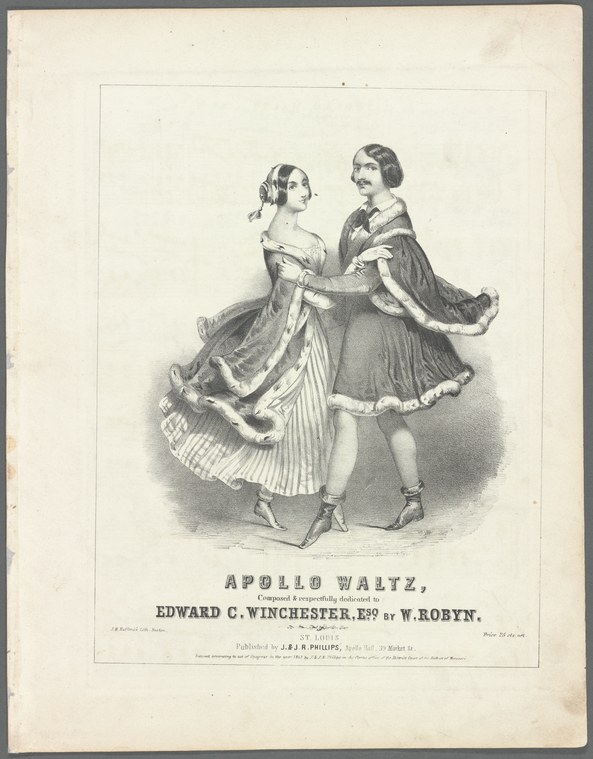
Apollo waltz
Unknown artist
- Medium:
- Lithograph
- Dance:
- Waltz
- Era:
- Early 1800s (Waltz Revolution)
- Source:
- New York Public Library
- Rights:
- Public domain — free to use, share and adapt.
- Recorded as:
- public_domain
This work shows the waltz at a precise moment in its social history—after its initial scandal and during its rapid adoption by the respectable middle class. The image documents not just the dance movement but the apparatus of dance pedagogy and circulation in the 19th century: lithographs like this taught people what the waltz looked like, what to wear, and how to behave when dancing it. For historians of social dance and costume, it is evidence of how ballroom fashion and dance technique were intertwined and mutually reinforcing.
What you are looking at
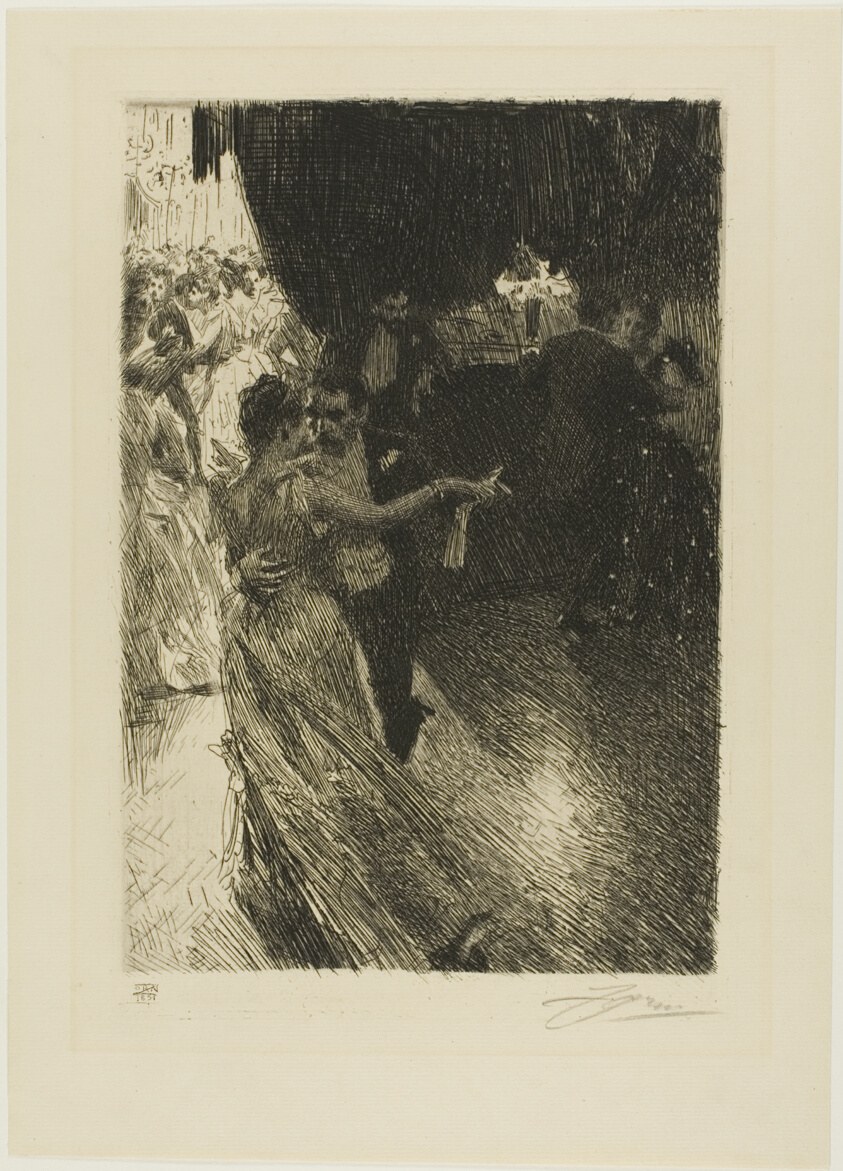
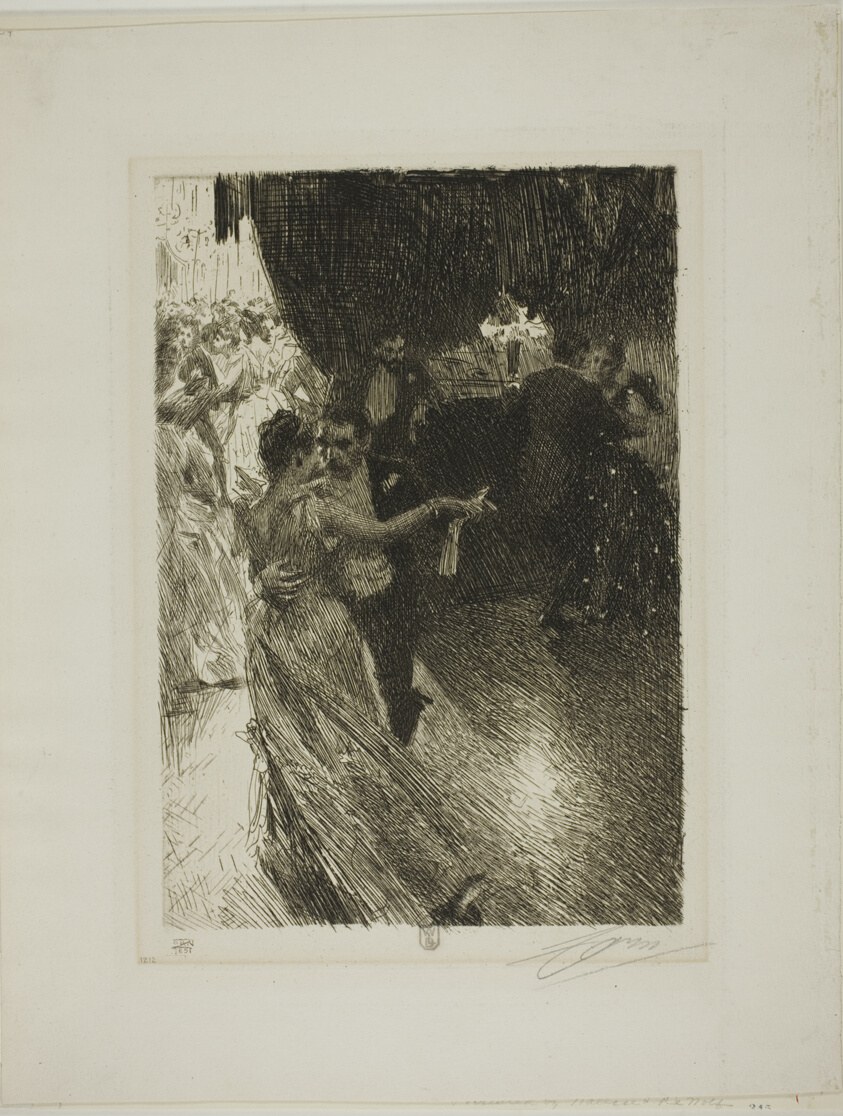
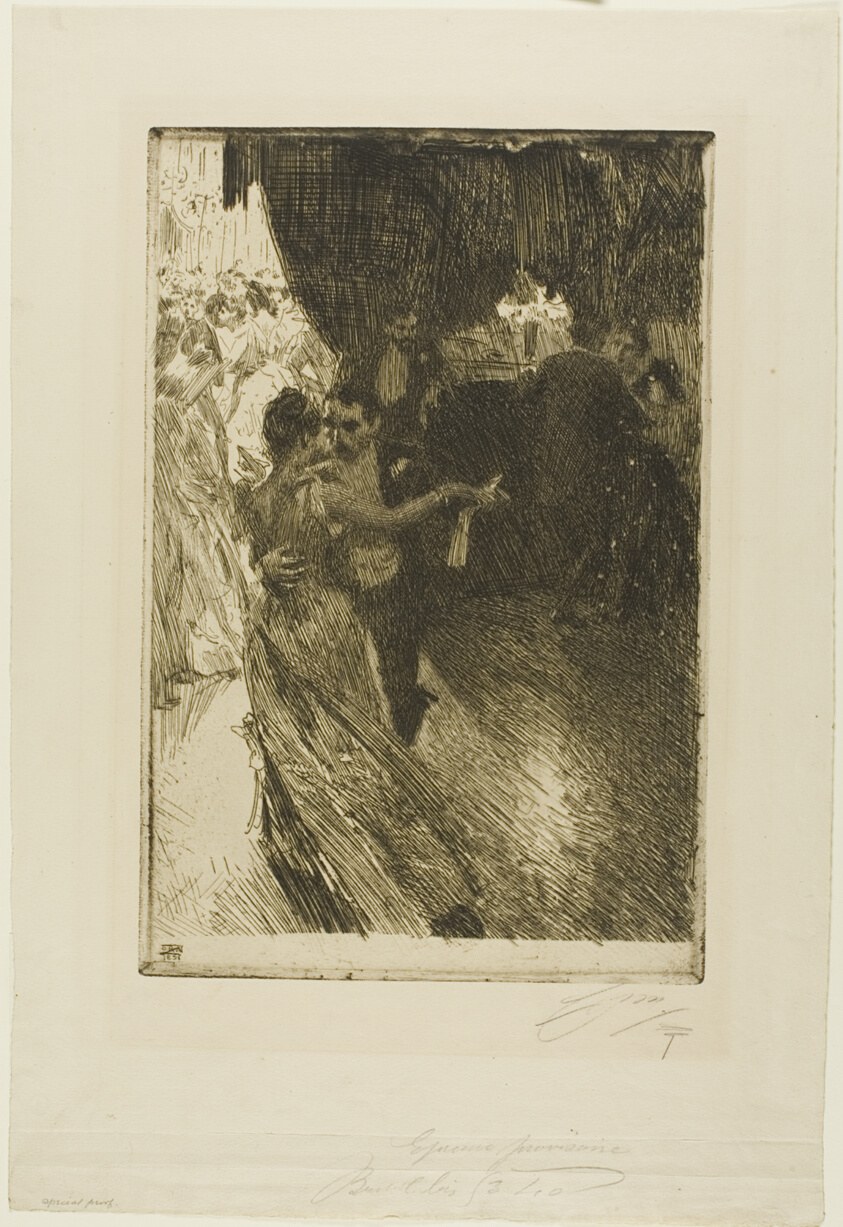
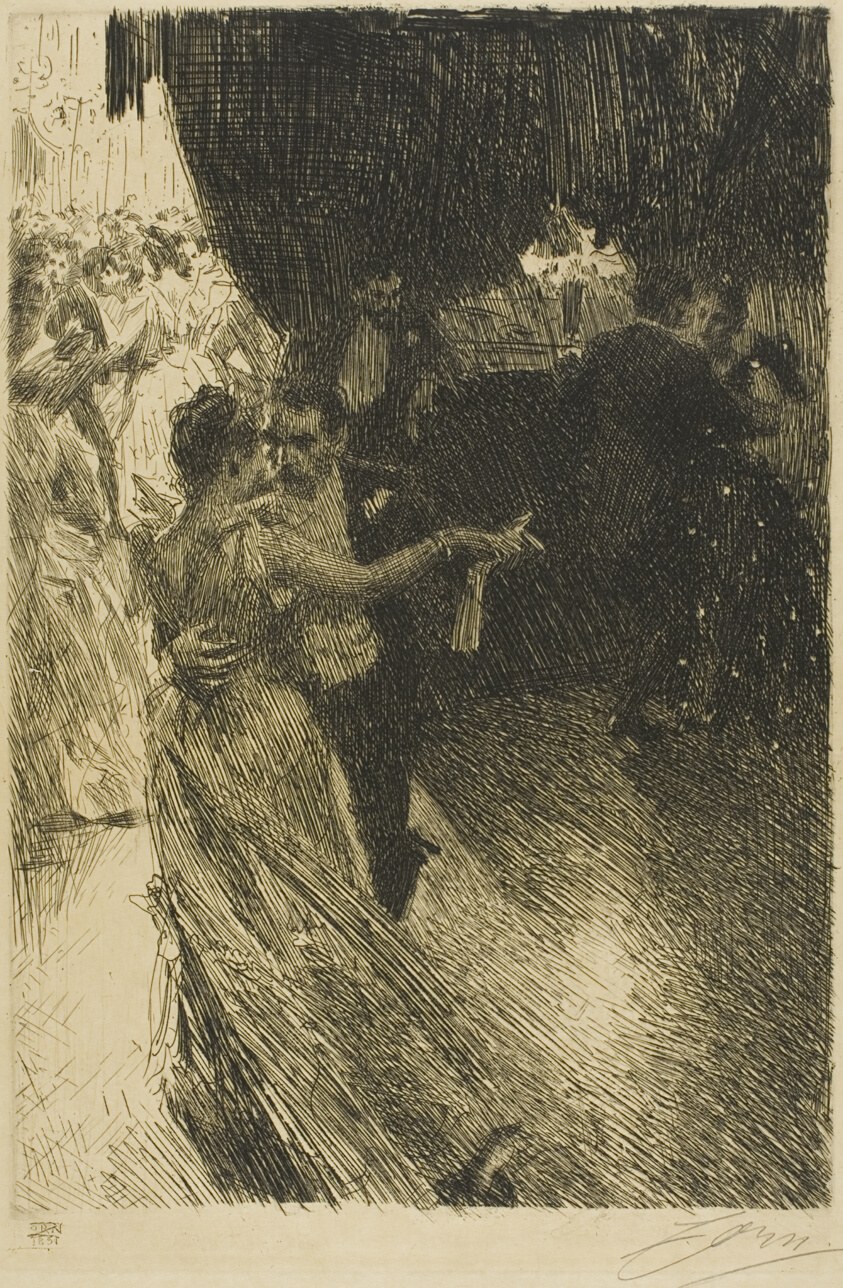
Two female dancers are shown in a moment of social interaction during a waltz. Both wear the voluminous skirts and off-shoulder necklines typical of 1840s ballroom fashion. The dancer on the left, shown in profile facing right, wears a light-colored dress with a fitted bodice and an enormous skirt with deep pleats or accordion folds that extend to the floor; her hair is styled close to her head with ringlets. The dancer on the right, facing left, wears a darker dress with similar silhouette and a shawl or wrap draped across her shoulders. Their bodies are positioned close together in a moment of social greeting or conversation rather than active dance movement—the left figure's arm reaches toward the right figure's arm, suggesting a gesture of greeting, acknowledgment, or partnership. The composition is set against a plain background with soft shading that emphasizes the figures without distraction. The lithographic medium renders the scene with fine detail in the fabric textures and a quality of refined social documentation rather than theatrical spectacle.
The dancing
Both dancers stand upright with relaxed, social posture rather than the rigid frame of formal ballroom technique. The figure on the left extends her right arm gently toward her partner, while her left arm hangs at her side; the figure on the right mirrors this with her left arm extended and right arm relaxed. Their bodies are turned slightly toward each other in a moment of acknowledgment or invitation rather than mid-dance. The positioning and gesture suggest the social choreography of the waltz—the moment of approach, invitation, or transition between movements—rather than the actual turning and propulsion of the dance itself. Neither dancer shows the dynamic weight shift or leg extension that would characterize active waltz movement.
The dance depicted
This is a waltz, as stated in the title and catalogue. The *Apollo Waltz* was a named waltz published in the early 19th century and this lithograph appears to be promotional or illustrative material. The image captures not the peak action of the dance—the turn and spin—but the social moment of greeting or partnership formation that framed the actual dance. This was common in dance prints of the 1840s, which documented the waltz's social role as much as its physical technique. The waltz had been controversial and exciting for only 20–30 years at the time this image was made, and prints like this helped circulate knowledge of the dance to readers who might never see it performed.
How it was made
This is a lithograph, a planographic printing process in which the image is drawn on stone and printed from the surface without carving. The technique allowed fine gradations of tone and detail, visible here in the soft modeling of the figures' faces, the careful rendering of fabric texture, and the subtle shading of the background. Lithography was relatively economical and could produce many copies from a single stone, making it ideal for distributing dance instruction and fashion information to the growing middle-class ballroom audience. The credit line indicates publication by J. & D. B. Phillips of London, a music and print publisher, suggesting this was sold as sheet music cover art or as a separate dance instruction print.
About this work
This is a promotional lithograph for a named waltz composition, likely from the 1840s, showing two women in the moment of social greeting that preceded or punctuated the actual dance. The waltz itself was still new and fashionable in Britain at this time—it had arrived from continental Europe only decades earlier and remained the subject of moral debate and intense social interest. By illustrating not the dramatic turn of the waltz but the courteous moment of partnership and approach, the print documents how the waltz functioned in ballroom society: not as unbroken spinning, but as a sequence of social and physical exchanges.
The image belongs in a dance gallery because it shows how a dance was circulated and consumed in the 19th century—not through video or notation, but through prints, published music, and fashion illustration. The dress worn by these dancers would have been instantly recognizable to any ballroom attendee, and the print's circulation would have both documented and reinforced the aesthetic and social conventions of waltz dancing.
How to look at it
Look first at the bodies: these dancers are not in motion but in transition—approaching each other, establishing contact, inviting partnership. The artist has chosen to freeze the social moment rather than the physical climax of the dance. This reflects the structure of the waltz in performance: much of the experience was the approach, the greeting, the negotiation of who would dance with whom. The careful rendering of the fabrics—the pleated skirts, the draped shawl—shows that the visual spectacle of the dance was inseparable from fashion; watching a waltz meant watching expensive textiles in motion. The lithographic technique allows fine detail and soft tone, creating an image that feels intimate and accessible rather than grand or theatrical.
The artist
The artist is not recorded. The work was composed and published by Edward C. Winchester, credited as the composer of the waltz, with music engraving or printing by W. Robyn. The print was published by J. & D. B. Phillips of London, a commercial music and art publisher. This distribution model—music composer credited on the title, artist uncredited—was typical of 19th-century dance prints, which were often anonymous works produced for commercial circulation rather than as named artworks.
The period
The waltz reached Britain and North America in the 1810s and 1820s and sparked intense debate about its propriety: its close hold, the speed of rotation, and the intimacy between partners challenged older ballroom conventions. By the 1840s, when this print was made, the waltz had become established and fashionable, but it was still recent enough to warrant illustrated documentation and named compositions. The ballroom was a central site of social life for the middle class, and prints, music, and fashion plates documenting ballroom dances were produced in enormous quantities. The voluminous skirts shown here reflect the silhouette of the 1840s-1850s, before the emergence of the crinoline.
Where it lives
This lithograph is held by the New York Public Library. It appears to be a published print, likely sold separately or as cover art for the piano score of the *Apollo Waltz* composition by Edward C. Winchester. The publisher's mark indicates professional distribution through the London print trade.
Dance in this work
Questions about this work
Why does the print show the dancers not moving?
The artist has chosen to depict the social moment of the waltz—the greeting and partnership formation—rather than the actual turning. This was typical of dance prints from this period, which were as much about social behavior and fashion as about the dance technique itself. The moment of approach and acknowledgment was as significant to the ballroom experience as the spin and turn.
What do the skirts tell us?
The enormous pleated skirts are typical of 1840s fashion and show how dramatically ballroom costume changed during the waltz era. The abundant fabric and deep pleats would have created a spectacular visual effect during the spinning of the waltz, and the skirt itself becomes part of the choreography. Fashion prints and dance prints of this era are often indistinguishable because the two were inseparable.
Was the waltz really controversial?
Yes. When it arrived in Europe and Britain from the German-speaking regions in the early 1800s, the waltz's close hold and speed shocked many observers who saw it as improper intimacy. By the 1840s, it had become respectable and fashionable, but prints like this still served to instruct people in proper waltz behavior and appearance. Named waltzes were composed by the hundreds, and prints like this helped circulate knowledge of the dance.
More Waltz artwork