49 works in this view — arrow keys or swipe to move between them.
Dance in Art
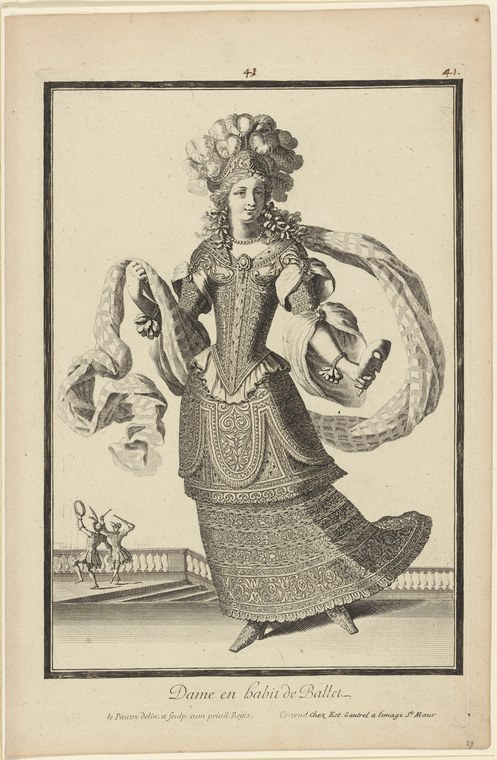
Dame en habit de ballet: Le Pautre delin. et sculp. cum privil. regis
Unknown artist
- Collection:
- Prints depicting dance
- Source:
- New York Public Library
- Rights:
- Public domain — free to use, share and adapt.
- Recorded as:
- Public Domain
This print documents the costume vocabulary of early professional ballet at a moment when dance was transitioning from court spectacle to theatrical performance. For historians of dance and dress, it is primary evidence of how the female dancer's body was framed, decorated, and displayed—a record of what was considered beautiful and appropriate in baroque theatrical practice.
What you are looking at
A single female dancer occupies the center of the composition, posed in formal theatrical dress against a plain background with a distant colonnade visible at lower left. She wears an elaborate corseted bodice with vertical ribbing, a voluminous skirt with decorative hem, and an ornate headdress crowned with feathers and curls. Her arms are raised and spread wide, holding gossamer drapery or scarves that billow outward on both sides of her body in a sweeping arc. Her pose is frontal and symmetrical, with her weight settled and her body upright rather than in motion—this is a presentation pose rather than a captured moment of movement. The engraving is finely detailed, with careful cross-hatching to suggest fabric texture and volume.
The dancing
A single dancer stands in a formal, open position with both arms lifted at shoulder height, palms facing outward or slightly forward, holding the flowing drapery that frames her silhouette. The torso is vertical and composed; there is no suggestion of weight transfer, turnout, or balletic line. The pose is ceremonial and static rather than dynamic, emphasizing display and presentation. The drapery extends the visual line of the arms dramatically, creating a broad horizontal emphasis across the composition.
The dance depicted
This is a theatrical dance costume study rather than a document of movement in action. The title *Dame en habit de ballet* (Woman in ballet dress) identifies the subject as a female ballet dancer of the 17th or early 18th century, and the formal presentation suggests this is a costume plate—either a record of an actual stage dress or a model for one. The lack of narrative setting and the frontal, symmetrical pose are typical of printed costume documentation from the baroque period. The drapery and feathered headdress indicate court or professional stage ballet rather than social dance.
How it was made
This is an engraving (intaglio), as confirmed by the fine linear hatching, the crisp contours, and the printing technique. The inscription credits "Le Pautre delin. et sculp." (Le Pautre drew and engraved it), indicating a single artist responsible for both design and engraving. The print shows characteristics of 17th–18th-century fashion documentation: it was likely produced as a single leaf or part of a series of costume studies for circulation among theater practitioners, designers, and educated collectors. The formal presentation and professional execution suggest an official theatrical publication or portfolio rather than a generic broadsheet.
About this work
This is a printed costume study documenting the formal theatrical dress of a professional ballet dancer from the baroque era. The engraving presents a single figure in idealized pose, displaying the elaborate corseted bodice, plumed headdress, and flowing drapery that characterized female stage ballet costume of the period. As a dated theatrical artifact, it records not movement but appearance—the silhouette and materials that defined elite court and professional performance. The work belongs in a dance archive as evidence of how ballet dancers were dressed, presented, and imagined for an educated audience in the age before narrative ballet dominated the stage.
How to look at it
Notice the static, frontal pose: the dancer is not caught mid-movement but presented as an object of display, much as a fashion figure or royal portrait might be. The composition uses symmetry and frontal orientation deliberately—this is not a naturalistic study but an idealized presentation. Pay attention to the drapery: it is rendered with great delicacy and seems to float or drift rather than move with the body's action, suggesting it is meant to enhance and extend the silhouette rather than respond to vigorous motion. The headdress is elaborate and tall, drawing the eye upward; the costume as a whole is designed to be seen from the front at a distance, as it would be from an audience in a theater.
The artist
The attribution to Le Pautre (the name appears in the inscription but the engraver is not otherwise identified in the catalogue record) suggests a French printmaker from the 17th or early 18th century. The family name Le Pautre is associated with several French artists of that era, including Jean Le Pautre, a prolific printmaker and designer. The professional execution and the inclusion of a privilege notice ("cum privil. regis"—with royal privilege) indicate an artist working under official patronage or at least with the permission of the French crown, which was typical of theatrical and courtly printmakers of the period.
The period
This engraving dates to a period when ballet was undergoing major institutional changes in France. Under Louis XIV, the court ballet (*ballet de cour*) had reached its peak in the mid-17th century, and by the late 1600s professional theatrical ballet was beginning to emerge as a distinct form. Female dancers were becoming more prominent in professional performance, and new costume and technique were developing to showcase them. The formal dress shown here—with its rigidity, ornamentation, and theatrical silhouette—reflects the aesthetic priorities of court and early professional ballet: elegance, hierarchy, display, and the subordination of movement to visual spectacle. Printed costume documentation of this kind proliferated in the 17th and 18th centuries as a means of recording and circulating the visual standards of elite performance.
Where it lives
This work is held in the New York Public Library's collection of prints depicting dance. It is catalogued as a historical print and costume study, likely part of a portfolio or series of theatrical costume documentation.
Dance in this work
Questions about this work
Is this a drawing of an actual performance?
No. This is a costume study or design print, not a document of a specific performance or moment of movement. It shows how a dancer would be dressed and how the costume would appear when worn, but it does not depict the dancer in action. The static, symmetrical pose is conventional for costume documentation and allows the viewer to see the full silhouette and detail of the dress.
What does the French title mean?
*Dame en habit de ballet* means "Woman in ballet dress" or "Woman in ballet costume." The word *habit* refers to the formal dress or costume itself, not to a habit or custom. This is a technical title for a costume plate.
Who was Le Pautre?
The catalogue record does not identify which member of the Le Pautre family created this print. The name was borne by several French printmakers and designers working in the 17th and 18th centuries. The inclusion of the royal privilege notice suggests the artist worked under official patronage or with permission from the French crown.
When was this printed?
The catalogue record does not provide a date. Based on the style of the engraving, the fashion of the dress, and the costume conventions depicted, this is likely from the late 17th or early 18th century, during the height of baroque theatrical ballet in France.
More dance artwork





