49 works in this view — arrow keys or swipe to move between them.
Dance in Art · 2019
The dancing lesson
Unknown artist
- Medium:
- Source:
- New York Public Library
- Rights:
- Public domain — free to use, share and adapt.
- Recorded as:
- public_domain
Dance histories often skip over teaching, moving from documented dances to the next documented dances. This print is rare evidence of the actual pedagogical moment and the gestural language used to transmit technique. For anyone studying 18th-century court dance, deportment, or the social role of dancing masters, this image provides visual documentation of what instruction looked like and how bodies were corrected and shaped.
What you are looking at
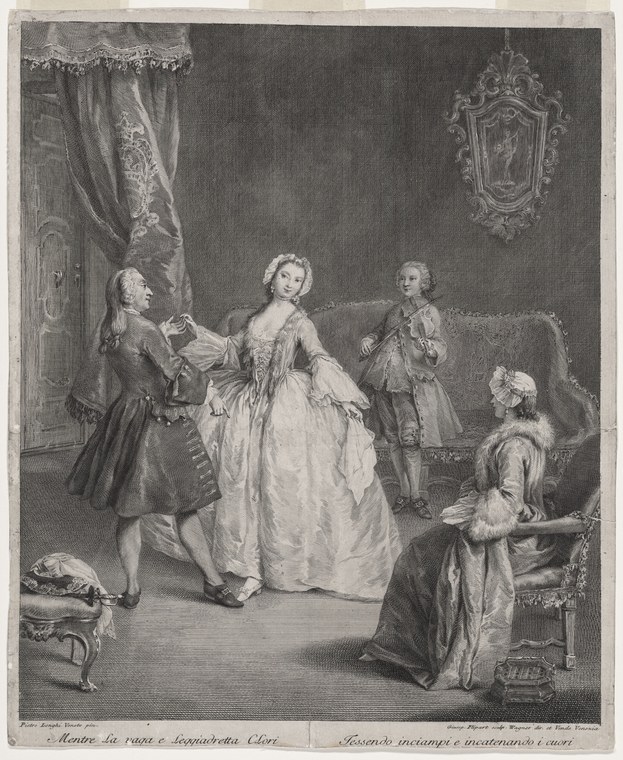
An 18th-century interior scene depicting a dancing lesson. A young woman in an elegant white gown stands at the center, her body angled in a poised position. To her left, a man in richly embroidered coat and breeches gestures toward her with his hand, apparently instructing or correcting her form. Another male figure stands to the right of the woman, also watching or participating. A young pupil, possibly a boy or younger girl, kneels or sits at the right of the composition, attentively observing the lesson. The setting is a grand room with draped curtains at the left, elegant furniture including what appears to be a sofa, and decorative wall ornaments typical of the period. The lighting is soft and even, suggesting an interior by daylight. A small dog rests in the lower left foreground, adding a note of domestic intimacy to the formal scene.
The dancing
The central woman holds an upright posture with her body facing right, her arms positioned in a manner suggesting instruction in arm carriage and frame. The male instructor at left uses an extended arm gesture—pedagogical rather than danced—pointing or guiding her position. The standing man to the right appears to maintain a formal stance, possibly demonstrating or awaiting his turn. The seated pupil's lowered position creates a clear hierarchy: master, dancing pupil, observer. None of the figures are in an active turned-out stance or mid-movement; instead, they are arranged to show posture, deportment, and the teaching moment itself.
The dance depicted
This is an 18th-century dance lesson scene, almost certainly depicting the teaching of court dances of the historic-baroque or historic-regency period. The woman's upright carriage, the formal gestures, and the pedagogical arrangement—with an instructor correcting or demonstrating positions—are consistent with the teaching of minuets, cotillion, or English country dances as practiced in aristocratic households of the 1700s. The scene captures not the performance of the dance but the instruction in its technique and deportment. The presence of a dedicated pupil, the formal dress, and the interior setting confirm this is elite dancing instruction rather than social dancing.
How it was made
This is a print—almost certainly an engraving or etching based on the tonal qualities, the fine linear hatching visible in the shadows and fabrics, and the monochromatic rendering. The technique allows for precise rendering of fabrics, the play of light across the draped curtain and the woman's gown, and fine detail in facial expression and gesture. The quality and finish suggest this is a finished plate, likely made for circulation among the educated classes. Engravings of this type were widely distributed in the 18th century as both artistic objects and as illustrated documentation of contemporary manners and instruction.
About this work
This print documents the pedagogy of 18th-century court dancing, a crucial but often invisible aspect of dance history. Rather than depicting a performance or a social dance event, it shows the interior work of teaching: the correction of posture, the demonstration of arm position, the attention to frame and carriage that distinguished aristocratic dancing from other movement. The scene is intimate in scale but formal in arrangement, reflecting the status of dance instruction as an essential accomplishment in elite education. This work sits at the intersection of dance history, art history, and the history of instruction and manners—it is evidence of how dance was transmitted, valued, and understood in its period.
How to look at it
The artist has chosen not a moment of dancing but a moment of instruction and correction—the freeze-frame is pedagogical rather than performative. Notice the instructor's extended arm: it is not danced but didactic, used to point, guide, or demonstrate. The woman's stillness is poised rather than arrested mid-motion. The seated pupil's gaze anchors the scene as a teaching scenario. The interior setting—curtains, furniture, the dog—normalizes dancing as part of domestic elite life, not a theatrical event. The Italian captions suggest this may be from a series documenting social customs.
The period
The 18th century saw the codification and standardization of court dances—minuets, cotillions, quadrilles—and a corresponding rise in professional dance masters and published instruction manuals. Dancing was central to aristocratic education and courtship ritual. The formal interior, the dress of the figures, and the dignified posture all point to the mid-to-late 18th century, when prints documenting contemporary manners and customs were widely popular. Dance instruction was a profitable profession, and scenes of instruction were common subjects in satirical and documentary prints of the period.
Where it lives
The work is held by the New York Public Library. It is a print of unknown artist, catalogued only as 'The dancing lesson.' The Italian captions below the image suggest it may be part of a larger series on manners and customs, possibly 18th-century Italian.
Dance in this work
Questions about this work
What dance is being taught?
The print does not depict a specific dance in motion. Instead it shows the teaching of court dance technique—the posture, arm carriage, and deportment that underlay minuets, cotillions, and English country dances. The formal dress and interior setting place this in 18th-century aristocratic culture.
Who are these people?
The central woman is the pupil. The man at left is almost certainly a dancing master or teacher, shown using a gesture to instruct or correct her position. The other man and the seated young figure are observers or waiting students. Their identities are not recorded.
Why show a lesson rather than actual dancing?
Prints of this period often documented instruction and manners as much as performance. Showing a lesson emphasizes that dancing was a learned skill requiring expertise, and that dancing masters were professionals of status. It also allows the artist to show the corrective moment and the attention to body position that mattered in technique.
What do the Italian captions say?
The captions are not legible enough in this reproduction to transcribe with certainty, but their presence in Italian suggests the print may be from an Italian series on social customs or may have been circulated in Italy.
More dance artwork