25 works in this view — arrow keys or swipe to move between them.
Dance in Art
Peasant dance
Unknown artist
- Medium:
- Dance:
- Folk/Country
- Source:
- New York Public Library
- Rights:
- Public domain — free to use, share and adapt.
- Recorded as:
- public_domain
Folk and country dances are documented far less often than court dances in historical art, making this image a rare visual record of how rural Europeans actually moved. The woman's posture and energy show a freedom of movement that contrasts sharply with the formal holds and positions of contemporary ballroom dance, revealing the different values of different social worlds.
What you are looking at
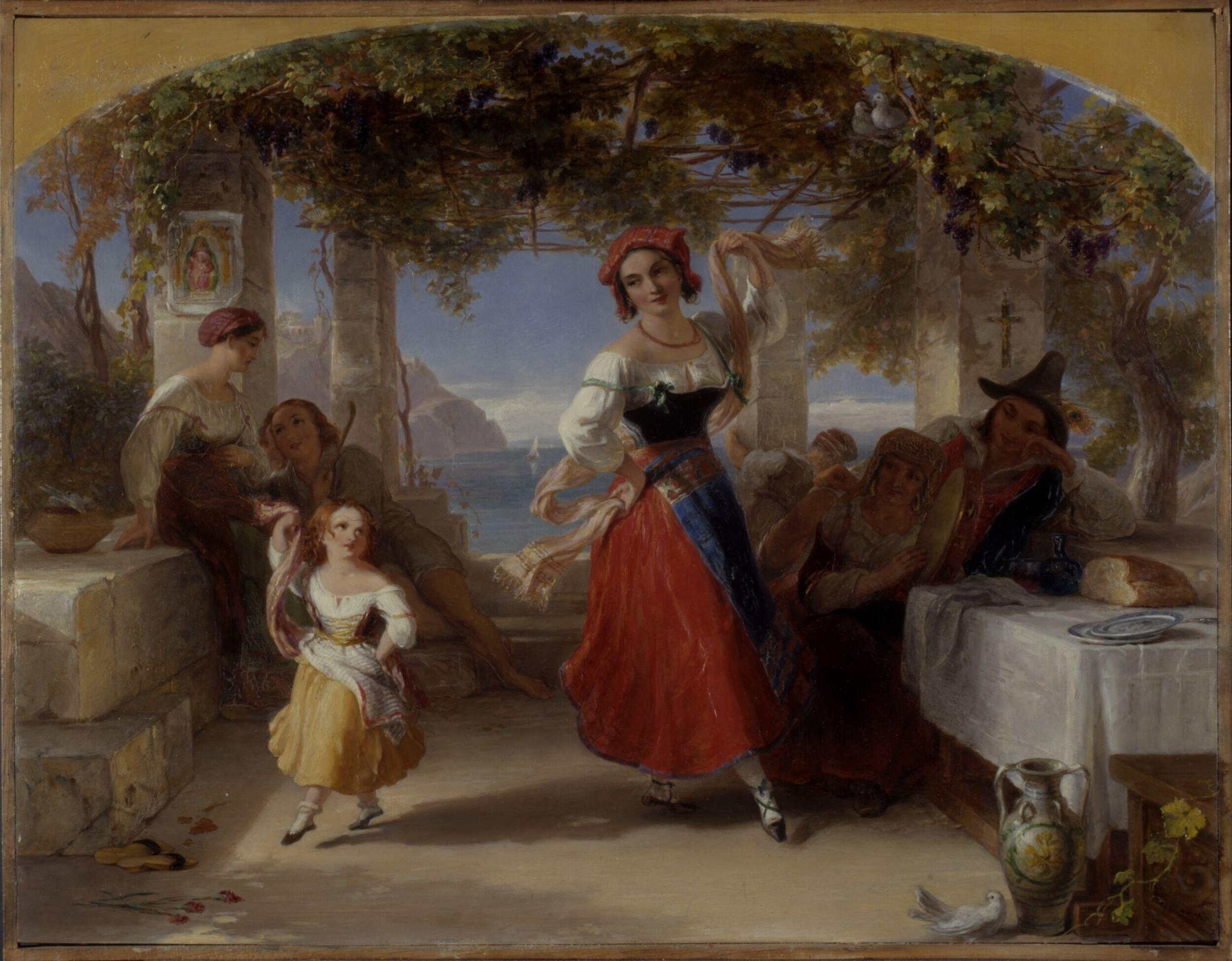
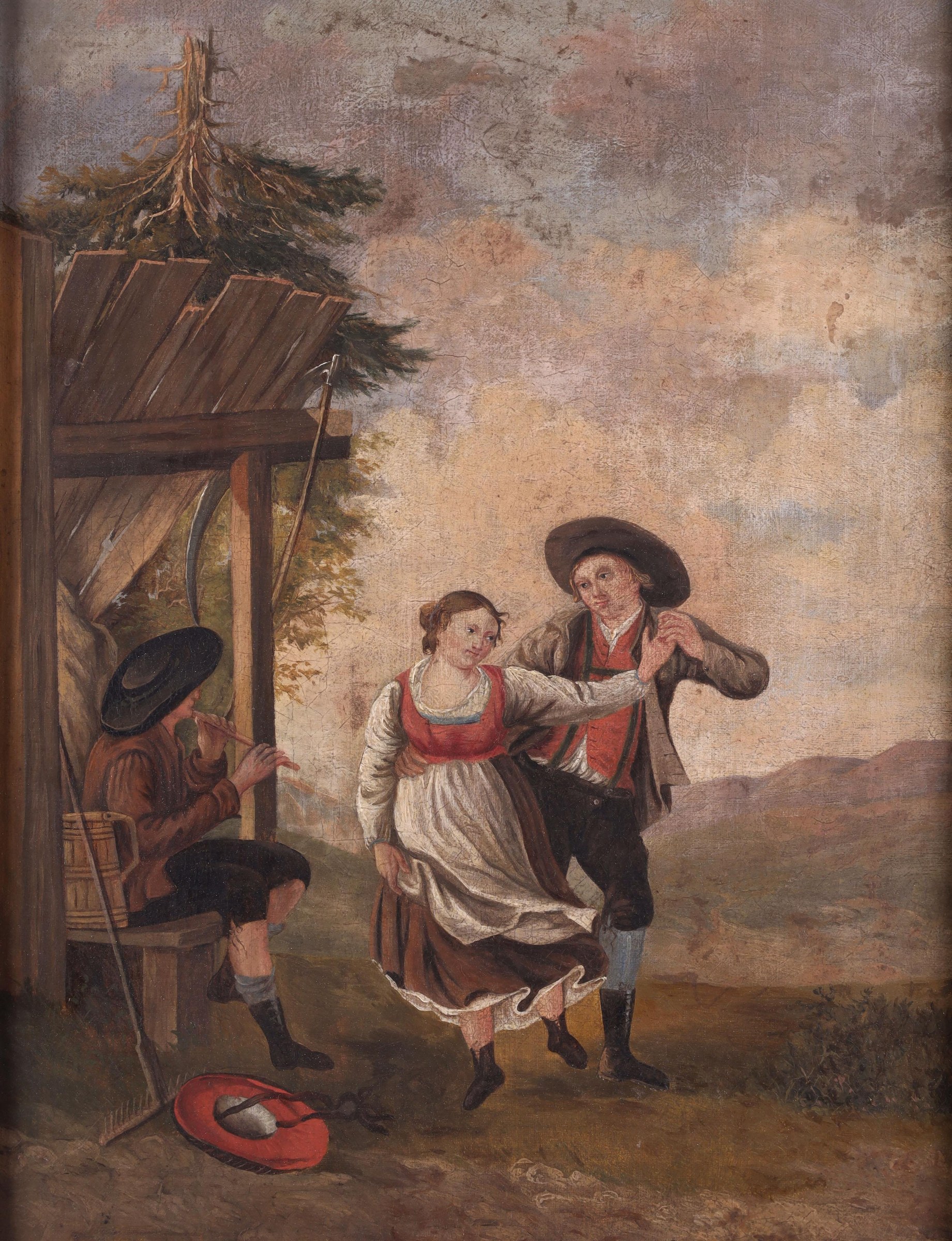
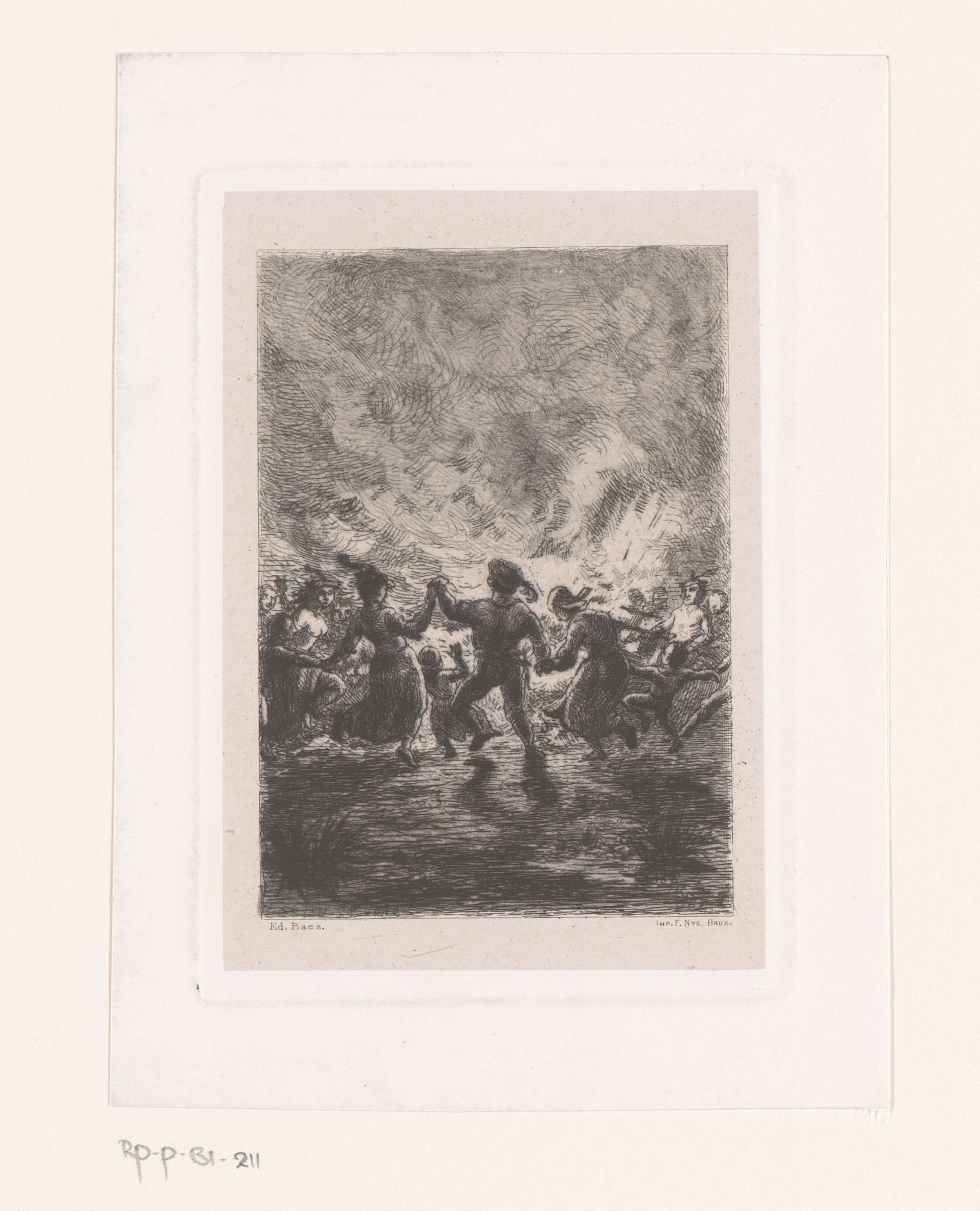
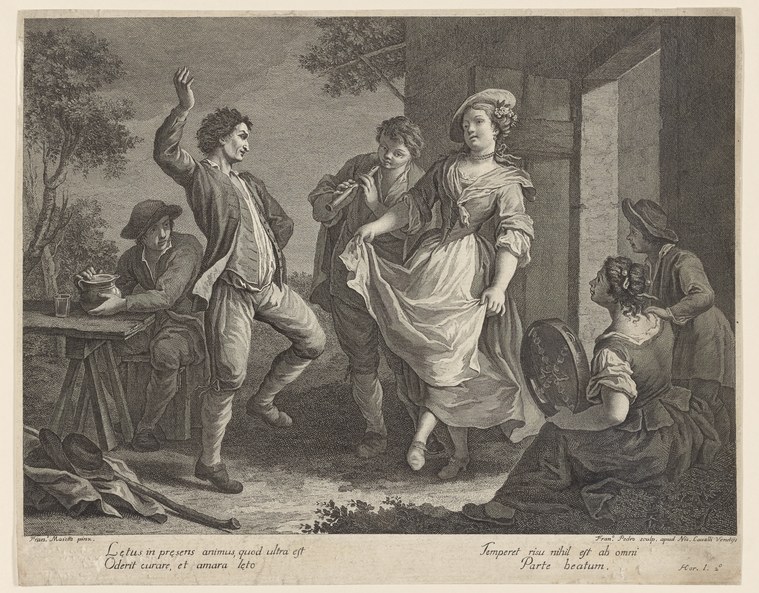
A lively peasant gathering unfolds in a rustic setting, with a stone structure and trees visible to the left. In the center, a woman in a white chemise and dark bodice dances with animated energy, one arm raised high, her body captured mid-movement. She wears a white cap typical of folk dress. Around her stand five other figures: two men in breeches and coats, one seated at a table on the left (possibly playing music or recording the scene), and others in various postures of observation or participation. The composition suggests a tavern or village square scene—a moment of social celebration. The engraving's fine cross-hatching creates depth and atmosphere, with careful attention to the textures of fabric, the musculature of limbs, and the play of light across the figures.
The dancing
The central dancer displays the energy of folk movement: her raised arm is high and loose, her torso twists, and her weight appears shifted in a dynamic step. The figures around her are not in formal ballroom hold but rather in the casual proximity of village celebration. The men in attendance wear working clothes rather than court dress. The positioning of the other figures—some standing, one seated—suggests this is a moment of communal dance rather than partnered social dancing in the ballroom sense.
The dance depicted
This depicts a peasant or country dance, the social form of movement that sustained rural European communities. The woman's posture—the high arm, the twist of the torso, the apparent lifting of the skirt—is consistent with folk choreography of the 17th or 18th century, where individual expressiveness and the celebration of the body were central. The presence of onlookers and the informal grouping suggest a village or tavern context. The inscription (in Latin) appears to reference the scene's social character, though it is difficult to read fully in reproduction. This is not courtly dance but its vernacular opposite: the movement of working people at leisure.
How it was made
This is an engraving, identifiable by its linear hatching and the precision of its line work. The technique allowed for fine detail in the rendering of fabric, musculature, and facial expression, and the image's circulation as a print suggests it was made for a broad audience—likely as part of a series documenting manners, customs, or social types. The engraving's formal composition and careful observation suggest it was created by a skilled printmaker, though the attribution is not recorded. The print medium and the care of its execution imply this was a work of some significance, not a casual sketch.
About this work
This engraving captures a moment of folk celebration in the 17th or 18th century, showing a peasant woman dancing with unselfconscious energy while her community looks on. It is a record of how ordinary people danced—without the formality of court manuals or the restraint of ballroom convention. The woman's body tells us what rural people valued in movement: lift, twist, freedom of the limbs, and the visible expression of joy. For dance historians, this image is precious because folk dance is so rarely documented in historical sources; most surviving images of dance from this period show courtly or theatrical forms. This engraving is a glimpse into the movement culture of people who left few written records.
How to look at it
Watch the central dancer's arm and torso. Her raised arm and the twist of her body capture a moment of exuberant movement that has no parallel in the formal dances of the ballroom. Notice, too, the casual grouping of the other figures—this is not a partnered dance in the modern sense, but rather a moment of individual expression within a communal setting. The engraver has frozen the instant of greatest energy, when the dancer's movement is most visible and most alive.
The period
This engraving dates to an era when folk culture was beginning to attract the attention of educated observers and artists—a moment when peasant life became a subject of curiosity and documentation. By the 17th and 18th centuries, as courtly and ballroom dance were becoming increasingly codified in manuals and instruction books, folk dance remained largely unwritten, passed on through practice and memory. This engraving may be part of a broader project of documenting rural customs and manners, a genre that grew in popularity as urban and court culture became more distant from village life.
Where it lives
The work is held in the New York Public Library collection and is catalogued as a print of unknown artist and date. It appears to be part of a series or collection documenting social customs and folk life.
Dance in this work
Questions about this work
How do we know this is a peasant dance and not a court dance?
The setting, costume, and grouping tell us this is vernacular dance. There is no formal ballroom, no musicians in court dress, no arranged couples in the rigid holds of ballroom protocol. The woman dances alone, watched by her community in what appears to be a tavern or village square. Her clothes are working dress, not finery. Most tellingly, her movement—loose-limbed, unrestrained, focused on the individual expression of joy—is the opposite of the controlled, partnered forms that court dance required.
Why is this image so valuable to dance historians?
Folk and country dances were almost never documented in visual art during this period. Most surviving images show court dances, theater, or ballroom forms—the dances of the educated and powerful. This engraving is one of the rare glimpses we have of how ordinary people danced. It shows us not just the step but the spirit of the movement: the energy, the joy, and the freedom of the body that mattered to rural communities.
What does the woman's arm position tell us about the dance?
The raised arm, held loosely and high, is characteristic of folk movement. It shows a freedom that would have been unthinkable in ballroom dance, where arms and hands were held in prescribed positions. The lift and the extension suggest movement that valued the whole body's expression, not just the feet or the line of the body as a formal unit.
More Folk/Country artwork