33 works in this view — arrow keys or swipe to move between them.
Dance in Art
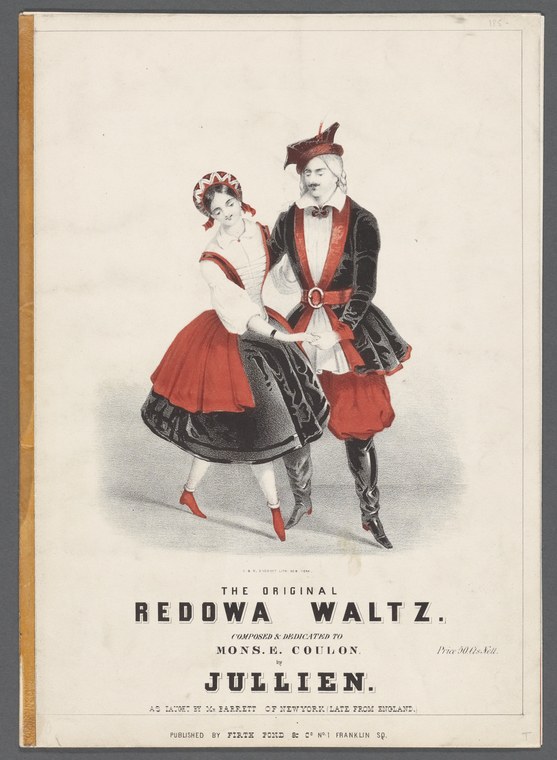
The original Redowa waltz ... by Jullien
Unknown artist
- Medium:
- Lithograph
- Dance:
- Waltz
- Era:
- Early 1800s (Waltz Revolution)
- Source:
- New York Public Library
- Rights:
- Public domain — free to use, share and adapt.
- Recorded as:
- public_domain
The redowa appears in dance history primarily through step notations and music; this image is rare evidence of how the dance actually looked in performance, showing the posture, frame, and dress conventions that shaped its execution. For students of ballroom dance history, costume history, and nineteenth-century social practice, this is a documentary image of high specificity—one of the few surviving visual records of a dance that was briefly ubiquitous and then forgotten.
What you are looking at
A lithographed promotional image showing a couple in fashionable 1840s dress performing the redowa waltz. The man, on the right, wears a dark jacket with red velvet facings, a red waistcoat with ornate buckle, and red-trimmed trousers with black boots; he sports a feathered hat and addresses the woman with a formal, upright bearing. The woman, on the left, wears a red skirt with black underskirt, a white bodice with red trim, and a decorative red headpiece with feathers; her posture is elegant and her weight appears shifted in mid-rotation. The two are captured in the characteristic closed-position embrace of the waltz, with the man's right arm at her waist and her left hand resting on his shoulder. The lithograph is printed in a limited color palette—red, black, and flesh tones on cream paper—and the figures are shown against a plain background, allowing full focus on the dancers and their costume detail.
The dancing
The couple stands in the standard waltz closed position: the man's right hand supports the woman's waist while his left arm extends to hold her right hand; her left arm rests on his right shoulder. Both figures are upright and formal, with the woman's body angled slightly away from her partner in the characteristic waltz frame of the period. The woman's skirt is caught in a swirl, suggesting mid-turn motion, while both dancers' postures are graceful and controlled. The man's slightly forward-leaning stance and the woman's perpendicular alignment to his body indicates the rotational momentum typical of the waltz.
The dance depicted
This is explicitly identified in the caption as 'the original Redowa waltz... by Jullien,' a popular ballroom dance of the 1840s-1860s. The redowa was a variant of the waltz that originated in Bohemia and became fashionable across Europe and America. It differed from the Viennese waltz in tempo, step pattern, and some sources indicate a slight hesitation or hop in the action. The image shows the redowa in its social ballroom context, performed by elegantly dressed partners in the formal closed hold standard to the period. The lithograph appears to be a promotional or instructional image—likely distributed with Jullien's published music for the dance—documenting how the redowa was actually performed by fashionable dancers of the era.
How it was made
This is a hand-colored lithograph, a reproductive technique that allowed rapid printing and wide circulation of popular dance imagery and music-hall publicity. The artist worked from a stone surface, drawing the figures in a fine linear style and leaving the background plain to focus attention on the dancers' posture and costume. The limited palette—applied by hand to selected printed impressions—suggests this was promotional material for the middle-class ballroom market, where colored prints advertised both the music composer and the fashionable dances of the moment. The technique's speed and affordability made such images a standard accompaniment to published dance music throughout the nineteenth century.
About this work
This lithograph documents the redowa waltz as danced in the 1840s-1850s, capturing not only the formal posture and closed-position frame standard to ballroom dancing of the period but also the specific fashions that accompanied the dance. The image is a primary document of social dance practice: it shows how the redowa differed visually from the Viennese waltz, records the exact hold and body alignment dancers were taught, and preserves the cut and construction of the costumes in which people danced. The caption credits the dance to Jullien, a prolific composer and impresario of popular dances, indicating this print was part of the commercial apparatus that spread fashionable ballroom dances from urban dance halls to provincial assemblies across the English-speaking world.
How to look at it
Notice the extreme formality of the closed position—the woman is held at a precise distance and angle from her partner, and both dancers are completely upright with no inclination of the torso. The artist has frozen the moment mid-rotation, as evidenced by the swirl of the woman's skirt, capturing the dynamic quality of the turning waltz while maintaining the static geometry of the frame. The level of anatomical detail in the limbs and the precision of the costume rendering indicate the print was made from observation of actual dancers or from a posed model—it is not a schematic diagram but a record of a real performance moment. The prominence given to the male dancer's elaborate costume suggests this was aimed at male dancers learning the role, a common audience for dance prints of the period.
The artist
The print is credited to 'Mons. E. Coulon' as composer/choreographer and published by Jullien, a celebrated French-British composer, conductor, and dance entrepreneur of the 1840s-1860s. Jullien was renowned for composing fashionable ballroom dances and for publishing instructional prints and sheet music that shaped social dancing practice across the English-speaking world. The unnamed lithographer was likely a London print workshop artist working in the commercial tradition of dance publicity.
The period
The 1840s-1850s saw an explosion of new ballroom dances and their rapid dissemination through printed music, step manuals, and promotional imagery. The waltz itself had only recently become respectable in polite society (it was controversial in the 1810s for its closed position and rapid rotation), and by the 1840s, variants like the redowa, polka, and mazurka competed for fashionable status. Publishers and composers like Jullien capitalized on this appetite by releasing new dances with instructional prints, which served simultaneously as advertisements and teaching aids. The redowa's Bohemian origins also reflect the period's romantic interest in folk and national dances, a taste that would intensify across the century.
Where it lives
This lithograph is held by the New York Public Library and is one of thousands of commercial dance prints and music covers in their collections. It represents the genre of promotional and instructional prints that accompanied published dance music in the nineteenth century, distributed to music teachers, dancing masters, and amateur dancers who wanted both the sheet music and visual instruction.
Dance in this work
Questions about this work
What is the redowa?
The redowa is a ballroom dance in triple meter (three-beat waltz time) that originated in Bohemia in the early nineteenth century. It became fashionable across Europe and America in the 1840s-1850s as a variant of the waltz, distinguishable by its tempo, step pattern, and a characteristic hesitation or hop in the motion. It was typically performed in the formal closed position shown here, and like the waltz, it involved continuous turning.
Who was Jullien?
Louis Antoine Jullien (1812–1860) was a French-British composer and impresario celebrated for creating popular ballroom dances and publishing the music and instructional materials that taught them to amateurs. He was one of the most commercially successful dance composers of his era and played a major role in establishing the fashionable dances of the 1840s-1850s.
How does this compare to a Viennese waltz?
The redowa and Viennese waltz both use closed position and continuous rotation in triple time, but the redowa has a slower, more deliberate tempo and includes a hesitation or hop in the footwork that gives it a different rhythmic character. The frame and posture are very similar, which is why both are waltz variants, but the redowa has a more measured, stately quality in performance.
Why is the woman's skirt swirling?
The artist has captured the dancers mid-rotation, so the centrifugal force of the turning waltz causes the woman's skirt to billow outward. This was a visible and essential feature of waltz performance, and it made the dance visually spectacular—the swirling skirts were part of its appeal and were often mentioned in contemporary accounts of ballroom dancing.
More Waltz artwork