34 works in this view — arrow keys or swipe to move between them.
Dance in Art
Specimens of waltzing
Unknown artist
- Medium:
- Lithograph
- Dance:
- Waltz
- Era:
- Early 1800s (Waltz Revolution)
- Source:
- New York Public Library
- Rights:
- Public domain — free to use, share and adapt.
- Recorded as:
- public_domain
This print is direct evidence of how the waltz was actually performed, taught, and consumed by society during the dance's revolutionary emergence. It shows that early waltz performance was not standardized but rather multiple and varied — dancers adopted different attitudes, holds, and expressions — and that satire and instruction were intertwined in how new dances entered popular culture. For historians of dance, fashion, and social history, it captures the moment when the waltz shifted from scandal to fashionable craze.
What you are looking at
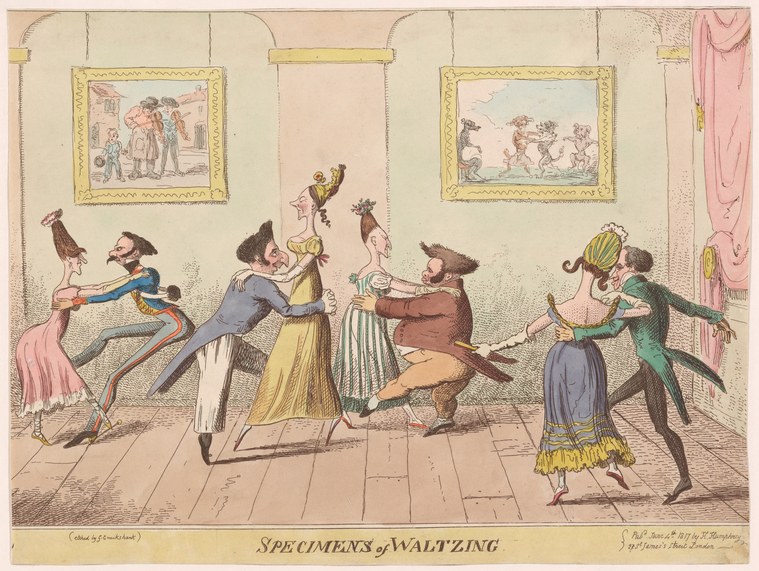
A crowded, energetic ballroom scene rendered in hand-colored lithography. The setting is an elegant interior with classical architectural elements — arched doorways, a dentil cornice, and framed paintings on pale walls. A pink velvet curtain drapes the far right. The floor is wooden, rendered with perspective lines receding into depth. Seven figures occupy the space in various states of motion, dressed in early 19th-century formal attire: men in tailcoats and breeches, women in high-waisted Empire silhouettes with long skirts. The scene captures a moment of deliberate chaos or exuberance: one couple in the center appears locked in a waltz hold, while figures around them gesture and pose in studied attitudes that suggest different 'specimens' or interpretations of the dance. The hand-coloring is delicate but varied, with flesh tones, blue and brown coats, yellow and white gowns, and pink accents throughout. The style is satirical or instructional in intent, with an air of gentle mockery about the fashionable dance craze.
The dancing
The bodies are arranged to display multiple dance positions and attitudes. The central couple shows a closed ballroom hold, with the man's arm around the woman's waist and her arm extended, both bodies in a turning motion. Surrounding figures adopt exaggerated poses: some with arms akimbo, others with legs extended or bent in theatrical attitudes, one figure apparently kicked up or lifted by a partner. The postures and expressions suggest satire — the dancers are performing versions or 'specimens' of waltzing rather than moving in natural flow. Arm positions, head angles, and the studied nature of each pose indicate the figures are modeling dance attitudes for observation rather than inhabiting a genuine dance moment.
The dance depicted
This is a representation of the waltz, the social dance that dominated European ballrooms from the 1810s onward and sparked considerable moral anxiety. The title 'Specimens of Waltzing' indicates the lithograph is presenting multiple versions or interpretations of how the dance might be performed — possibly satirizing the variations, affectations, or novelty of the style. The waltz's defining feature is the closed hold and three-beat rotational motion, both visible here. The print is instructional or satirical, showing how fashionable society danced and how the waltz might be comically exaggerated. The theatrical poses of surrounding figures suggest the artist is commenting on the waltz's theatrical nature or the variety of ways dancers attempted to master it.
How it was made
This is a hand-colored lithograph, a technique that allowed rapid, affordable reproduction and wide circulation in the early 19th century. Lithography's fluidity of line and capacity for narrative detail made it ideal for satirical and social commentary imagery. The delicate hand-coloring in pastels — pale yellows, blues, pinks, and flesh tones — adds charm and specificity to the figures. This medium was typical for popular prints aimed at the middle-class ballroom-going public: it was cheaper than engraving, faster to produce, and perfect for capturing contemporary fashion and social manners. The presence in the NYPL collection suggests this was a widely circulated print intended to amuse and instruct viewers about current dance practice.
About this work
This is a satirical or instructional lithograph documenting the waltz during its moment of arrival and fashionable enthusiasm in Europe. The image presents multiple 'specimens' of waltz dancers — some performing in conventional closed embrace, others in exaggerated or comic attitudes — suggesting both the dance's novelty and the varied ways society interpreted it. The waltz was revolutionary in ballroom dance for its close physical contact, rapid rotation, and sensuality, all of which made it controversial; this print both celebrates the fashion and gently mocks the elaborate attitudes dancers adopted. It is a document of a specific moment in dance history when the waltz was not yet stabilized into a single correct form, but rather a site of experimentation, performance, and social anxiety. The early 19th-century ballroom interior and Empire fashion confirm the dating, and the hand-colored lithograph format confirms this was a popular, widely distributed image — part of the machinery by which new dances were disseminated and discussed in print.
How to look at it
Notice how the artist has frozen not a single continuous motion but rather a composite of different waltz poses and attitudes, as if presenting a chart or specimen collection. The central couple shows the characteristic closed hold and incipient rotation, but the surrounding figures are not dancing with them — they are posing, gesturing, and displaying alternate versions of the dance. The title and composition suggest the artist is both celebrating and satirizing the waltz's fashionability: the 'specimens' are offered for admiration but also, perhaps, for amusement at their studied artificiality. Look also at the ballroom interior — the elegant architecture and furnishings confirm this is a space for elite or upper-middle-class sociability, where the waltz signaled modernity and fashionable taste.
The period
The waltz emerged in Vienna and southern Germany in the late 18th century and rapidly spread across European ballrooms in the 1810s-1820s, causing moral panic among conservative observers who objected to the close physical contact between male and female dancers and the rapid, giddy rotational motion. Medical writers warned that waltzing could cause health damage; clergy condemned it as lascivious; yet it became the defining social dance of the Regency and early Victorian periods. Lithography, newly perfected in the 1790s, was the ideal medium for circulating satirical or documentary prints about fashionable life to a wide audience. This print belongs to a rich genre of early 19th-century social satire depicting ballroom manners, romance, and the adoption of new dances. Contemporary prints by other artists show similar scenes of waltz dancing, often with comic exaggeration emphasizing the dizziness, passion, or impropriety of the dance.
Where it lives
The print is held in the New York Public Library collection, where it is catalogued as a lithograph from the early 1800s. Its presence in a major American institutional collection suggests it was either imported to the United States as a fashionable print or was part of a later acquisition of European satirical prints. The NYPL acquired many such prints as evidence of 19th-century social life and manners.
Dance in this work
Questions about this work
Why are there so many different dancers shown at once?
The title 'Specimens of Waltzing' indicates this is a composite or comparative image, showing multiple interpretations or versions of how the waltz could be performed. This was a common format in early 19th-century satirical prints — the artist is presenting a kind of visual chart or survey of fashionable attitudes, rather than documenting a single continuous dance moment. It allows the viewer to see the variety and novelty of the waltz at the moment it arrived in European ballrooms.
Is this a serious instruction in how to waltz, or is it making fun?
It is probably both. The central couple shows the waltz hold and rotation accurately, suggesting the artist knew the dance. But the exaggerated poses of surrounding figures, the theatrical framing, and the word 'specimens' suggest satire or comic exaggeration. Early 19th-century society was fascinated and scandalized by the waltz in equal measure, and popular prints often walked the line between instruction and satire, celebration and mockery.
When was the waltz considered scandalous?
The waltz caused moral panic from the 1790s through the 1820s. The close physical contact, the rapid spin, and the dizzying sensation alarmed conservative observers, clergy, and medical writers, who warned that it was dangerous and improper. Yet by the 1820s-1830s, it had become the most popular ballroom dance in Europe and North America, and respectability followed fashion. This print captures the moment of transition when the waltz was fashionable enough to be widely printed and celebrated, but still novel and comic enough to merit satirical treatment.
How do I know this is a lithograph?
The catalogue record identifies it as a lithograph, and the image confirms this: the line is fluid and capable of fine detail, the hand-coloring is applied in delicate pastels, and the overall aesthetic matches the conventions of early 19th-century color lithography, which was the ideal medium for reproducing satirical and social-commentary prints for a broad audience.
More Waltz artwork