33 works in this view — arrow keys or swipe to move between them.
Dance in Art · 2019
Ballroom dancers
Unknown artist
- Medium:
- Dance:
- Ballroom
- Source:
- New York Public Library
- Rights:
- Public domain — free to use, share and adapt.
- Recorded as:
- public_domain
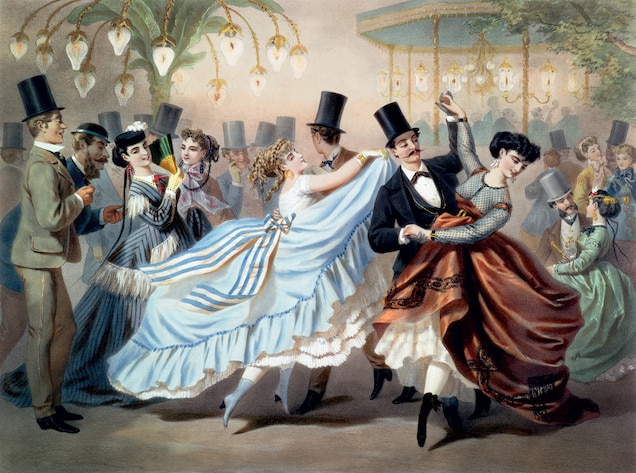
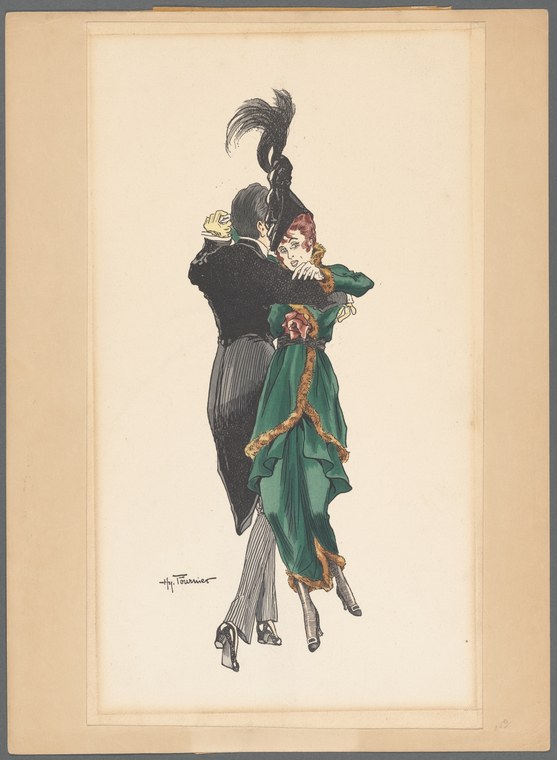
This image captures the ballroom as a site of formal social practice and elite display in the early 20th century, showing how dance instruction and fashion were intertwined. The precision of the rendering and the care lavished on costume detail reveal how seriously ballroom dance was taken as a mark of refinement and social standing.
What you are looking at
A single couple in formal ballroom dress, shown in a moment of elegant dance. The man wears a dark tailcoat with gold epaulettes suggesting military rank, while the woman wears a striking emerald green gown with coral-orange trim and rosette details at the bodice. The woman's pale complexion and rouged cheeks are sharply rendered; she wears her hair up in a styled arrangement. The man stands behind and to the side of the woman in a classic ballroom frame, his posture upright and controlled. Both figures are shown mid-movement against a plain background, suggesting a studio or formal ballroom setting rather than a narrative scene. The artist has used a technique that combines line work with selective hand-coloring, emphasizing the luxury fabrics and the formal protocol of the dance.
The dancing
The couple adopts a closed ballroom hold with the man positioned slightly behind and to the woman's left, a standard frame for early 20th-century formal dance. The woman's weight appears forward, her body aligned with the man's as they face the same direction. The man's right arm would be at her back (not fully visible from this angle), and their other hands connect at mid-body height. Both dancers maintain an upright, dignified posture characteristic of ballroom technique, with no flex or casualness in the frame. The woman's skirt falls in elegant folds that suggest the moment of a turn or forward motion.
The dance depicted
This depicts a formal ballroom dance, most likely a waltz or foxtrot given the closed position, the upright frame, and the formal attire suggesting a gilded-age or early 20th-century ballroom. The woman's costume—particularly the emerald silk and careful styling—and the man's military dress indicate this is a scene of social ballroom dancing among the upper classes. The artist has chosen to show the dancers in a controlled, formally-trained frame rather than in exuberant motion, emphasizing technique and decorum over drama.
How it was made
This is a hand-colored print, most likely a lithograph or chromolithograph given the tonal base and the precision of the hand-coloring. The artist has rendered the figures in fine line work with selective color applied to costume, skin tone, and hair, allowing the emerald and coral hues to dominate the composition. This technique was common for fashion and dance illustration in the early 20th century and allowed for relatively economical production and wide distribution among middle and upper-class audiences interested in current ballroom styles.
About this work
This is a formal ballroom dance illustration showing a couple in the closed position characteristic of early 20th-century social dancing. The man's military attire and the woman's elaborate gown signal an upper-class ballroom context, while the artist's refined technique—combining engraved line work with precise hand-coloring—places this within the tradition of commercial dance and fashion illustration. The image documents both the formal technique and the sartorial spectacle of gilded-age ballroom culture.
How to look at it
Observe the precision of the closed ballroom frame: the alignment of the bodies, the placement of the hands, the upright carriage. The artist has chosen a moment of controlled movement rather than a dramatic turn, emphasizing the formal protocol and technique that distinguish ballroom dancing from other forms. Notice how the costume carries as much visual weight as the dance itself—the emerald silk and military decoration are rendered with the same care as the body positions, reflecting the era's understanding of ballroom as a unified system of movement, dress, and social meaning.
The artist
The artist is not recorded in the catalogue, but the signature visible in the lower left appears to read 'Barbier' or similar. This style and technique are consistent with the work of commercial dance and fashion illustrators working in the early 20th century, particularly in New York or European ballroom culture.
The period
The image belongs to the height of the gilded age ballroom, roughly 1900–1920, when formal social dancing was a crucial ritual for the upper classes and a subject of intense commercial interest. Ballroom dance instruction was booming, with new dances like the foxtrot and tango arriving from the Americas and triggering both enthusiasm and moral panic. Illustrated prints of ballroom couples were popular items for dance schools, studios, and aspirant dancers seeking to learn correct form and fashion.
Where it lives
This print is held in the New York Public Library collection. It is a commercial illustration, likely produced for sale to dance schools, studios, or private collectors interested in ballroom technique and fashion.
Dance in this work
Questions about this work
What ballroom dance is this?
The closed position and formal frame suggest a waltz or foxtrot, dances that dominated upper-class ballrooms in the early 20th century. The artist does not mark the specific dance, but the upright posture and the alignment of the bodies are consistent with the formal technique taught for both dances during this period.
Why is the man wearing a military uniform?
The gold epaulettes indicate military rank. This may indicate the man is an officer attending a formal ball, or it may simply be a convention of ballroom illustration to show the male dancer in formal dress. The uniform adds social prestige and formality to the scene.
Is this a real couple or a generic example?
This appears to be a generic illustration created to teach or showcase ballroom technique and fashion, not a portrait of specific individuals. The focus on correct frame and costume suggests it was designed as an instructional or aspirational image for dancers and dance students.
More Ballroom artwork