35 works in this view — arrow keys or swipe to move between them.
Dance in Art
The waltz
Unknown artist
- Medium:
- Lithograph
- Dance:
- Waltz
- Era:
- Early 1800s (Waltz Revolution)
- Source:
- New York Public Library
- Rights:
- Public domain — free to use, share and adapt.
- Recorded as:
- public_domain
The waltz was the first mass social dance in which close physical contact between man and woman became normative and publicly acceptable. This lithograph, created during the decades of that transformation, shows how artists documented and celebrated the dance as evidence of social modernity. For historians of dance, gender, and 19th-century ballroom culture, it is a primary visual source on how the waltz was understood and displayed at the height of its acceptance.
What you are looking at
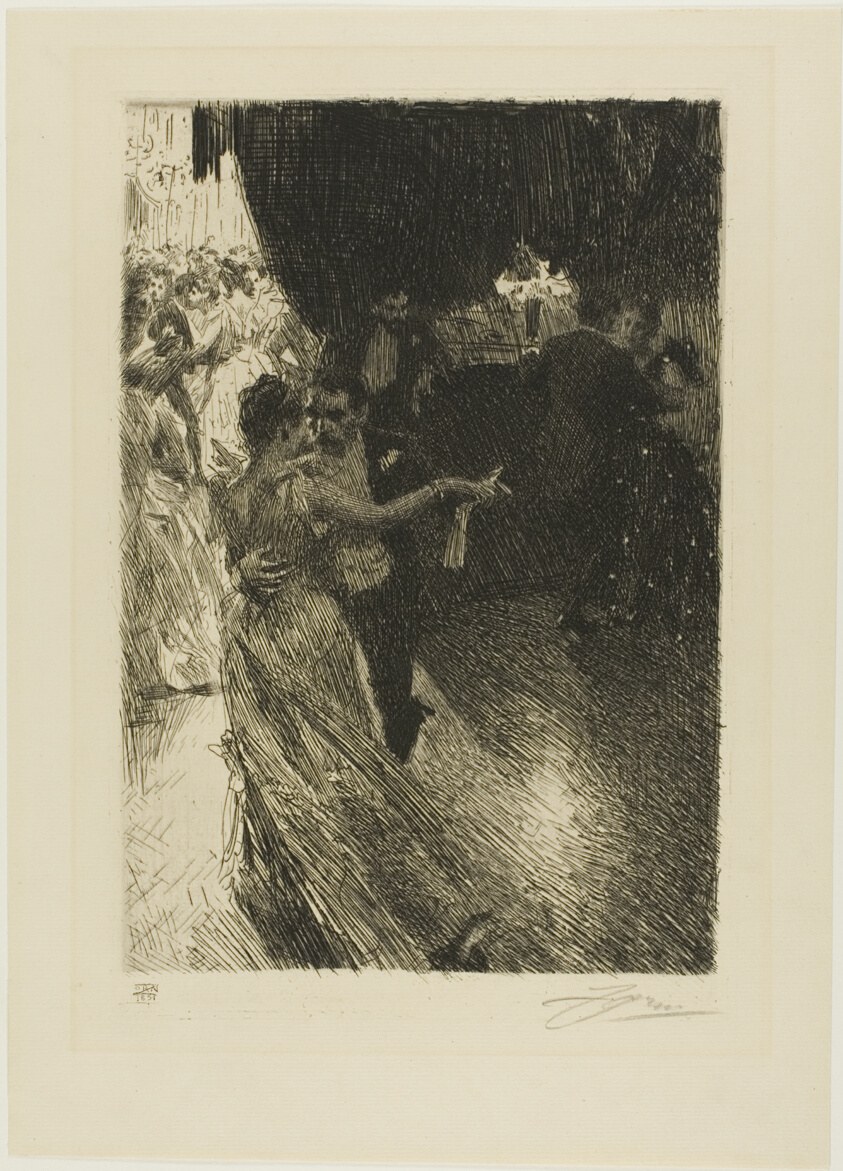
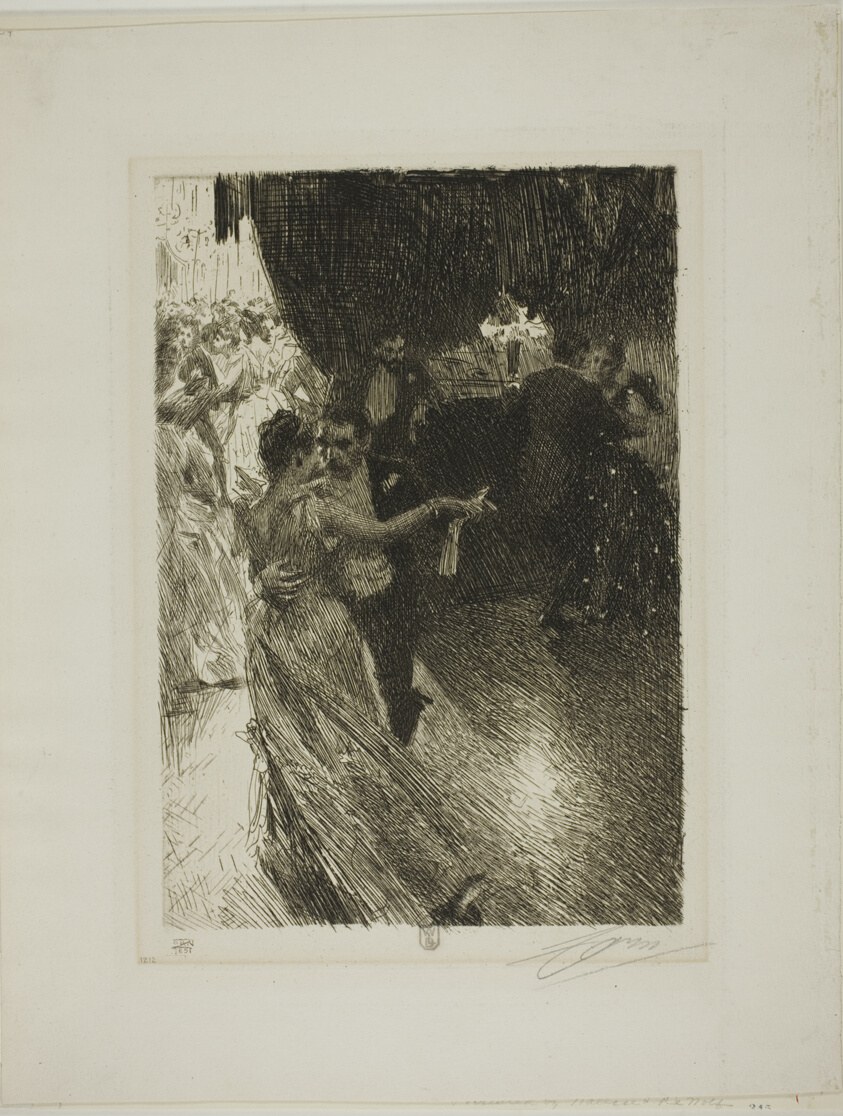
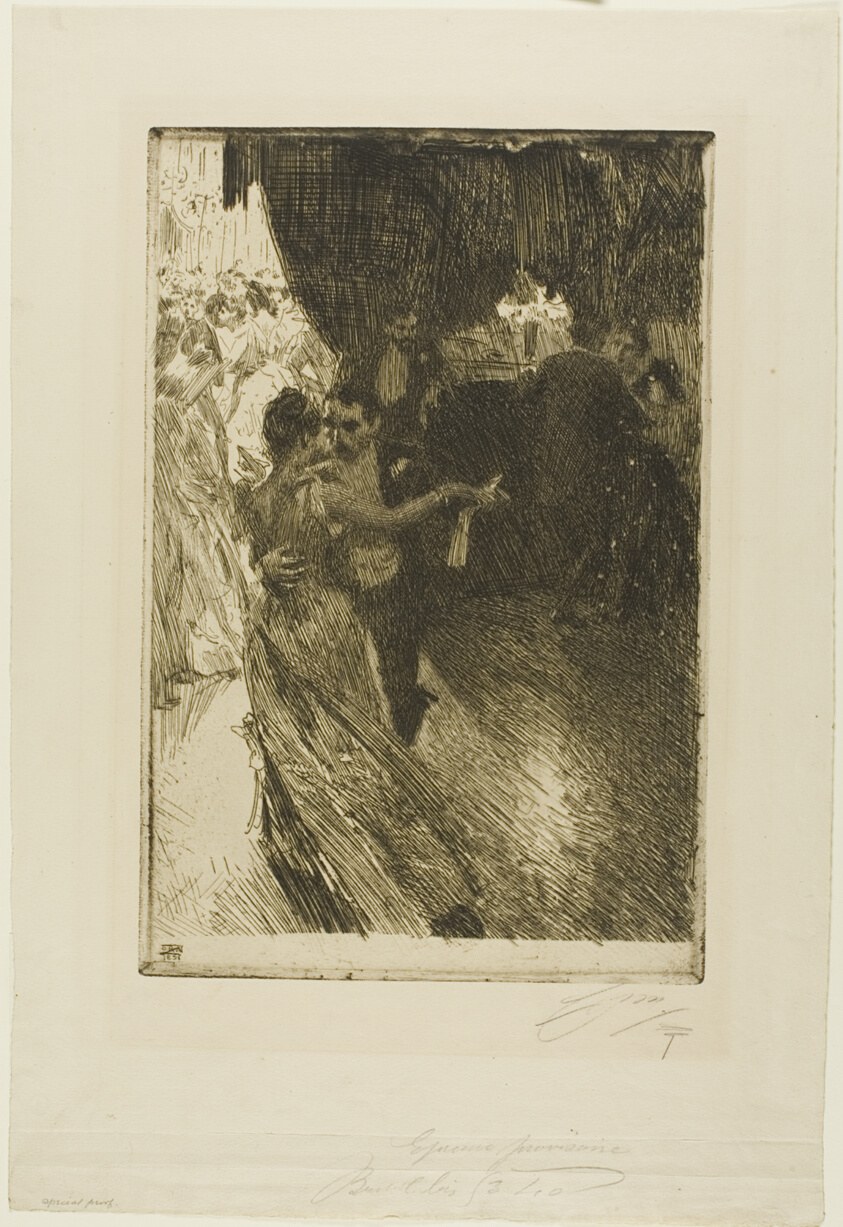
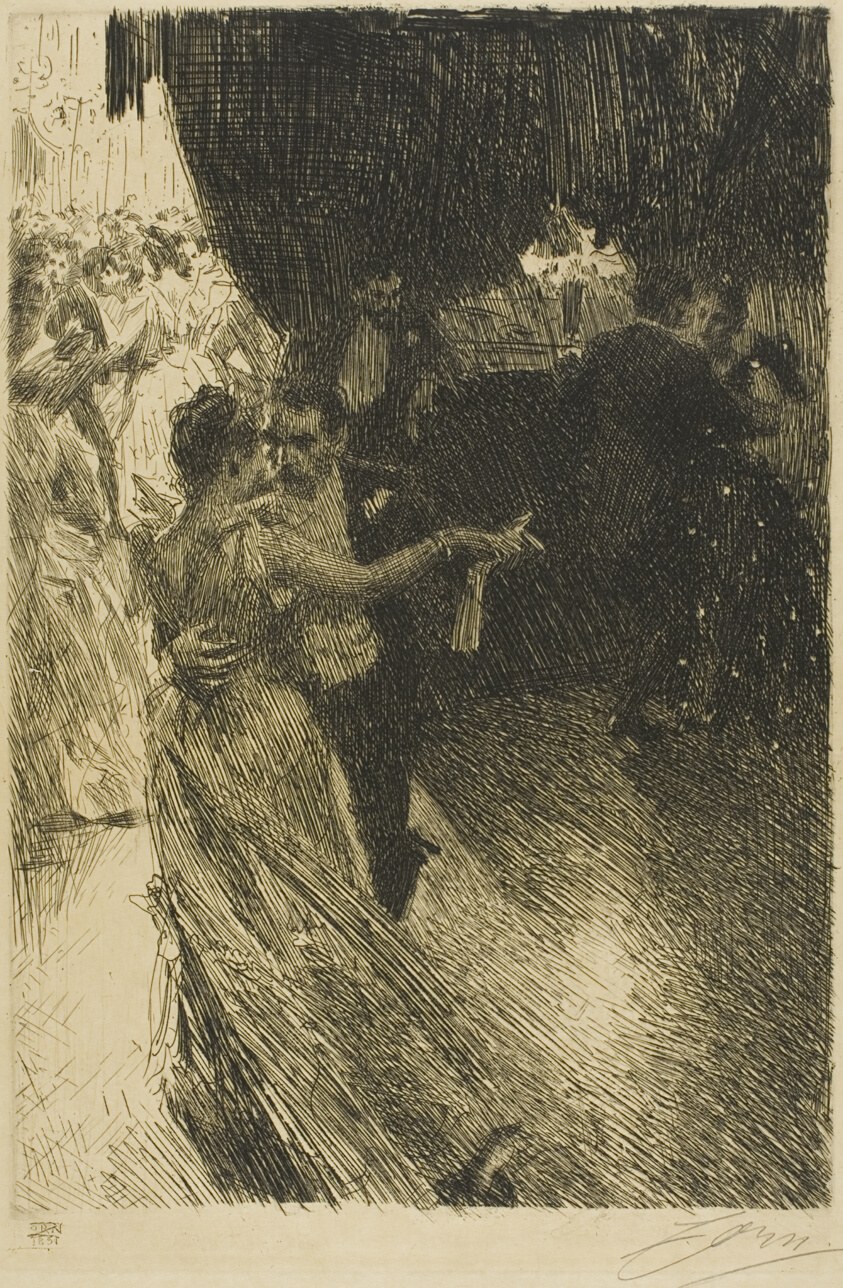
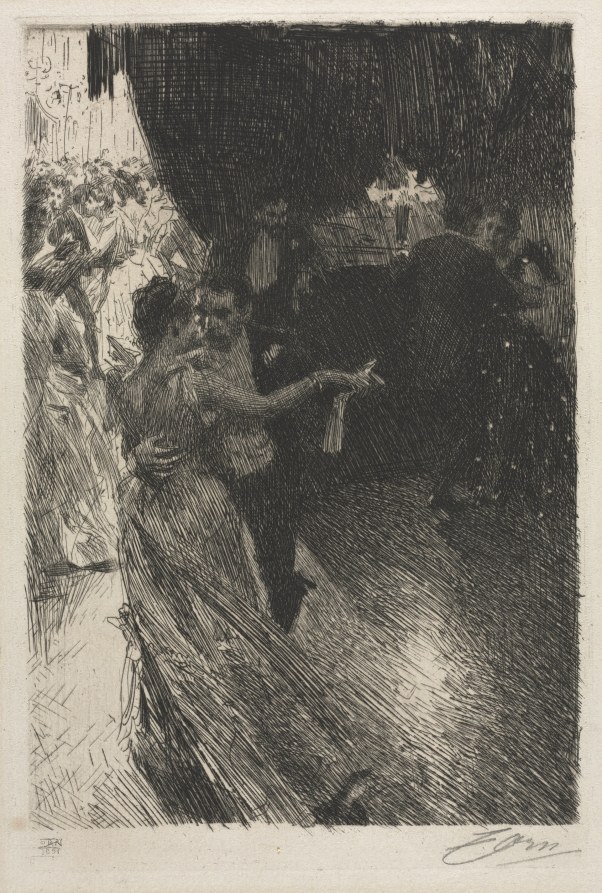
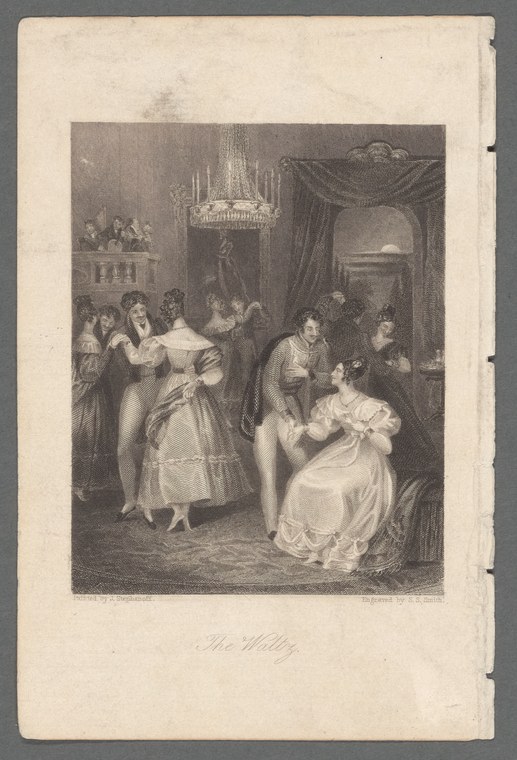
A formal interior scene of a ball or social gathering, rendered in lithographic greytones. The composition divides into two spatial zones separated by a grand chandelier: on the left, figures in evening dress stand conversing and observing; on the right, in the foreground, two women in white gowns dance together in an open frame, their bodies turned toward each other in the three-quarter pose characteristic of the waltz. The setting is palatial—heavy drapery swags from above, a doorway or alcove opens on the right, and the distant left suggests a gallery or anteroom where additional guests cluster. Candlelight from the suspended chandelier falls across the scene, creating sharp contrasts between lit fabric and shadow. The mood is one of fashionable leisure: the dancers move within a space observed but not crowded, their isolation from the throng suggesting the waltz as a display piece as much as an embrace.
The dancing
The two principal dancers occupy the right third of the composition, their bodies angled in three-quarter view. They stand close, the woman on the right leaning slightly back while her partner (the woman on the left, suggesting a female-female or male-presented figure in drag or artistic convention) supports her frame. Both women's arms are raised and positioned in the characteristic closed hold of the waltz—the leading figure's right hand on the follower's back, left hand extended to meet hers. Their skirts billow outward from the turn, the fabric catching light to suggest rotational movement. The posture shows an understanding of the waltz's essential mechanics: the couple as a single rotating unit, the woman's weight transferred through her partner's support, the frame held rigid while the lower body turns beneath it.
The dance depicted
This is unquestionably a waltz, the dance that revolutionized European ballroom practice in the early 19th century. The record correctly identifies it; the image confirms it through pose, hold, and setting. The waltz demanded closed hold—man and woman (or in artistic representation, two figures in dancing relationship) facing the same direction while the lead steered the couple through rotational figures across the floor. This lithograph captures the moment of the turn itself, the dancers suspended in the characteristic three-quarter attitude that defined waltz posture. The dance was scandalous when new—the closeness, the speed, the woman's exposure—and its acceptance into elite ballrooms (as shown here in the palatial setting) marks a profound shift in European social dance between 1800 and 1830. The title *The Waltz* suggests this is a genre scene meant to document or celebrate the dance at the moment of its fashionable triumph.
How it was made
A lithograph printed from stone, a process that allowed fine gradations of tone across the surface, lending the image its subtle greyscale atmosphere. The technique was ideal for popular reproduction—cheaper than engraving, faster than etching, capable of capturing both architectural detail and figural nuance. Lithography became the dominant medium for dance imagery in the 19th century precisely because it could circulate widely and at speed. The hand of the artist is visible in the parallel lines used to build shadow, the careful hatching of the drapery, and the soft transitions between lit and dark areas. The work belongs to a visual culture of dance documentation—not a record of a specific performance, but a type-scene meant for ballroom patrons and dancing masters to admire and learn from.
About this work
This lithograph depicts the waltz at its moment of social triumph, freezing the dance in a formal ballroom setting that affirms its status as elite rather than vulgar entertainment. The two principal dancers are shown in the closed hold that made the waltz radical: facing the same direction, the follower leaning back into the lead's support, the couple rotating across the floor in a visible spiral. Around them, the architecture and the observing guests frame the dance as spectacle and as social fact—this is how the fashionable world now moves. The work belongs to a large body of early 19th-century dance imagery that recorded the waltz's rise from disreputable innovation to ballroom standard, a revolution in human contact and physical form that no previous dance had required.
How to look at it
Attend first to the posture of the two dancers: the lead's right hand placement on the follower's back, the extension of the left hand to meet hers, and the rigid frame that allows the couple to function as a single unit. Note the follower's backward lean—this is not passivity but a necessary mechanics of the waltz turn, the lead's body and arm providing the pivot point. The artist has caught the moment mid-turn, the skirts billowing outward from centrifugal force, which communicates speed and rotational energy that a static, upright pose could not. Finally, observe the isolation of the dancers within the crowded ballroom: they are lit and detailed while the surrounding guests fade into shadow, a convention that isolates the dance itself as the scene's true subject.
The period
The waltz emerged in Vienna and spread across Europe between 1780 and 1830, replacing the geometric, distant figures of the minuet and cotillion with a couple rotating rapidly in close embrace. The dance was initially condemned as indecent—the proximity, the speed, the woman's exposure as she leaned back in the turn—but by the 1810s it had become a marker of fashionable society. The lithographic medium emerged at exactly this moment and became the primary vehicle for dance imagery, allowing fast reproduction of dance scenes for ballroom patrons and dancing masters. This print belongs to a wave of such imagery created between approximately 1810 and 1840, when the waltz was still novel enough to document and celebrate, but established enough that its dominance could be taken as given.
Where it lives
The work is held in the New York Public Library collection and was sourced from that institution. It is catalogued as a lithograph of unknown artist and date, though the style and subject matter place it securely in the early 19th century, likely between 1810 and 1840 when waltz imagery was in high demand.
Dance in this work
Questions about this work
Why did the waltz cause such scandal?
The waltz required close physical contact—the couple held in a closed embrace facing the same direction—at a time when European ballroom dance kept partners at arm's length or allowed no contact at all. The woman leaning backward into the man's support was seen as indecent exposure. By the 1820s the dance had been accepted into elite ballrooms, but the scandal of its origins never entirely faded.
How do you know this is a waltz and not another dance?
The image shows the defining features of the waltz: closed hold (partners facing the same direction, the lead's right hand on the follower's back), the follower leaning backward, and the rotational frame that kept the couple turning across the floor. These were not features of earlier ballroom dances like the minuet or quadrille. The title also confirms the identification.
What does the setting tell us?
The palatial interior—the chandelier, drapery, multiple rooms—signals that this is an elite ballroom, not a popular dance hall. The presence of well-dressed observers suggests a fashionable gathering where the waltz has become a normal and admired feature of social life. The artist is documenting the waltz as a marker of genteel status.
More Waltz artwork