26 works in this view — arrow keys or swipe to move between them.
Dance in Art · 2023
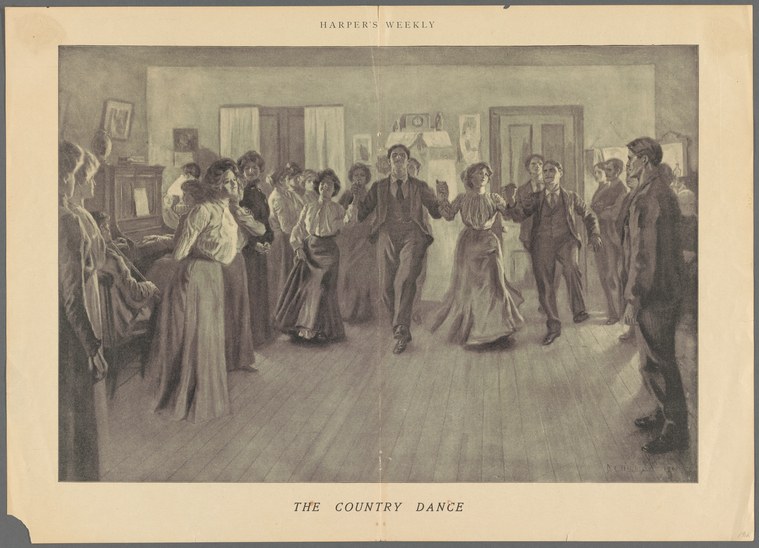
The country dance
Unknown artist
- Medium:
- Dance:
- Folk/Country
- Source:
- New York Public Library
- Rights:
- Public domain — free to use, share and adapt.
- Recorded as:
- public_domain
This image is primary evidence for understanding country dance not as a codified technique but as a social practice embedded in ordinary American life. For dance historians and social historians alike, it documents the scale, setting, and mixed-gender social function of amateur dancing, revealing assumptions about propriety, leisure, and courtship in the Gilded Age.
What you are looking at
An interior domestic space filled with couples and groups in period dress, rendered in soft charcoal or crayon tones. The setting appears to be a parlor or assembly room with wooden floorboards, high walls lined with doorways and framed pictures, and furniture at the edges. A large group of roughly twenty figures occupies the center of the room, arranged in loose formations suggesting simultaneous dancing or preparation for it. The figures wear late 19th-century clothing: women in long skirts with fitted bodices, men in dark suits and jackets. The lighting is diffuse and atmospheric, creating a sense of warm indoor social gathering. The composition is crowded and informal, with figures overlapping and turning in various directions, suggesting a moment of active or imminent dancing rather than a formal procession or tableau.
The dancing
The dancers display varied postures: some couples appear to stand in close proximity as if about to take hold, while others seem to be in motion or turning. The hold and frame are indistinct from this distance and medium, making it difficult to determine whether these are closed ballroom holds, open folk holds, or informal hand contact. Several figures have their arms raised or extended, suggesting active movement. The arrangement is not rigidly linear or processional, but rather scattered and naturalistic, with bodies at multiple angles and depths within the room.
The dance depicted
The title identifies this as a country dance, and the domestic interior setting, the period costume (late 19th century), and the informal, multi-couple grouping are consistent with the Anglo-American tradition of country dancing—a social form involving lines, sets, or circles of couples performing figures to music. The image does not show the precision or formality of a ballroom dance such as a waltz or quadrille, nor does it depict folk regional costume. Instead it captures an amateur social event in a private home, which aligns with the country dance tradition as a participatory, playful domestic entertainment.
How it was made
This is a print, likely a lithograph or engraving made in the late 19th or early 20th century, characterized by soft tonal gradations and the ability to render interior atmosphere. The technique allows for nuanced expression of light and shadow across a crowded interior scene, and the soft medium—possibly crayon or chalk—creates an intimate, informal mood appropriate to a domestic subject. The print medium ensured circulation through magazines, newspapers, or periodicals such as Harper's Weekly (as indicated by the publication credit), reaching a broad educated American audience.
About this work
This is a genre scene capturing a middle-class American domestic social event of the late 19th century: a country dance held in a private parlor. The print documents not the technical execution of the dance, but its social context—the mingling of couples, the informality of the setting, the pleasure of participation. Country dancing was a widespread social practice among the American middle class, distinct from both the formalized ballroom tradition and rural folk practice. The image preserves a moment of leisure and collective play in domestic space, offering insight into how dance functioned as social bonding and courtship in urban or suburban households of the period.
How to look at it
Look at the scattered, informal positioning of the figures: this is not a choreographed procession or a single unified couple, but a crowded sociable event with simultaneous activity. Notice how the artist has chosen to capture not a climactic moment of technical display, but the preparation and mingling phase—the social and flirtatious prelude to organized dancing. The soft tonal technique and warm interior lighting emphasize the domestic comfort and social ease of the setting, inviting the viewer to feel present in the room rather than observing from outside. The overlap and varying depths of the figures create a sense of liveliness and gentle chaos typical of an amateur social dance.
The period
The late 19th century saw a flourishing of both formal ballroom dancing (waltz, quadrille, cotillion) and the continuation of simpler country dance traditions in American homes. Country dancing had roots in English folk and contra traditions but persisted as a casual, participatory form alongside more codified ballroom styles. The rise of illustrated magazines like Harper's Weekly (founded 1857) created demand for genre scenes of contemporary American life—picnics, parlor entertainments, social gatherings—and dance was a natural subject for capturing bourgeois leisure and courtship rituals. Such images served both documentary and aspirational purposes, modeling acceptable social behavior for middle-class readers.
Where it lives
This print is held in the New York Public Library collection and is identified as a Harper's Weekly reproduction, indicating it was published as an illustration for a major American weekly magazine of the period. Such images circulated widely to a national audience and were often clipped and kept as period records or decoration.
Dance in this work
Questions about this work
How is country dancing different from ballroom dancing?
Country dance involved groups or couples dancing figures and patterns, often in lines or sets, with less formal hold and more participatory energy. Ballroom dances like the waltz or quadrille were more codified, required training, and were danced by couples in formal hold in designated ballroom spaces. Country dancing was more accessible and informal, as this image shows: it happened in parlors, did not require years of instruction, and emphasized social inclusion and fun over technical precision.
What does this image tell us about gender and social mixing in the Gilded Age?
The image shows men and women mingling freely in a private home, preparing to dance together—a sight that would have been scandalous a century earlier. This reflects the increasing social freedom of middle-class American women by the late 19th century, and the acceptance of mixed-gender dancing as an appropriate leisure activity. The domestic setting also suggests that not all social dancing required public dance halls; private homes hosted regular social events.
Why is this published in Harper's Weekly rather than a dance manual?
Harper's Weekly illustrated the lives and leisure habits of its educated middle-class readership. A genre scene of a country dance appealed as cultural documentation and as an aspirational image of refined home entertainment. It was not meant to teach the steps, but to celebrate the social ritual and to circulate among readers a model of how genteel Americans socialized and courted.
More Folk/Country artwork