32 works in this view — arrow keys or swipe to move between them.
Dance in Art
Ladies of the ballet
Unknown artist
- Medium:
- Dance:
- Ballet
- Source:
- New York Public Library
- Rights:
- Public domain — free to use, share and adapt.
- Recorded as:
- public_domain
This work documents a crucial shift in how modernist artists represented professional dance: from narrative and spectacle to the materiality of the dancer's body and the reality of theatrical labor. It also exemplifies an important tradition of print imagery that allowed intimate, backstage scenes to circulate among a wider audience than painting alone could reach.
What you are looking at
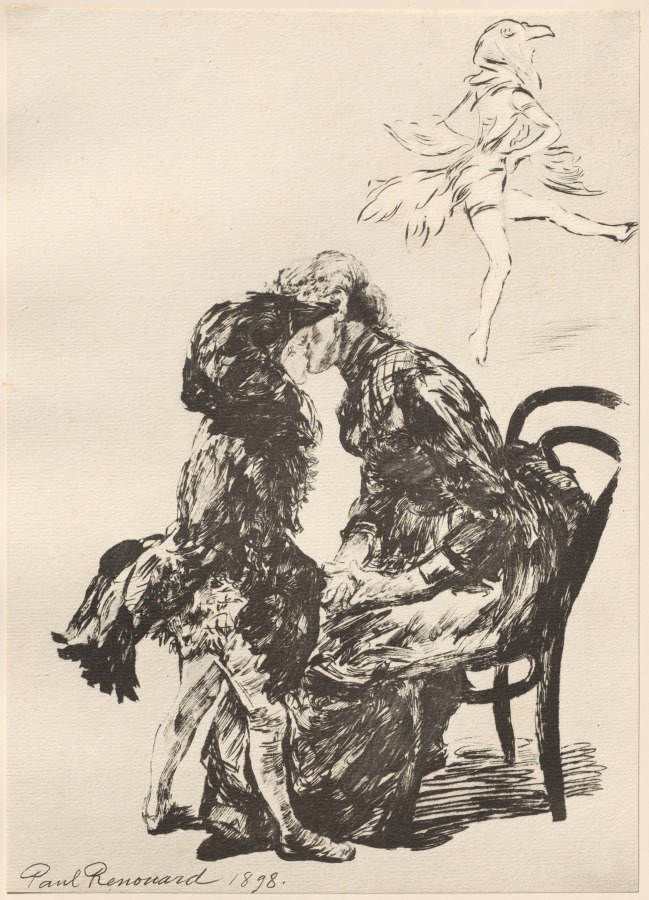
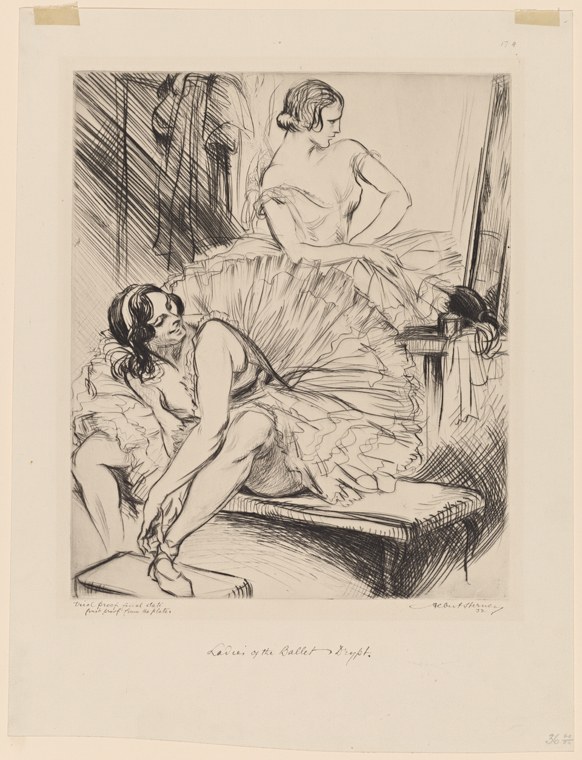
A private dressing room or backstage space containing two female ballet dancers. The figure at left, nude or partially draped, crouches on the floor in an attitude of rest or preparation, her body folded inward with one leg bent. Behind her, a second dancer sits upright on what appears to be a bench or chair, also lightly clothed or draped in gauze. A third figure, barely sketched, appears in the background at right. The setting is intimate and domestic—there is a window with heavy cross-hatching suggesting interior shadow, and the sparse furnishings suggest a dressing room or waiting area. The artist has used bold, confident pen strokes to establish form and volume, with extensive cross-hatching to create depth and atmosphere. The overall mood is one of candid observation: these are dancers at rest between rehearsal or performance, captured in unglamorous, functional poses.
The dancing
The crouching dancer at left demonstrates exceptional understanding of the body at rest: her weight is centered over her feet, her spine curved in a natural fold, her musculature rendered with anatomical precision. The seated figure behind maintains upright carriage even in repose, suggesting trained posture. Both figures are unidealized—they are not posed for effect—yet the artist has rendered their forms with the clarity of someone who understood ballet anatomy. The spatial relationship between the two main figures creates a sense of shared, unremarked intimacy.
The dance depicted
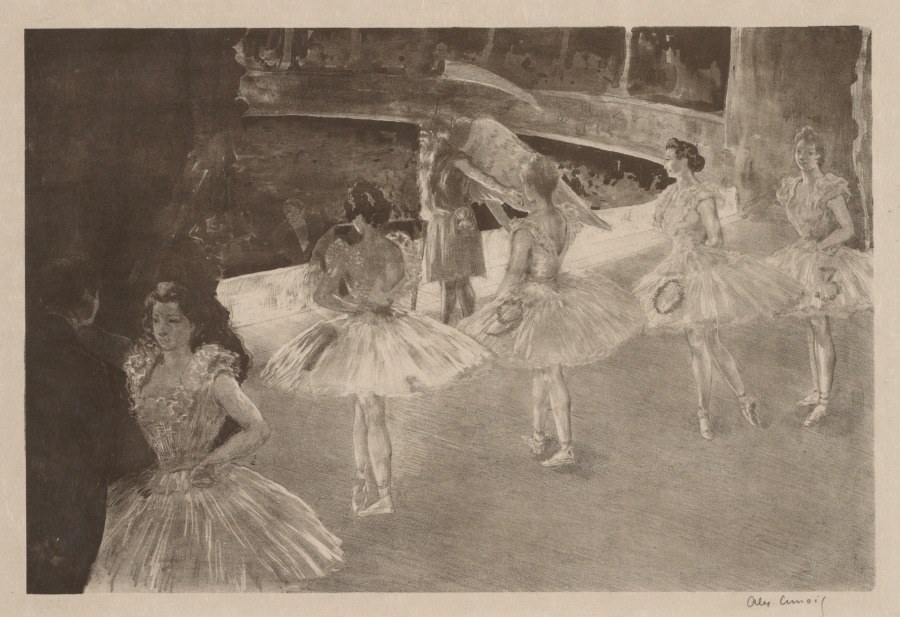
This is ballet, almost certainly professional or semi-professional theatrical ballet of the late 19th or early 20th century, identified by the dancers' lean musculature, the gauze or tulle drapery, and the context of a dressing room. The work is not about the dance itself but about the dancers' bodies at rest—a modernist turn away from narrative or spectacle toward the quotidian reality of theatrical labor. The title 'Ladies of the Ballet' places this within a tradition of backstage imagery that emphasized the physical and social lives of professional dancers, often with a voyeuristic undercurrent.
How it was made
This is a print, most likely an etching or drypoint given the bold, expressive line work and the tonal effects created by cross-hatching. The technique allows for both precision (in anatomical detail) and expressiveness (in the gestural quality of the lines). The medium was suited to circulation among a cultured audience—this is art for collectors and connoisseurs rather than mass reproduction. The confidence of the line suggests an artist of considerable skill, trained in academic drawing.
About this work
This is a study of ballet dancers at rest, rendered as a print in the early 20th century. It belongs to a tradition of backstage or dressing-room imagery that treated the ballet studio and theatre as sites of authentic life rather than spectacle. The work is part of a shift in how artists represented dance: away from the idealized, costumed figure performing narrative, toward the unadorned body and the labor that sustained performance. The artist has chosen a moment of exhaustion or preparation—not the visible spectacle of the dance itself.
How to look at it
The viewer should attend to the contrast between the crouching figure's muscular tension and the seated figure's repose: the artist is interested in how trained bodies carry themselves even at rest. Notice how the cross-hatching creates volume without outlining—the forms emerge from shadow and light. The sparse setting and informal poses suggest the artist's interest in catching the dancers unaware, in moments between performance, rather than in the choreographed spectacle itself.
The period
The early 20th century saw a growing interest in the bodies of professional dancers as subjects worthy of serious artistic attention. Degas had pioneered backstage ballet imagery in the late 19th century, establishing the studio and dressing room as legitimate subjects. By the turn of the century, this tradition was well established, and prints allowed such imagery to reach a broader market. The unidealized, anatomically acute rendering of the female body in labor reflects modernist interest in authenticity and material reality, in contrast to the idealized nudes of academic tradition.
Where it lives
The work is held in the New York Public Library collection, part of a broader holdings of prints and drawings documenting 19th and early 20th-century cultural life.
Dance in this work
Questions about this work
Who were the 'Ladies of the Ballet' in early 20th-century art?
The phrase referred to professional ballet dancers, particularly those in European and American companies. In art and literature of the period, they were often subjects of fascination and sometimes exploitation, caught between their status as trained artists and their vulnerability as women in a theatrical economy. Prints and drawings of dancers at rest or in dressing rooms were a genre that allowed artists to present them as real people rather than costumed performers.
Why would an artist choose to draw dancers at rest rather than dancing?
By the early 20th century, modernist artists were increasingly interested in authenticity and the unglamorous reality of professional life. A dancer resting or preparing reveals the physical toll and genuine effort behind performance—it is a more honest subject than an idealized stage image. This approach also allowed artists to study anatomy and movement without the constraints of narrative or spectacle.
What technique was used to make this print?
The work appears to be an etching or drypoint, techniques that allowed for both fine detail and bold, expressive line work. The cross-hatching that creates shadow and volume is characteristic of these media. Prints made it possible to reproduce such intimate, naturalistic scenes and distribute them to collectors, making backstage ballet imagery more widely accessible than painting alone.
More Ballet artwork