49 works in this view — arrow keys or swipe to move between them.
Dance in Art
Procession of dancers and musicians
Unknown artist
- Collection:
- Prints depicting dance
- Source:
- New York Public Library
- Rights:
- Public domain — free to use, share and adapt.
- Recorded as:
- Public Domain
This image is a primary document of how the Renaissance understood and reinvented classical dance—not through historical research but through artistic fantasy and courtly display. For dance historians, it shows the assumptions about classical movement that shaped court masques, intermezzos, and the formal aesthetics of early ballet. For art historians, it exemplifies how engraving functioned as a vehicle for learned and courtly knowledge in the early modern period.
What you are looking at
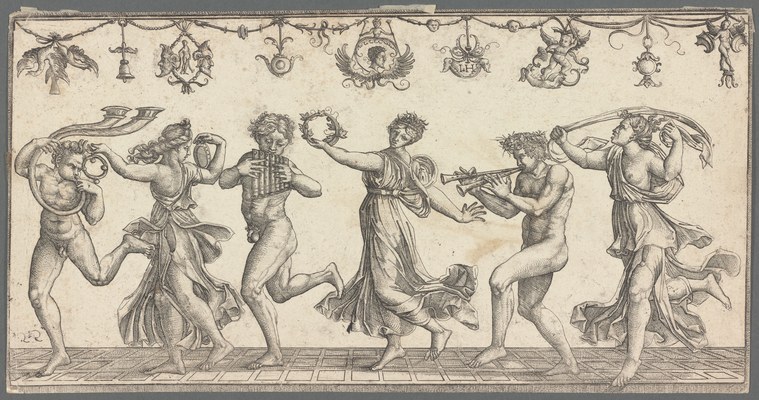
A procession of classical figures moves left to right across a narrow frieze, each engaged in distinct poses of dance or musical performance. The composition recalls a relief sculpture or antique frieze: the figures are arranged on a single ground line with minimal spatial depth. At the top of the image hangs a decorative border of cherub heads and swags of fruit or cloth, suggesting a classical interior or festive architectural setting. The figures wear classical drapery (chitons, himations) and some carry attributes—a lyre, a shield, what may be a thyrsus or pipe. The line includes both male and female figures; some are in dynamic poses suggesting movement, others more static; one woman seems to lead or conduct the procession. The whole is rendered in fine line work typical of sixteenth- or seventeenth-century engraving, with careful attention to musculature and the fall of fabric but no shading or tone beyond the line itself.
The dancing
The figures move in a loose procession, alternating between dynamic and posed attitudes. Several show extended arms or lifted legs suggestive of saltation or pantomimic gesture. The male figures display anatomical definition common to classical dance reconstruction; the women maintain varying degrees of contrapossto. No formal ballroom frame is evident. The positioning suggests a classical court or masque arrangement rather than partnered social dance—figures relate more to the procession as a whole than to each other in closed holds. The diversity of poses and the presence of musical instruments indicate a mixed ensemble of dancers and musicians rather than a single dance form.
The dance depicted
This is most likely a sixteenth- or seventeenth-century interpretation of antique Greek or Roman dance, reconceived through the lens of Renaissance classicism. The attributes (lyre, thyrsus, shield) and the frieze composition suggest a learned or antiquarian source—possibly a treatise on ancient dance, a masque, or an ornamental record of festival choreography. The figures do not perform a single recognizable dance but rather a sequence of classical attitudes, each designed to suggest grace, musicality, or mythological character. The presence of both dancers and musicians indicates a staged entertainment of the kind popular in Renaissance and early Baroque courts, where dance was integrated with music and spectacle.
How it was made
This is an engraving, executed in fine line work on paper. The technique—precise hatching, careful anatomical rendering, and the shallow frieze format—suggests professional production, likely mid-to-late sixteenth or early seventeenth century. The decorative header of putti and swags indicates this was intended as ornamental or didactic, possibly part of a printed book on dance, costume, or courtly recreation. Engraving allowed precise reproduction and circulation among educated audiences; the format and finish suggest this was made for collectors, scholars, or courtiers with an interest in antiquity and refined taste.
About this work
This engraving presents a Renaissance or early Baroque vision of classical dance, arranged as a frieze of figures in antique dress moving to unstated but implied music. It belongs to a tradition of learned recreation of ancient movement—a practice central to sixteenth- and seventeenth-century court culture, where princes and scholars attempted to reconstruct or reimagine Greek and Roman performance. The work exists at the intersection of antiquarian scholarship, courtly spectacle, and printmaking; it records not historical evidence but a cultivated fantasy of the classical body in motion, filtered through Renaissance aesthetics and engraving technique.
How to look at it
Observe how each figure occupies a distinct moment or posture rather than executing a unified step sequence. Notice the variety of arm and leg positions, the alternation of facing and profile views, and the way some figures turn inward while others gesture outward. The presence of musical instruments (lyre, pipes) tells you that music and dance were conceived as inseparable. The frieze format invites the eye to read from left to right as if following a procession or a narrative unfolding in time. The finish and precision of the engraving suggest this was a finished, high-quality work intended for display or study, not a working sketch.
The period
The sixteenth and seventeenth centuries saw an intense European fascination with antique dance, fueled by humanist scholarship, the recovery of classical texts, and court culture's hunger for refined spectacle. Treatises on dance often included woodcuts or engravings showing postures and attitudes; intermezzos and court ballets freely drew on classical mythology and dress. This engraving sits within that tradition: it is neither a faithful reconstruction nor a record of actual performance, but rather a cultivated image of what learned, courtly audiences wished classical dance to be—graceful, orderly, musically coherent, and consonant with classical ideals of beauty and proportion.
Where it lives
The work is held in the New York Public Library's collection of prints depicting dance. It lacks recorded artist, date, and medium information in the catalogue, suggesting it entered the collection as a single-leaf engraving or as part of a dispersed bound volume.
Dance in this work
Questions about this work
Is this a record of an actual dance that was performed?
Almost certainly not in literal detail. This is a learned fantasy of classical dance created in the Renaissance or early Baroque period, based on classical texts, artistic imagination, and the courtly ideal of refined movement. It may have been inspired by court entertainments, but it is not a documentary image. Real court dances of the period looked quite different.
What are the musical instruments for?
They indicate that this ensemble combined dancers and musicians in a unified spectacle—a common format for court entertainment. The lyre and pipes suggest the classical mode; in actual performance, such a scene would have involved live music synchronized with the choreography.
Why is it arranged as a frieze?
The frieze format drew on antique precedent (Greek and Roman friezes were popular subjects for Renaissance study) and also served a practical purpose: it allowed the engraver to display multiple figures and attitudes in a single, easy-to-print composition. It was also a convention for ornamental and didactic prints.
More dance artwork





