38 works in this view — arrow keys or swipe to move between them.
Dance in Art
Waltzes from Maritana
Unknown artist
- Medium:
- Lithograph
- Dance:
- Waltz
- Era:
- Early 1800s (Waltz Revolution)
- Source:
- New York Public Library
- Rights:
- Public domain — free to use, share and adapt.
- Recorded as:
- public_domain
This work documents the moment when the waltz transitioned from scandalous novelty to operatic convention, and shows how the dance was visualised for a mass audience at the height of Romanticism. For anyone studying the waltz's cultural ascendancy, gender performance in dance, or the visual culture of Victorian theatre, this print is primary evidence.
What you are looking at
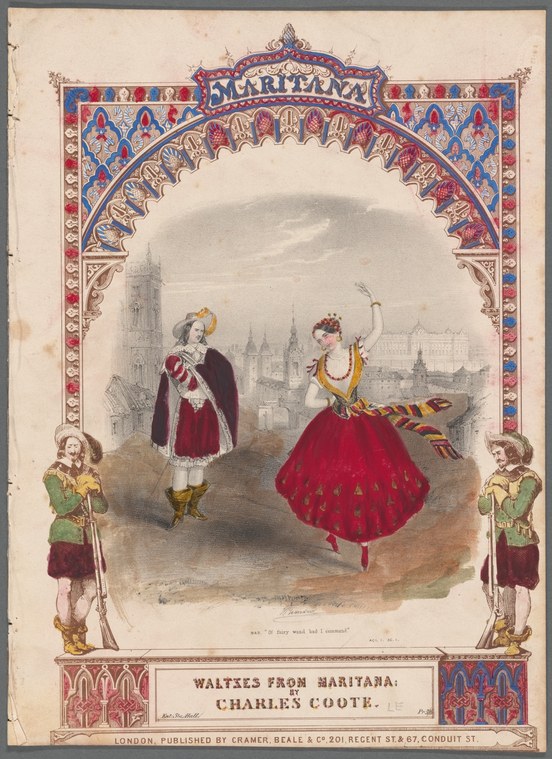
A lithograph ornamented with decorative borders in the Moorish revival style popular in the 1840s–50s. Within the ornamental frame, two figures occupy a London rooftop overlooking the Thames and Westminster. The man wears a military uniform with a feathered hat and red cloak; the woman, in a brilliant red ball gown with yellow-gold trim and feathering, executes a dramatic waltz pose. Her body is sharply arched, weight on one leg, the other extended. The sky behind them is rendered in soft grey washes suggesting dusk or dawn. Two small military figures stand as sentinels at either side of the frame. The composition frames the dance as a moment of courtship or romantic drama staged against a recognisable London landmark.
The dancing
The woman is captured mid-turn in a classical waltz frame, her torso leaning back with marked curvature, one leg supporting her weight while the other appears extended or in flight. Her arm position is characteristic of Romantic-era ballroom dance—one arm extended upward and outward. The man stands in profile, his military posture upright and formal, watching or about to engage. Their spatial relationship suggests the waltz hold at a critical moment of extension or swing.
The dance depicted
This depicts a waltz, the most fashionable ballroom dance of the 1840s–50s. The extreme arch of the woman's back and the dynamic extension of her limbs capture the waltz's characteristic rotational momentum and the dramatic curvature of the body that made it scandalous and alluring to Victorian observers. The title associates this with the opera *Maritana* (1845), suggesting this may represent a specific dramatic waltz from the production. The posture is theatrical rather than purely social—it emphasises spectacle and emotional intensity in the manner of staged ballroom scenes in opera.
How it was made
This is a hand-coloured lithograph, the primary medium for theatrical and musical imagery in the mid-19th century. Lithography allowed rapid, affordable distribution of images tied to current productions and popular music. The colour is applied selectively—the woman's dress receives full treatment in brilliant red and gold, while much of the surrounding scene remains in monochrome wash, directing attention to the dancing figure. The decorative Moorish border was an economical way to frame and elevate modest theatrical merchandise, giving cheap prints an ornamental appearance.
About this work
A mid-Victorian lithograph advertising or commemorating a waltz scene from Covent Garden or Drury Lane. The print captures both the social phenomenon of waltz-dancing and its operatic dramatisation: the dance is not naturalistic but posed for maximum visual and emotional effect. The woman's extreme arch and lifted extension would have struck contemporaries as daring—the waltz was still controversial in respectable circles—and the theatrical context (an opera house rooftop, military glamour, London monuments) makes it clear that this is not social dancing but performance, the waltz as spectacle. The image belongs to a vast literature of musical and theatrical prints that circulated among opera-goers and dance enthusiasts in the 1840s–50s.
How to look at it
Notice how the lithographer has chosen a moment of maximum extension rather than the neutral turning position: the woman's body is arched, almost defying gravity, her limbs spread wide. This was a deliberate artistic choice to convey the waltz's emotional and physical drama. The architectural setting—a rooftop, a city monument—frames the dance as a matter of public spectacle rather than private ballroom custom. The military uniforms and ceremonial atmosphere transform the waltz from social dancing into an act of courtship or passion witnessed by witnesses, which is how opera presented it to audiences.
The artist
The artist is not recorded, but the work was published by Cramer, Beale & Co of Recdent Street, a major London publisher and dealer in theatrical prints and musical scores in the mid-19th century. Such firms employed teams of lithographers to produce rapid responses to successful opera and ballet premieres, often working from sketches by theatrical designers or choreographers. The image is one of thousands issued in this format and circulation.
The period
The waltz had arrived in London from Vienna around 1812 but remained socially contested until the 1830s–40s, when Romantic opera and ballet canonised it. *Maritana*, first performed in 1845, was a Spanish-flavoured melodrama popular across Europe, and any operatic waltz would have been a commercial draw. In visual culture, the waltz was represented increasingly as a moment of extreme bodily extension and emotional abandon, departing from earlier depictions of the dance as smooth and controlled rotation. This shift in imagery reflects a change in performance style: as the waltz became respectable, it became more theatrical, the body more dramatically posed.
Where it lives
This print comes from the New York Public Library collection, likely part of its holdings of 19th-century theatrical ephemera and musical merchandise. Such prints were produced in quantity and sold cheaply at theatres and music shops, which is why many survive in institutional collections rather than in family archives.
Dance in this work
Questions about this work
What is the waltz doing on a rooftop?
The setting is part of the opera's dramatic scenario, not a realistic ballroom. Operatic dances were often placed in striking or exotic locations—palaces, gardens, rooftops—to heighten their romantic or spectacular effect. The London rooftop with the Thames and Westminster Abbey visible is also a flattering frame, situating this fashionable Continental dance within the British capital.
Why is the woman's body arched so extremely?
This pose was a conventional way to represent the waltz's swinging momentum and emotional intensity in Romantic-era visual culture. It also served a commercial purpose: the exaggerated curve made the image more striking and more erotic, appealing to the taste for Romantic spectacle. Real ballroom waltz was less dramatic; this is theatrical waltz.
Is this a record of an actual performance?
Unlikely to be a documentation of a specific moment; rather, it is a promotional or commemorative image compiled after the opera's premiere, combining recognisable characters with an idealised pose. The ornamental frame and multiple elements suggest it is a composite commercial image rather than a backstage sketch.
More Waltz artwork