27 works in this view — arrow keys or swipe to move between them.
Dance in Art · 2023
The country dance
Unknown artist
- Medium:
- Dance:
- Folk/Country
- Source:
- New York Public Library
- Rights:
- Public domain — free to use, share and adapt.
- Recorded as:
- public_domain
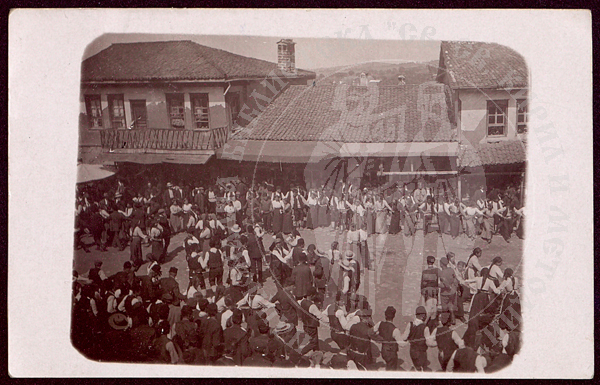
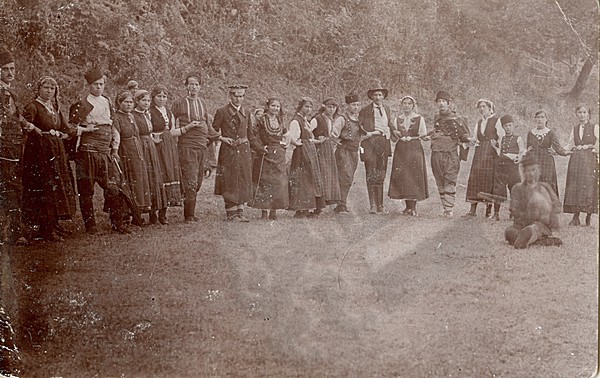
This image is primary evidence for how 19th-century country dancing was actually practiced—not idealized or staged, but documented as a lived social practice in real settings with mixed crowds and informal participation. For dance historians, it offers visual confirmation of the scale, setting, and social structure of country dances that literary sources describe. For cultural historians, it shows what counted as newsworthy about dance in the Victorian era: not technique or virtuosity, but the dance as a marker of community, tradition, and ordinary social life.
What you are looking at
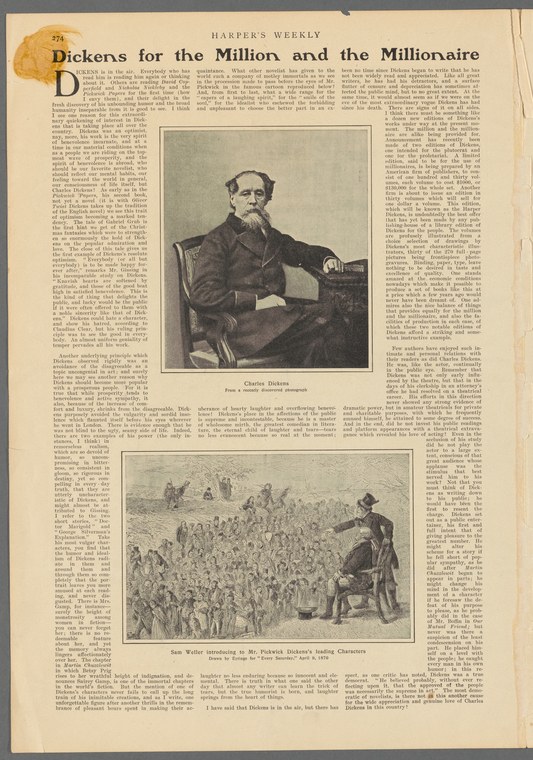
This is a wood engraving or steel engraving from Harper's Weekly illustrating a country dance scene. The lower half of the page shows a large crowd of dancers and onlookers in what appears to be an indoor social setting—a barn or assembly hall—with figures densely packed across the composition. The crowd surrounds a central dancing couple or group, with musicians visible on a raised platform or stage area. The figures wear period clothing suggesting the 19th century, with women in long dresses and men in coats. The upper portion of the page contains the article text with a portrait of Charles Dickens and an inset illustration labeled "Sam Weller introduced to Mr. Pickwick Dickens's leading Character." The arrangement suggests this is a journalistic feature about country dancing, likely prompted by a Dickens story or novel.
The dancing
The dancers in the crowd are rendered small and in loose groupings rather than as individually articulated figures. The central couple or group of active dancers appears to be in motion, though the engraving's scale and density make specific holds and arm positions difficult to discern with certainty. The surrounding onlookers stand and watch, suggesting this is a participatory social dance rather than a performance for passive viewing. The overall composition suggests a reel or country dance involving multiple couples moving through patterns, with spectators rotating in and out of participation—the typical structure of 19th-century country dancing.
The dance depicted
This depicts a country dance (also called a country reel or country set) as it was practiced in 19th-century America and England. Country dancing was a social form where couples moved through synchronized patterns, often in longways sets or square formations, with all participants expected to know the figures. The engraving shows the characteristic informality and communal participation of the form—not a staged performance but a social gathering where everyone could join. The setting, crowd density, and the way the dancers are positioned around a central space all confirm this is the kind of participatory social dance that would have been common in rural and small-town communities and was widely documented in popular literature of the period.
How it was made
This is a wood or steel engraving, a relief printing technique that produces fine linear detail and was the standard method for reproducing illustrations in newspapers and weekly periodicals in the 19th century. The technique required skilled engravers to cut fine lines into a wooden or steel block, and the resulting prints were durable and could be printed alongside type. This particular engraving appears in Harper's Weekly, a major American illustrated newspaper, indicating it was created for mass circulation to a broad general audience. The technique's capacity for fine detail allowed the artist to render the crowd convincingly, though individual figures remain somewhat generalized.
About this work
This engraving documents a 19th-century country dance as it appeared to a mass audience through the pages of Harper's Weekly. The work is part of a journalistic feature—likely inspired by Charles Dickens's writing, given his prominence in the adjacent article—that uses the dance as a subject of cultural interest and social commentary. The image captures not the technical virtuosity of professional dancers but the communal and participatory character of social dancing among ordinary people. It represents a moment when country dancing was still a vital part of American social life, before the rise of ballroom dancing and modern commercial entertainment reshaped popular dance culture.
How to look at it
Look at the composition of the crowd: the way dancers are clustered in the center and onlookers ring them suggests the specific social structure of the country dance, where the floor belonged to the active dancers while others waited their turn. Notice how the engraver handled the challenge of rendering many figures at small scale—individual faces and bodies are generalized, but the overall density and movement of the crowd conveys the energy of the dance. The inclusion of the musicians and the raised platform shows the artist understood that country dancing required live music and a designated space. The informality of the gathering—the way people stand, the lack of any formal stage or architectural framing—is itself the point: this is a democratic, participatory social form, not an elite or professional spectacle.
The artist
The engraving is unattributed in the catalogue record, which is typical for journalistic illustrations of this period. Harper's Weekly employed a large staff of engravers and illustrators, many of whose names were not recorded in the publication. The image was likely created by one or more artists working in the Harper's shop, following a standard journalistic workflow: a sketch or design would be prepared, then transferred to an engraving block for the skilled engraver to cut. The style and execution are consistent with the house style of Harper's Weekly in the mid-to-late 19th century.
The period
This engraving dates from an era (mid-to-late 19th century) when country dancing and other folk-derived social dances were becoming subjects of nostalgic interest and cultural documentation even as they were beginning to decline in urban areas. The rise of illustrated newspapers like Harper's Weekly made it possible to bring images of regional and working-class culture to a national audience. Charles Dickens, whose prominence in the adjacent article suggests he may have inspired this feature, was a major force in directing middle-class attention to the lives and customs of ordinary people. At the same time, ballroom dancing and other commercially organized dance forms were increasingly displacing country dancing in fashionable society, making country dances a subject of sentimental or antiquarian interest.
Where it lives
This engraving was published in Harper's Weekly, a major American illustrated newspaper. The New York Public Library holds a collection of Harper's Weekly issues, and this page is part of that periodical collection. The image is a journalistic illustration rather than a stand-alone work of art, created for one-time publication to accompany an article about country dancing and (likely) related to Dickens's writing or reputation.
Dance in this work
Questions about this work
What is a country dance?
Country dancing is a social form in which multiple couples move through synchronized patterns, typically in longways sets (two long lines facing each other) or square formations. Unlike ballroom dancing, it involves many couples dancing at once, with all participants expected to know the figures. It was the dominant social dance in rural and working-class communities in 19th-century America and Britain and has deep roots in European folk tradition.
Why would Harper's Weekly publish an image of a country dance?
By the mid-to-late 19th century, country dancing and folk culture generally were becoming subjects of interest to urban, middle-class readers through the influence of writers like Charles Dickens (whose work celebrated ordinary people and their customs). Illustrated newspapers like Harper's used such images to bring scenes of regional or working-class life to a national audience, often with a tone of nostalgia or antiquarian interest as these practices were beginning to decline in urban centers.
How do we know this depicts a real social practice and not an artist's invention?
The composition and spatial logic of the image—the way dancers occupy the center floor while onlookers ring them, the presence of live musicians, the informal indoor setting—match the documented structure of 19th-century country dances. The image is consistent with written accounts and other visual sources from the period. The choice to publish it in a newspaper, not an artistic journal, suggests it was intended as documentary rather than imaginative illustration.
More Folk/Country artwork