49 works in this view — arrow keys or swipe to move between them.
Dance in Art · 2019
Dance of shishi (lion dance)
Unknown artist
- Source:
- New York Public Library
- Rights:
- Public domain — free to use, share and adapt.
- Recorded as:
- public_domain
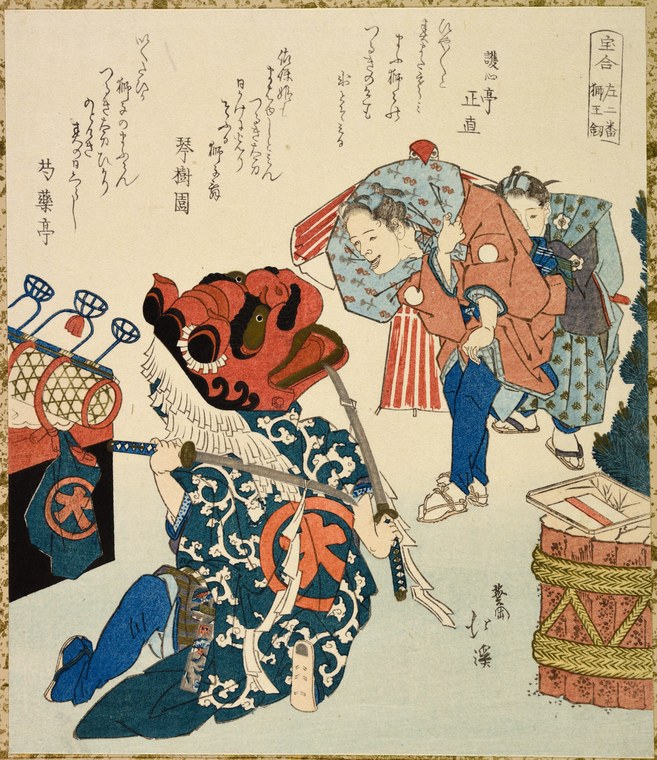
The image is one of the few visual records of shishi mai as it was actually practiced in 19th-century Japan, showing not the formal staged performance but the informal, interactive version performed in homes and streets. For dance historians and practitioners, it documents the historical costume, the scale and construction of the lion head, and the social protocols governing how the dancer engaged with spectators. For anyone studying East Asian ritual art or the intersection of performance and community blessing, the print is evidence of how a spirit-summoning art remained embedded in ordinary social life.
What you are looking at
A Japanese woodblock print depicts a shishi (lion) dancer in full performance regalia confronting three elegantly dressed women and children who appear delighted or startled by the encounter. The lion figure dominates the left side of the composition: its massive red head with exaggerated features—bulging eyes, gaping mouth with prominent teeth, and elaborate decorative patterns in blue and white—towers over the human figures. The dancer's body is concealed beneath a long patterned textile in deep blue and orange, which trails across the foreground. The women wear rich kimono in coral, blue, and patterned fabrics; one holds a parasol above her head. The setting appears to be a public or domestic space with woven baskets and folded textiles visible on the right edge, suggesting the event was documented or staged indoors. The print's composition emphasizes the theatrical encounter between the mythical creature and the spectators, capturing a moment of interaction rather than pure performance.
The dancing
The lion figure is shown in a forward-lunging or greeting posture, its massive head angled toward the women with an expression of playful aggression or blessing rather than threat. The three women and children are clustered together in a protective or curious huddle, their bodies leaning slightly away from the lion yet drawn toward it—a classic pose of delighted apprehension captured in Japanese genre art. The women's postures are constrained by their formal kimono and the social decorum of the period; they stand upright with controlled gestures rather than dancing themselves. The smallest figure (a child) leans against the central woman's leg. No one is in motion; this is a moment of encounter and greeting rather than active participation in the dance.
The dance depicted
This is a shishi mai (lion dance), a form of performance art with deep roots in East Asian ritual and entertainment traditions. The shishi dancer performs as a protective spirit or auspicious creature; the large, articulated head is traditionally manipulated by one or more dancers concealed beneath the costume. The image captures not the acrobatic display or celebratory movement typical of the dance, but rather the social moment—the blessing or greeting of spectators, possibly during a festival, New Year celebration, or formal occasion. The print documents the dance as a cultural practice embedded in daily life rather than as a staged theatrical performance.
How it was made
This is a Japanese woodblock print (likely from the mid-19th century based on style, though not confirmed by the record), executed in the ukiyo-e tradition with hand-applied color (probably using the polychrome technique). The artist has used the technical capacity of woodblock printing to render fine details in the women's garments and facial features while creating bold, graphic areas of flat color in the lion's costume and head. The medium allowed for wide circulation and reproduction; such prints were affordable popular art, distributed to domestic audiences and collected as records of contemporary customs and entertainment.
About this work
This woodblock print documents the shishi mai, a performer art in which a dancer or dancers animate a large ritual head to bring a protective spirit or auspicious creature into contact with spectators. The work is not a high-art record of formal theatrical performance but rather a genre scene—a document of how shishi dancing actually met and blessed people in Japanese domestic or semi-public spaces during the 19th century. It belongs in a dance gallery because it preserves both the physical form of the costume and the social function of the performance: the encounter between the mythical and the human, mediated through ritual and play. The print's composition privileges the moment of interaction over the acrobatic spectacle, revealing what mattered about the dance in its cultural context—its role as a blessing, an entertainment, and a bridge between everyday life and the realm of protective spirits.
How to look at it
Attend to the scale and frontal presentation of the lion head: the artist has made it monumental and confrontational, dominating the composition to convey its power and presence. Notice how the women's and children's body language—the slight lean, the clustering, the raised parasol—registers delighted alarm or protective curiosity rather than fear. The print captures the choreography of blessing and greeting that governs the encounter: the lion advances or hovers; the humans respond with a mixture of deference and delight. The costume details—the patterning, the textile, the articulation visible in the neck—are rendered with precision, suggesting the artist was documenting a real object and practice rather than inventing a fantastical scene.
The artist
The artist is not recorded in the catalogue, but the print's style, technique, and subject matter are consistent with mid-19th-century Japanese woodblock printing (ukiyo-e). The work likely comes from the period when such genre scenes and contemporary celebrations were standard subjects for woodblock artists working for domestic audiences. Without further documentation, the maker cannot be identified, but the execution suggests a professional studio familiar with the requirements of color woodblock production and the conventions of depicting costume and gesture.
The period
Shishi mai (lion dance) was a well-established performance tradition in Japan during the 19th century, with roots in earlier ritual practices connected to Shinto shrines and Buddhist temples. By this period it had become a popular street and domestic entertainment, particularly associated with New Year celebrations and auspicious occasions. In visual culture, the expansion of woodblock printing in the late Edo and Meiji periods created a appetite for genre scenes documenting contemporary life—merchants, actors, entertainers, and ordinary celebrations. This print sits within a wider tradition of depicting performance art and street life as subjects worthy of artistic attention and commercial reproduction.
Where it lives
The work is held by the New York Public Library and appears to have entered the collection as part of their holdings in Japanese prints and visual culture. No accession number, acquisition date, or previous provenance is recorded in the catalogue provided.
Dance in this work
Questions about this work
What is a shishi dancer doing in this print?
The dancer is greeting or blessing the women and children by moving the large lion head toward them. In Japanese tradition, the shishi is a protective spirit believed to bring good fortune and ward off evil; the performance is simultaneously entertainment and a ritual blessing. The print captures the moment of social interaction—the greeting or encounter—rather than acrobatic dance moves.
How many dancers are inside the costume?
The print does not show what is inside the costume; one or more dancers would be concealed beneath the long textile body. The visible element is the large articulated head, which may be manipulated by one dancer or passed between two, depending on the tradition. The print documents only what the audience sees.
Is this a New Year celebration?
The print does not include calendrical or contextual information to confirm a specific occasion. However, shishi mai was most commonly performed during New Year celebrations, festivals, or other auspicious events. The setting appears domestic or semi-public (with folded textiles and woven baskets visible), suggesting an indoor performance in a home or community space rather than a formal theatrical venue.
Why is the lion head so large and dramatic?
The scale and expressive features—bulging eyes, gaping mouth, bold coloring—serve both practical and spiritual functions. The oversized head makes the performer visible and commanding in a crowded space; the exaggerated expression conveys power, auspiciousness, and playful energy. The style follows centuries of East Asian tradition in depicting guardian spirits and protective creatures as vital, larger-than-life presences.
More dance artwork