49 works in this view — arrow keys or swipe to move between them.
Dance in Art · 2018
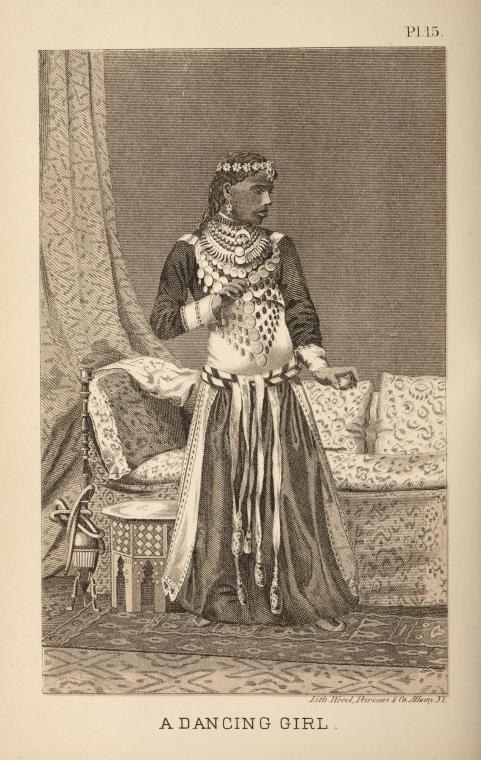
A dancing girl.
Unknown artist
- Medium:
- Source:
- New York Public Library
- Rights:
- Public domain — free to use, share and adapt.
- Recorded as:
- public_domain
This image is one of the primary visual records we have of how Renaissance and early Baroque court dances were actually performed and costumed—a window into movement, posture, and the relationship between clothing and choreography in a period before photography. For dancers and historians of early European dance, such engravings are among the most reliable guides to period style, as they show the carriage of the body, the use of space, and the role of costume in shaping movement in ways that written dance notation cannot fully convey.
What you are looking at
A woman in elaborate historical dress stands in a richly furnished interior, positioned as if pausing mid-movement. She wears a white spotted bodice with a deep neckline, a high jeweled collar, a decorative crown or tiara, and long dark sleeves. Her lower body is draped in layered skirts of graduated tones—light cream fading to deep brown—that fall in sharp, formal pleats suggestive of controlled movement. The setting is a domestic interior with patterned upholstered furniture visible behind her and a decorative textile or curtain on the left. The artist has rendered the figure in sharp profile or three-quarter view, capturing an instant of poised stillness rather than energetic motion. The engraving's fine parallel lines create subtle modeling across the fabrics, emphasizing the geometric precision of the pleated skirts and the ornament of her dress.
The dancing
A single dancer stands with her weight centered, her body held upright and formal. Her arms are positioned with deliberate restraint—one hand appears to gesture gently, the other held at her side. The pose suggests containment rather than extension; there is no dramatic reach or leap. Her head is turned slightly, her gaze directed away from the viewer, adding to an impression of composed decorum. The costume's rigidity—the boned bodice, high collar, and structured skirts—permits only limited mobility of the torso and suggests that movement would have been primarily from the hips downward and through the feet.
The dance depicted
This appears to be a social or theatrical dance of the Renaissance or early Baroque period, most likely a pavane, galliard, or similar court dance. The formal dress, the controlled posture, and the interior setting all point to aristocratic entertainment rather than popular dance. The pleated skirts are characteristic of 16th-century fashions and would have been engineered to enhance the visual effect of turning, stepping, and gliding movements. Without seeing the full sequence of positions or knowing the context of the print's source, precise identification is difficult, but the image documents a moment of codified, highly mannered movement performed by a woman of rank.
How it was made
This is an engraving, likely 18th or 19th century, executed in the fine-line tradition. The technique allows the artist to capture intricate textile detail and precise anatomical proportion while maintaining a portable, reproducible format suitable for circulation among collectors and theatrical enthusiasts. The print's formal presentation—with title, plate mark, and careful composition—suggests it was part of a series or bound collection documenting dance, costume, or theatrical practice. The monochromatic medium required the artist to convey texture and depth through line work alone, demanding exceptional control and attention to the fall and fold of fabric.
About this work
This engraving documents a historical dancing figure, almost certainly from the 16th or early 17th century, presented as a study of aristocratic dance practice and costume. The woman's formal dress, poised carriage, and the refined interior setting establish her as a member of the court or theater world. The print belongs to a tradition of dance documentation in which artists recorded fashionable movement and attire for posterity and reference, particularly important in an era when dance notation was minimal and much knowledge resided in the bodies of practitioners. The work functions simultaneously as a portrait of an individual dancer or type, a fashion plate, and a record of social practice.
How to look at it
Attend to the relationship between the costume and the body: the way the pleated skirts hang and suggest the weight of the body beneath them, the constraint imposed by the boned bodice and high collar on the spine and shoulders, and the precise positioning of the hands and feet. The engraver has frozen a single moment, but the formal posture and the engineer of the clothing suggest a larger vocabulary of steps and turns. Notice how the figure's stillness and formal bearing create a sense of dignity and control—this is not recreational dance but codified movement performed for an audience of rank. The detail of the pleats, the jewels, and the fabric textures are not merely decorative but documents of how movement was visually enhanced and supported by the material culture of the period.
The artist
The artist is not recorded in the catalogue. The engraving's style, technique, and presentation suggest a professional print workshop, likely European and active in the 18th or 19th century. The work may derive from an earlier source (a drawing or painting) or may be part of a larger series on dance, theater, or costume. Without attribution, it is impossible to discuss the artist's practice, but the quality of execution indicates training and familiarity with both dance and the conventions of theatrical prints.
The period
If the dance depicted is from the Renaissance or early Baroque (as the costume suggests), this engraving was likely made well after the fact, in the 18th or 19th century, when interest in historical costume and dance was growing among collectors and antiquarians. The 18th century saw a proliferation of prints documenting older fashions and theatrical practices, often as part of broader historical or costume studies. By the time this print was made, the dances it records would have been archaic, consulted by historians or dancers interested in historical reconstruction rather than performed as living practice.
Where it lives
The work is held in the New York Public Library collection and is accessible through their digital collections. It is catalogued as a print with the title 'A dancing girl' but lacks detailed provenance information. The library record does not specify the artist, printer, date, or edition, suggesting it may have entered the collection without full documentation.
Dance in this work
Questions about this work
What period dance is this?
Based on the costume—the pleated skirts, jeweled collar, and boned bodice—this likely represents a Renaissance or early Baroque court dance such as a pavane or galliard. However, the engraving itself is probably 18th or 19th century, made long after these dances were fashionable, as a historical record or antiquarian study.
Who was this dancer?
The identity of the dancer is not recorded. She may have been a historical figure whose name was lost, or she may represent a type or generic example of a court dancer, created for circulation among collectors interested in historical costume and theatrical practice.
How do we know what dances looked like without video?
Engravings, paintings, and sculptures like this one are primary sources for historical dance. Combined with written dance notation (which survives from the 15th century onward), costume records, and music, they allow historians and dancers to reconstruct how movement was performed, how the body was carried, and how costume shaped gesture.
Why is the figure so still?
The engraver has captured a single moment in a longer sequence of movement. The formal, upright carriage and the controlled positioning reflect the aesthetics of court dance, in which restraint, symmetry, and dignity were valued. The pose may represent the preparation for a turn, a step, or a transition between positions.
More dance artwork