49 works in this view — arrow keys or swipe to move between them.
Dance in Art
Vue du Temple de Venus
Unknown artist
- Collection:
- Prints depicting dance
- Source:
- New York Public Library
- Rights:
- Public domain — free to use, share and adapt.
- Recorded as:
- Public Domain
This print documents the visual and spatial conventions of court dance at a moment when it was becoming a recognized art form worthy of illustration and commemoration. For historians of dance, it offers concrete evidence of how dancers positioned themselves, how many participated, and how dance was framed within ceremonial space—information rarely preserved in written descriptions alone. The work also illustrates the close relationship between dance and the other arts in court culture, showing dance as a medium for displaying architectural magnificence and allegorical meaning.
What you are looking at
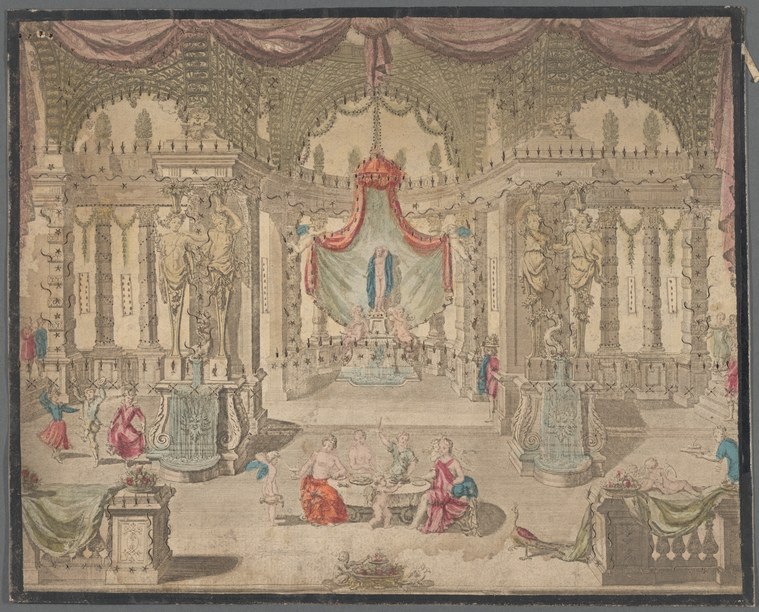
A grand architectural interior stages an elaborate court dance in what appears to be a temple or palace setting. The space is defined by Corinthian columns supporting a coffered ceiling draped with ornate fabric swags in rose and green tones. In the center background, an altar or focal point is marked by a red drapery. The floor is a polished expanse where multiple figures in rich silks and jewel tones—reds, blues, greens, golds—are positioned in various attitudes of dance and attendance. Some figures kneel or sit, engaged in musical performance or observation; others stand in formal poses. The architectural framing creates deep receding planes that emphasize the ceremonial nature of the event. The entire scene is rendered with meticulous attention to perspective, drapery, and the play of light across surfaces, suggesting this is a print depicting an idealized, possibly theatrical or allegorical vision of courtly dance.
The dancing
The dancers and attendants maintain formal, composed postures throughout—no dynamic leaps or rapid motion are suggested. Several figures are grouped in conversation or observation rather than active dance. Those in motion appear to move slowly and deliberately, with arms held in graceful but controlled positions. The overall impression is one of stateliness and formality rather than vigorous physical display. The figures' relationships to one another suggest procession, presentation, and ceremony rather than partner dancing or energetic social movement.
The dance depicted
This appears to depict a court or temple ceremonial dance of the late Renaissance or early Baroque period, most likely a formal court ballet or ballo rather than a recreational dance. The architectural grandeur, the allegorical framing (if the title's reference to Venus's temple is literal), and the formal bearing of all figures suggest a spectacle staged for nobility or in a sacred context. The slow, dignified carriage and the prominence given to visual display and tableau over footwork points to court dance traditions of the sixteenth or early seventeenth century, where dance was an art of presence and geometry rather than technical virtuosity.
How it was made
This is a hand-colored engraving or etching, established from the fineness of the line work, the precision of the architectural detail, and the watercolor wash applied to define spatial planes and costume color. The technique allowed for wide distribution among the educated classes and collectors of prints, making such allegorical or courtly scenes popular documents of elite culture. The careful tonal gradations in the fabric swags and the delicate rendering of both architecture and human figures suggest a skilled printmaker working in the tradition of Renaissance or early Baroque illustration.
About this work
This hand-colored print presents a vision of courtly or ceremonial dance set within an idealized classical temple, rendered with the precision and allegorical grandeur characteristic of Renaissance and Baroque court culture. The work commemorates or celebrates the aesthetics of formal, slow-moving court dance as practiced among European nobility, where dance was inseparable from music, architectural setting, and courtly virtue. The image survives as evidence of how dance was imagined and staged in elite contexts, and of the tight integration between dance, visual art, and architecture in early modern festival culture.
How to look at it
Attend to the architectural frame and the human figures' relationship to it: this is not a snapshot of motion, but a formal composition in which dancers and attendants together create a tableau of ceremonial order. Notice how figures are distributed across the space in poses of presentation and observation rather than energetic movement. The stillness and formality are the point—this is dance as decorum and spectacle, not as athletic display. The print's precise perspective and architectural detail place the viewer at a fixed vantage point, the position of an honored spectator in an actual court or theater.
The period
The late sixteenth and early seventeenth centuries saw the formalization of court dance as an elite art in Italian and Northern European courts. Dance was increasingly documented visually through engravings and etchings, which circulated descriptions of celebrated festivals and spectacles among patrons and collectors who could not attend them in person. The association of dance with temple settings and classical allegory reflects the Renaissance revival of antique forms and the belief that dance was a path to virtue and cosmic harmony—concepts that made court dance a proper subject for serious visual art.
Where it lives
The work is catalogued in the New York Public Library's collection of prints depicting dance, a thematic assemblage that groups works by content rather than by artist or period. This suggests the print was valued for its documentation of a dance scene rather than for its artistic signature or place in a particular artist's oeuvre.
Dance in this work
Questions about this work
Is this an actual record of a real dance performance?
Unlikely to be a direct record. It is more likely an allegorical or imaginative vision of courtly dance set in a classical temple—a convention that allowed printmakers to elevate dance to the status of high art by associating it with antiquity and virtue. Such prints often commemorated famous spectacles or invented idealized versions of court dance for collectors.
What dance style is being shown?
The formal carriage, slow movement, and emphasis on geometric positioning suggest a court ballo or early ballet—the slow, dignified courtly dance traditions of the Renaissance and early Baroque. The absence of vigorous footwork or acrobatic display is consistent with dance of this period, in which elegance of bearing and precision of formation were paramount.
Why is the setting a temple?
The title invokes the Temple of Venus, drawing on Renaissance and Baroque practice of linking courtly dance to classical and allegorical themes. Dance in temples or sacred settings suggested that dance was a civilizing art worthy of respect, not merely entertainment. The classical architecture also elevated the subject and appealed to educated viewers familiar with antique literature and art.
More dance artwork





