25 works in this view — arrow keys or swipe to move between them.
Dance in Art
The Waltz
Camille Claudel
- Medium:
- bronze sculpture
- Dance:
- Waltz
- Era:
- 1900-1920 (Ragtime/Early Jazz)
- Source:
- Wikimedia Commons
- Rights:
- Public domain — free to use, share and adapt.
- Recorded as:
- public_domain
This is one of the most recognized sculptures of dance in Western art history, and it captures something essential about how the waltz was *experienced* and *imagined*—not as a technical accomplishment but as an erotic and emotional transaction. For historians of ballroom dance and its cultural meaning, the work is primary evidence of how the dance was understood by the artistic elite in the early 20th century.
What you are looking at
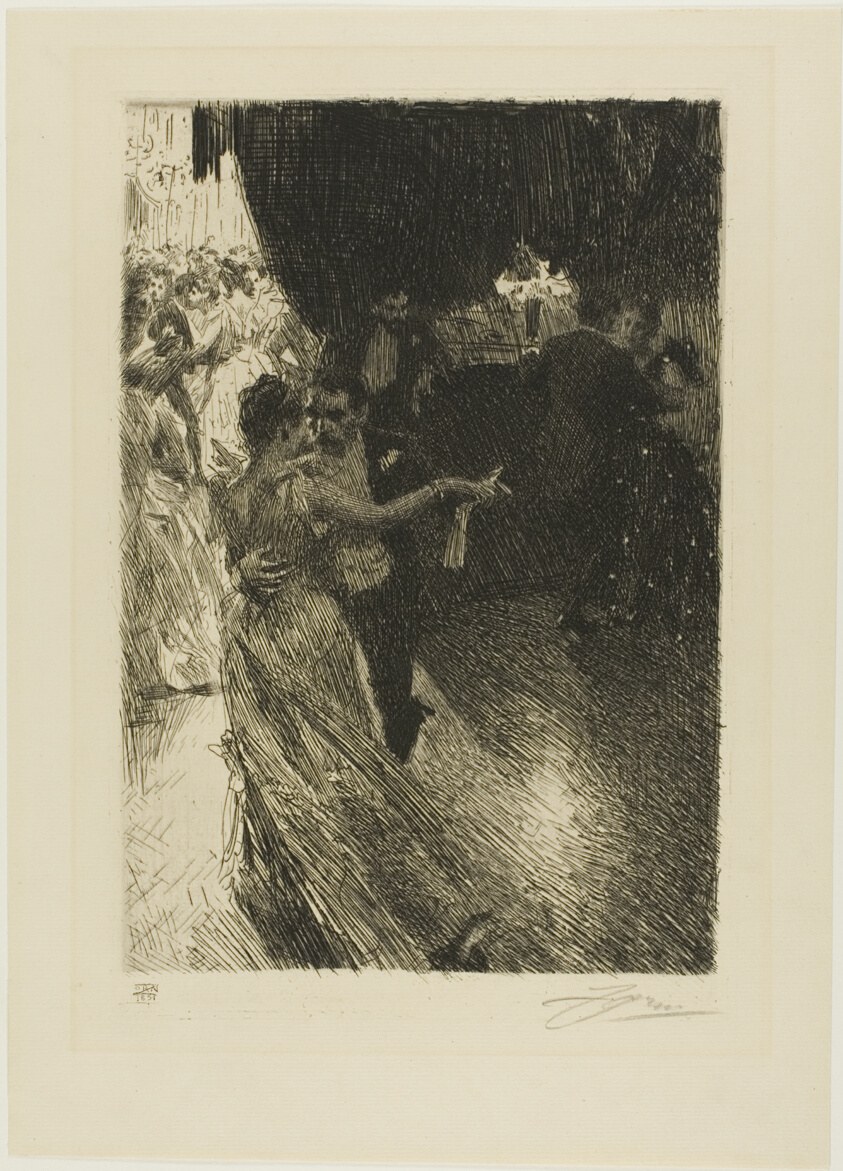
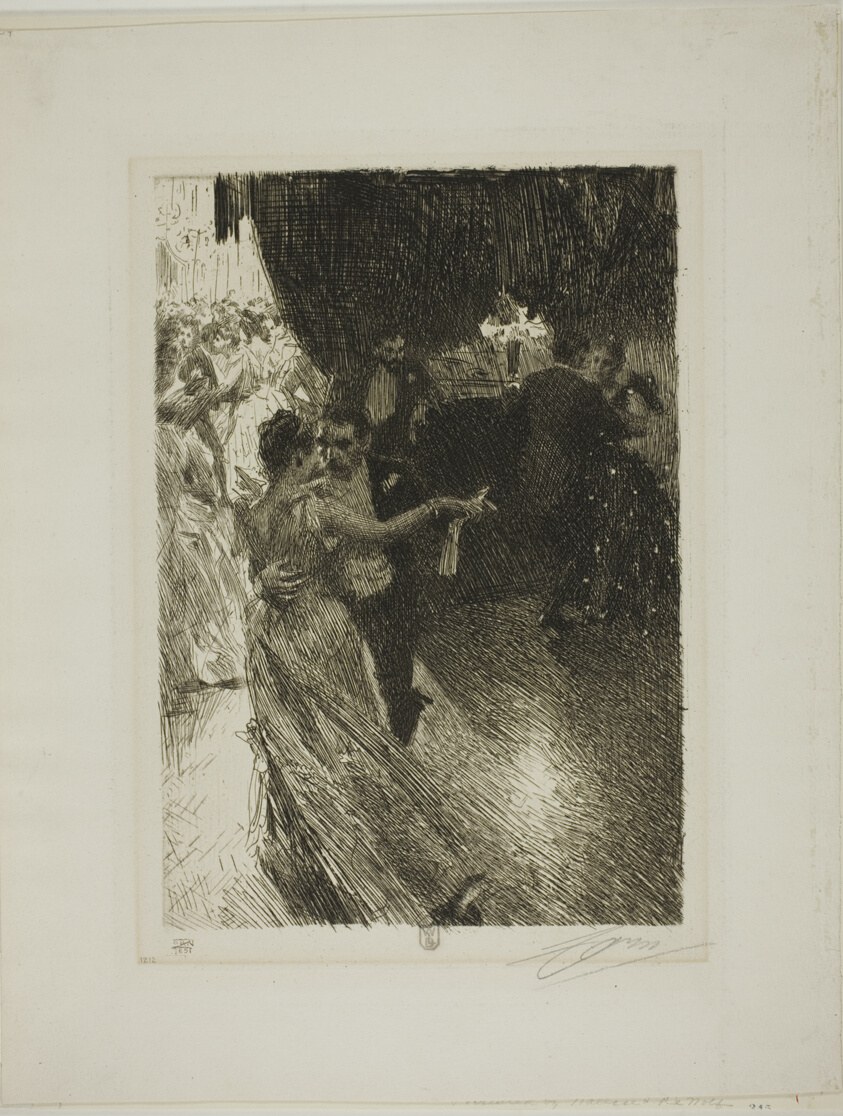
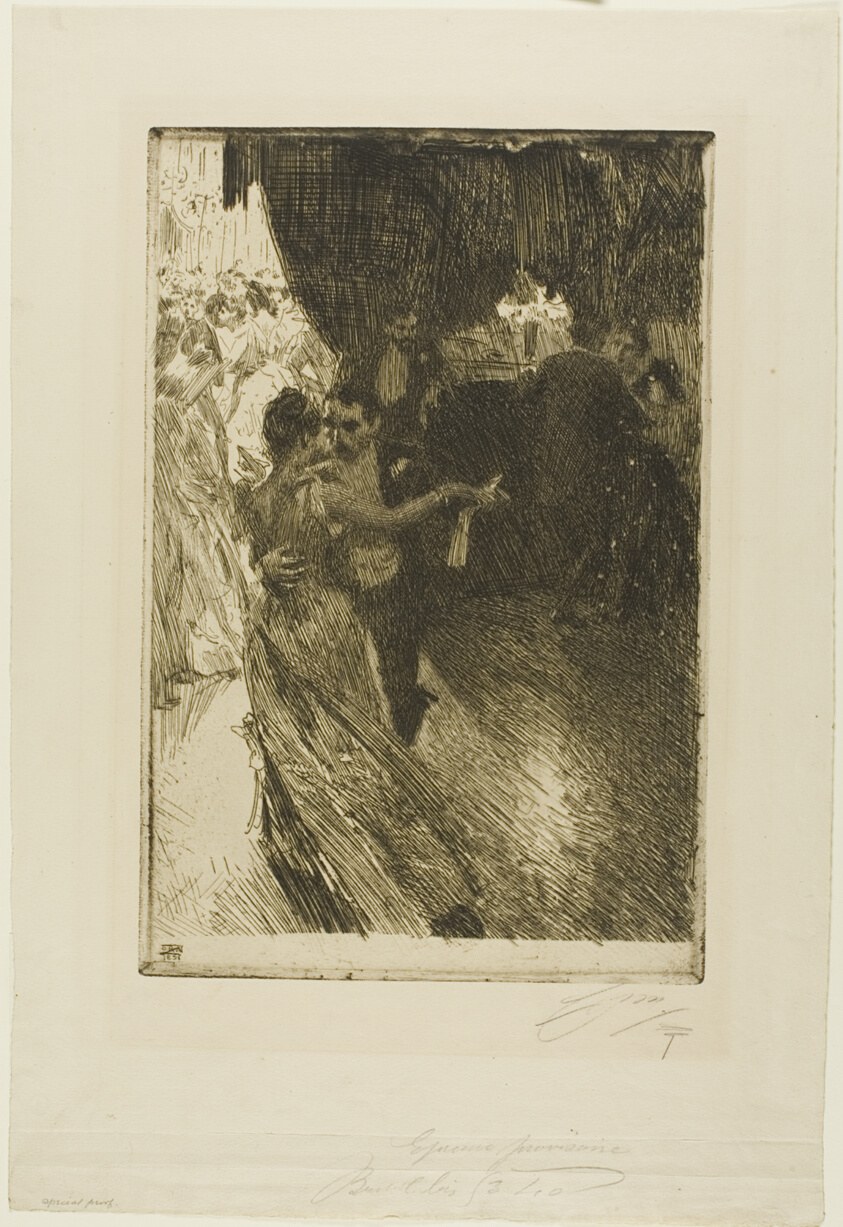
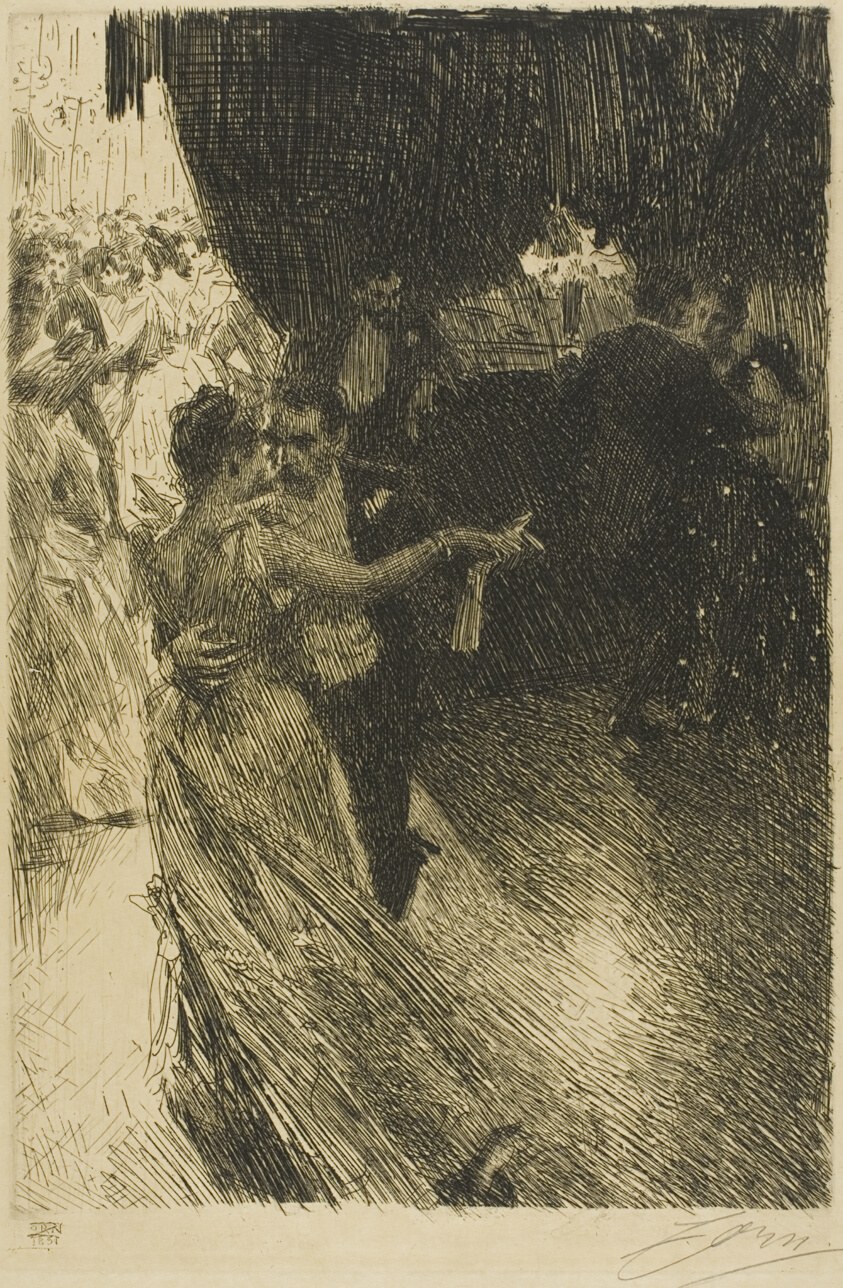
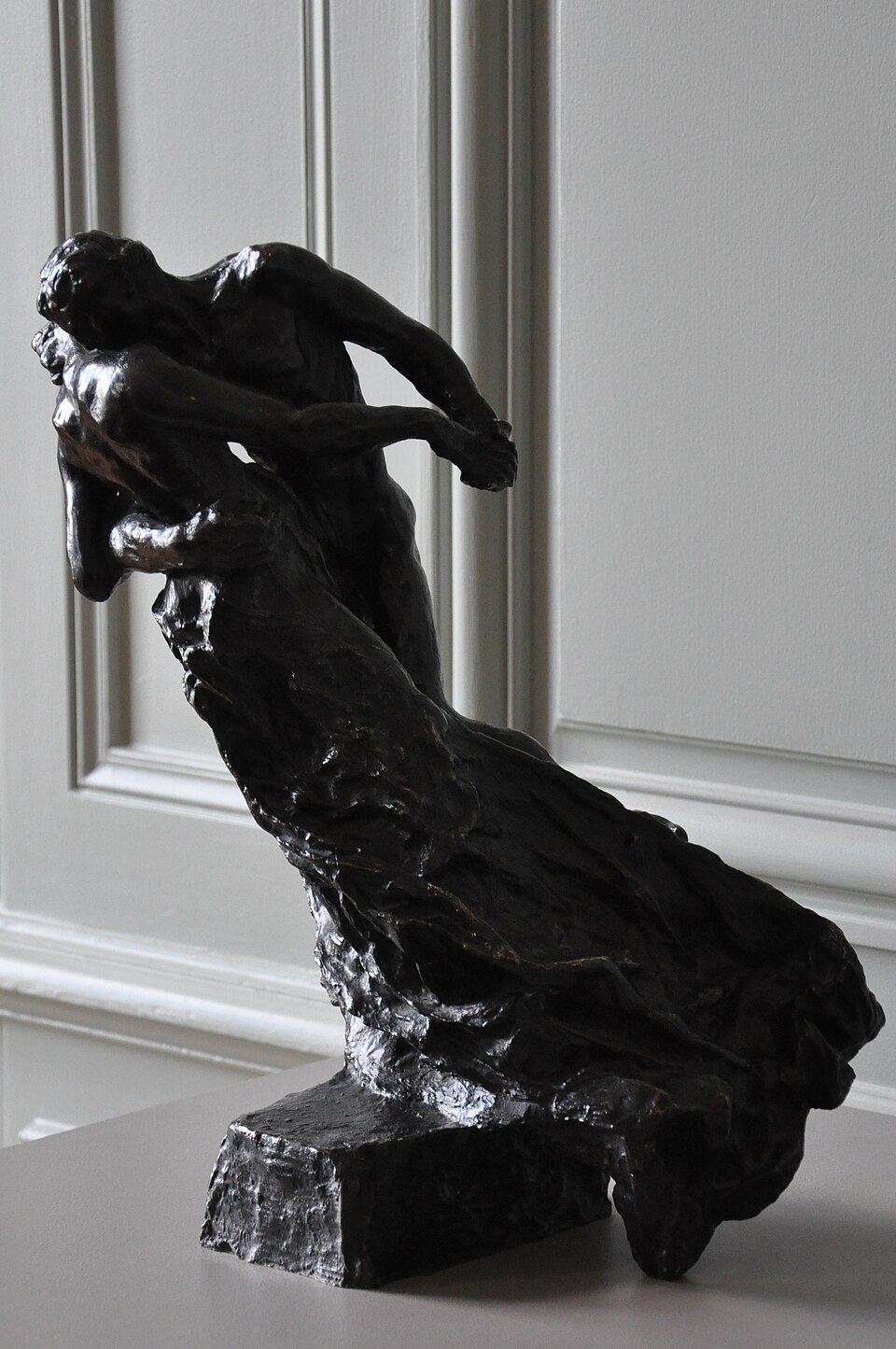
A bronze sculpture captures a pair of waltzers at the apex of their turn, their bodies fused into a single rising arc. The couple leans sharply back and inward, the woman's body extending in a long diagonal line from the man's embracing arm, her hair and drapery streaming downward in the direction opposite to their motion. The man's face is turned toward his partner, his arm tensed across her back; the woman's head tips back, her face partially obscured but her body language communicating complete surrender to the momentum of the dance. Below them, the base is rough and organic, almost geological, suggesting bedrock or earth—a stark contrast to the polished, fluid forms of the dancers themselves. The work is lit from the front, creating deep shadows that emphasize the hollow spaces between the figures and throw their musculature into sharp relief. The photograph captures the sculpture in a gallery setting, mounted at eye level against a white wall with vertical paneling.
The dancing
Two bodies locked in closed ballroom hold, but the hold is distended and dynamic: the man stands nearly upright while the woman extends backward and outward, her body arched in an extreme line that reads as both voluptuous and perilous. His arm curves protectively across her back; her arm extends away from her body in the line of rotation rather than clasped at his shoulder. The sculptor has caught the instant of maximum tilt and spiral—the moment when centrifugal force dominates over balance, and the woman's weight hangs entirely from the man's support. The work is read from any angle, but frontally it reads as an embrace threatening to collapse into a fall.
The dance depicted
This is unmistakably waltz, identified by the closed ballroom hold and the rotational momentum frozen in sculptural form. The waltz was the defining social dance of the 19th century, practiced by couples in public ballrooms across Europe and America in closed embrace. The work documents not the regulated, vertical waltz position of technical ballroom instruction, but rather the theatrical, romantic ideal: the woman surrendering to the momentum of the turn, her body dipped and extended, the dance as a form of intimate theater. The sculptor emphasizes the sensuality and risk inherent in the form—the couple moving at speed, the woman trusting entirely to her partner's control.
How it was made
Cast bronze, a medium that allows the artist to capture and preserve dynamic movement in permanent form. The surface is finished to varying degrees: the faces and upper bodies are finely modeled and polished, while the base and drapery retain a rougher texture that suggests movement and turbulence. The bronze casting process requires an armature and precise foundry work to achieve the cantilever and overhang of the woman's extended body without structural failure. This is a work of technical virtuosity as well as artistic vision.
About this work
Camille Claudel's *The Waltz* is a bronze sculpture that freezes the moment of maximum intimacy and risk in ballroom dancing. Made in 1905, it belongs to the tradition of Rodin and late 19th-century sculpture in which human movement and emotion are compressed into a single, legible gesture. The work is neither documentary—a record of how waltz was danced in the ballroom—nor abstract: it is a romantic image of the dance, an interpretation of what waltz meant to the artistic imagination of its time. The sculpture has entered the canon of dance imagery because it speaks to something beyond the step: the surrender, trust, and erotic charge of partner dancing at its most intense.
The work documents a historical moment in which the waltz had become not just a dance but a symbol of modernity, passion, and the collision of social propriety with emotional desire. Claudel's image resists the academic restraint typical of sculpture of the period and insists instead on the body's capacity for abandonment.
How to look at it
Attend to the moment the sculptor has chosen: not the vertical axis of a stable waltz position, but the instant of maximum tilt, when the couple is caught mid-turn and the woman's entire weight depends on her partner's arm. Look at how Claudel uses the bronze surface to differentiate between control (the man's tensed musculature, the smooth finish of his face and torso) and abandon (the streaming hair, the rough base, the woman's extended vulnerability). The work is designed to be read from multiple angles; walking around it reveals how the sculptor has modeled the space between the bodies and the energy flowing through the pair.
The artist
Camille Claudel (1864–1943) was a French sculptor trained under Rodin, whose assistant and collaborator she was for many years. Her work is characterized by psychological intensity, attention to the body in emotion, and a willingness to depict vulnerability and desire without sentimentality. *The Waltz* is one of several works in which Claudel explored dance and movement as subjects; her sculptural language is fluid, modernist, and deeply concerned with the moment of transformation or surrender. She worked in marble and bronze, often choosing subjects from literature, mythology, and contemporary life that allowed her to explore female experience and agency.
The period
The waltz enjoyed a second surge of cultural prestige in the 1890s and early 1900s, when it was reinterpreted as a symbol of modernity and emotional authenticity in reaction against Victorian formality. Symbolist and Art Nouveau artists, Claudel among them, were attracted to dance as a subject because it allowed the representation of the body in transformation, free from the constraints of neoclassical ideology. The sculpture was created in the same cultural moment as Henri Becque's *La Parisienne* and the early Diaghilev ballet, when dance was being repositioned as a serious subject for artistic and intellectual attention. Claudel's work sits at the intersection of academic sculpture tradition and modernist innovation.
Where it lives
The work is documented in the catalogue record as a bronze sculpture dated 1905, currently held in an unrecorded collection. The image comes from Wikimedia Commons, a digital archive that hosts images of artworks in public and private collections worldwide.
Dance in this work
Questions about this work
Is this a real couple, or is it an idealized representation?
Claudel modeled the work from observation and imagination combined. While the lovers are not identifiable individuals, their bodies are rendered with anatomical precision and psychological specificity. The work belongs to the tradition of allegorical sculpture, in which ideal types—*Lovers*, *Passion*, *Surrender*—are embodied in particular, convincing bodies.
How was this sculpture made?
Claudel would have begun with a clay model, which was then cast into bronze using the lost-wax process. This labor-intensive technique allows for the preservation of fine detail and the possibility of multiple casts. The process required solving technical problems: the cantilevered extension of the woman's body required careful calculation to ensure the sculpture would not topple or crack during casting and cooling.
When was the waltz at its cultural peak?
The waltz was at its height of prestige in the 1880s–1920s, the period in which Claudel made this work. By the early 20th century, it had become a symbol of European modernity and was used in visual and literary art to represent both romance and decadence. Claudel's sculpture captures the moment at which the waltz was being elevated from a mere social dance to a metaphor for emotional and erotic intensity.
What is the rough base supposed to represent?
The textured base functions both practically—as structural support for the cantilevered figures—and symbolically, suggesting earth, instinct, or the turbulent emotional forces beneath the refined surface of the dance. The contrast between the smooth, polished bodies and the rough base emphasizes the collision between civilization (the dance, the embrace, the ballroom) and nature or desire.
More Waltz artwork