37 works in this view — arrow keys or swipe to move between them.
Dance in Art
Sylphiden. Polka
Unknown artist
- Medium:
- Lithograph
- Dance:
- Polka
- Era:
- Late 1800s (Victorian Ballroom)
- Source:
- New York Public Library
- Rights:
- Public domain — free to use, share and adapt.
- Recorded as:
- public_domain
This image captures the moment when Romantic ballet—specifically the sylph archetype from *La Sylphide*—had become so culturally dominant that it was used to market concert music to the general public. For dance historians, it is primary evidence of how the pointe shoe, the short tutu, and the weightless, classical pose had crystallized into universally recognizable symbols of 'theatrical dance' by the late 1800s. For dancers, it documents the visual language of early Romantic ballet as it was transmitted through commercial lithography.
What you are looking at
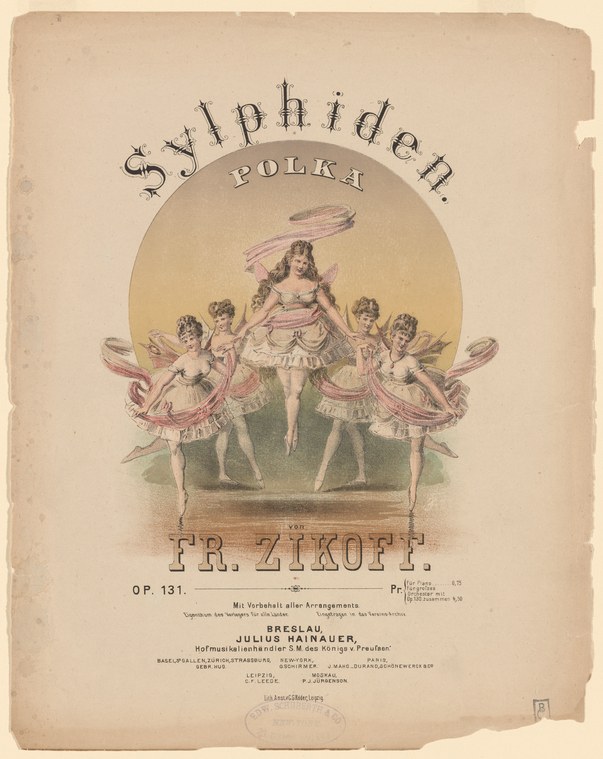
A lithographed cover page for a polka composition titled *Sylphiden* (The Sylphs), centered on an ethereal theatrical scene. Five female dancers in pale, gossamer costumes float across a stage in an arrangement suggesting weightlessness and grace. The central figure stands tallest, dressed in a short white tutu or ballet skirt with pink silk ribbons flowing from her shoulders and arms. Four smaller figures—likely representing the corps de ballet or attendant sylphs—surround her in a symmetric composition, each similarly dressed in short white skirts and posed with arms raised and extended. All dancers wear pale tights and pointe shoes. The figures are rendered in soft, naturalistic tones against a warm golden background, creating an impression of luminosity. Below the scene, ornamental text frames identify the work as a polka composition by Fr. Zikoff, Op. 131, published by Julius Hainauer in Breslau. The lithograph's decorative typography and the romantic imagery suggest this was a cover for sheet music, circulated for domestic and concert performance.
The dancing
Five dancers are arranged in a hierarchical composition: the central figure stands en relevé (on the balls of her feet, suggesting pointe work) with arms extended sideways in a classical second position or épaulement, while four attendant figures are positioned around her in mirror-image poses—some with arms raised overhead, others with arms extended laterally. All figures exhibit the upright carriage and turned-out legs characteristic of ballet training. The corps figures are smaller in scale, creating an illusion of spatial depth. Their poses suggest a moment of floating suspension rather than active traveling movement, with bodies elongated and weight lifted.
The dance depicted
This is a theatrical ballet image, most likely depicting a scene from or inspired by the Romantic-era ballet *La Sylphide* (1832), the most famous ballet featuring sylph characters. The word *Sylphiden* (Swedish/German: "The Sylphs" or "The Sylph Maidens") and the ethereal aesthetic confirm a sylph subject. The polka form itself—a lively, modern social dance of the 19th century—creates an interesting cultural collision: the composition title indicates a stage ballet with romantic ballet vocabulary (pointe work, tutus, classical positioning), but it was published as a polka, a popular dance for ballroom and concert use. This suggests the piece was meant either as a concert polka inspired by the famous ballet, or as a stylized, theatrical version of the polka for trained dancers, not social dancing.
How it was made
This is a lithograph, a planographic printing process in which an image is drawn on stone or metal using greasy ink, then chemically treated so that ink adheres only to the drawn marks. The technique allowed for subtle gradations of tone (visible in the soft modeling of the dancers' bodies and the warm golden background wash), fine linear detail in the typography, and hand-coloring, which has been applied here in soft watercolor—pale flesh tones, white dresses, pink ribbons, and warm sepia backgrounds. Lithography was the dominant medium for theatrical sheet-music covers, poster art, and popular illustrations in the 19th century, making this work a typical product of mass but refined circulation for middle-class and concert audiences.
About this work
This lithographed sheet-music cover presents a theatrical ballet image dressed in the vocabulary of Romantic-era pointe work and classical positioning: five sylph-like figures in tutus and pointe shoes, arranged in a symmetric, weightless composition. The work conflates two 19th-century dance forms—the iconic Romantic ballet *La Sylphide* and the polka, a modern social dance—suggesting it was marketed as a concert piece bridging theatrical and social dance worlds. The image is a primary record of how ballet imagery was circulated through popular media, and what visual conventions—the tutu, the pointe shoe, the ethereal pose—had come to symbolize theatrical dance for literate European audiences by the late 1800s. The work belongs in a gallery of dance art as both a document of ballet iconography and an artifact of 19th-century music publishing and theatrical culture.
How to look at it
Attend first to the moment of weightlessness the artist has frozen: no dancer's foot is planted; all are in suspension or relevé, and the composition emphasizes vertical lift and floating. Notice the careful symmetry of the corps figures around the central sylph, a stage-design convention that emphasizes the ethereal and otherworldly rather than naturalism. The pink silk ribbons flowing from the central figure's shoulders and arms were a signature costume element of sylph ballets, making this a deliberate visual citation of *La Sylphide* iconography. The soft, luminous background and the careful modeling of the pale flesh tones are technical achievements of lithography, and they contribute to the romantic mood—this is not documentary realism, but theatrical illusion.
The artist
The composer Fr. Zikoff is not recorded in major biographical databases; the work was published by Julius Hainauer, a music publisher in Breslau (now Wrocław), suggesting regional Central European production. The lithographer is not credited. The lack of attribution is typical of commercial sheet-music illustration of this period, where cover art was a collaborative and often anonymous product of publishing houses.
The period
By the late 19th century, Romantic ballet—epitomized by *La Sylphide* (1832) and *Giselle* (1841)—had become the dominant theatrical dance form in Europe. The sylph, the ethereal female spirit in a white tutu and pointe shoes, had become the visual archetype of 'ballet' itself. Simultaneously, the polka—a lively, modern social dance from the 1840s—had become a favorite of composers and concert musicians. This work sits at the intersection: it takes the imagery of Romantic ballet's most famous invention and applies it to a modern, social dance form, suggesting that by the 1880s–1890s, ballet aesthetics had become aspirational and iconic enough to enhance the cultural status of popular dance music. The lithograph's soft, hand-colored technique was the standard medium for theatrical and commercial illustration, ensuring wide circulation among the educated middle class.
Where it lives
This lithograph comes from the New York Public Library collection, where it is catalogued as a sheet-music cover. It is part of the historical record of 19th-century music publishing and theatrical imagery circulation in Europe, held as an artifact of commercial print culture.
Dance in this work
Questions about this work
Is this related to *La Sylphide*?
Almost certainly yes. The title *Sylphiden*, the costume (tutu and pointe shoes), and the ethereal pose are all direct visual references to the 1832 Romantic ballet *La Sylphide*. This polka composition borrowed its imagery and subject matter from that famous work, suggesting it was marketed as a concert piece inspired by or celebrating the ballet.
Why would a polka have a ballet image on its cover?
By the late 19th century, theatrical ballet had become so prestigious and visually iconic that its imagery could be used to elevate other musical genres. Using sylph imagery gave the polka a theatrical, refined, even romantic quality—suggesting this was concert music for educated audiences, not merely popular dance music. It reflects the cultural prestige of ballet in Victorian Europe.
Are these dancers actually dancing, or just posing?
This is a freeze-frame of a choreographed moment, not a document of traveling movement. The symmetric, floating composition emphasizes the theatrical and static over the kinetic—this is an image of stage presence and visual beauty rather than dynamic action. This was a common choice in 19th-century theatrical lithography, which prioritized compositional harmony over movement clarity.
How was this image made?
This is a hand-colored lithograph, a printing technique that allowed artists to create subtle tonal effects (visible in the soft golden background and flesh tones) and fine detail. The lithographic process made it ideal for theatrical sheet-music covers, which needed to be both visually appealing and producible in moderate quantities for middle-class consumers.
More Polka artwork