39 works in this view — arrow keys or swipe to move between them.
Dance in Art
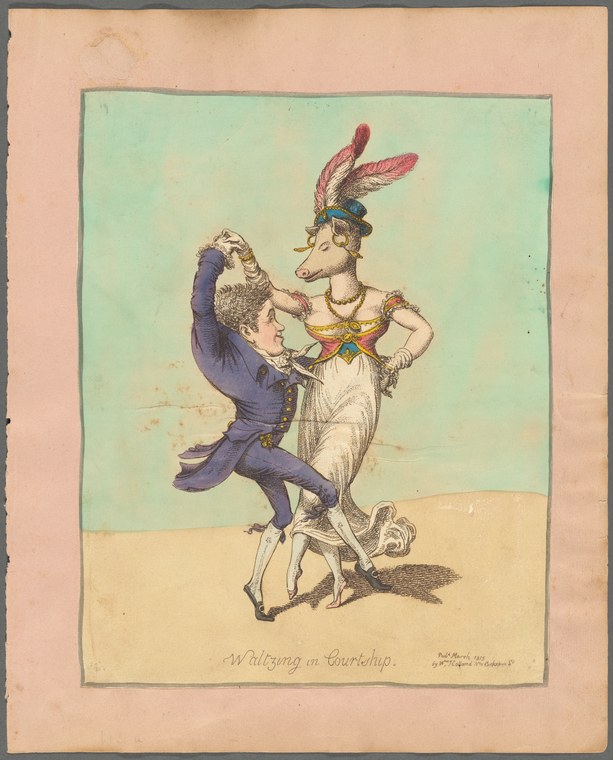
Waltzing in courtship
Unknown artist
- Medium:
- Lithograph
- Dance:
- Waltz
- Era:
- Early 1800s (Waltz Revolution)
- Source:
- New York Public Library
- Rights:
- Public domain — free to use, share and adapt.
- Recorded as:
- public_domain
This print is a primary document of the Waltz Revolution—the moment when a new dance form challenged established social order and became a flashpoint for debates about gender, propriety, and modernity. For anyone studying how dance functions as cultural commentary, or how the waltz itself was perceived and resisted, this image records not the dance as it was performed, but how it was understood: as a loss of control, a transgression, and a power reversal.
What you are looking at
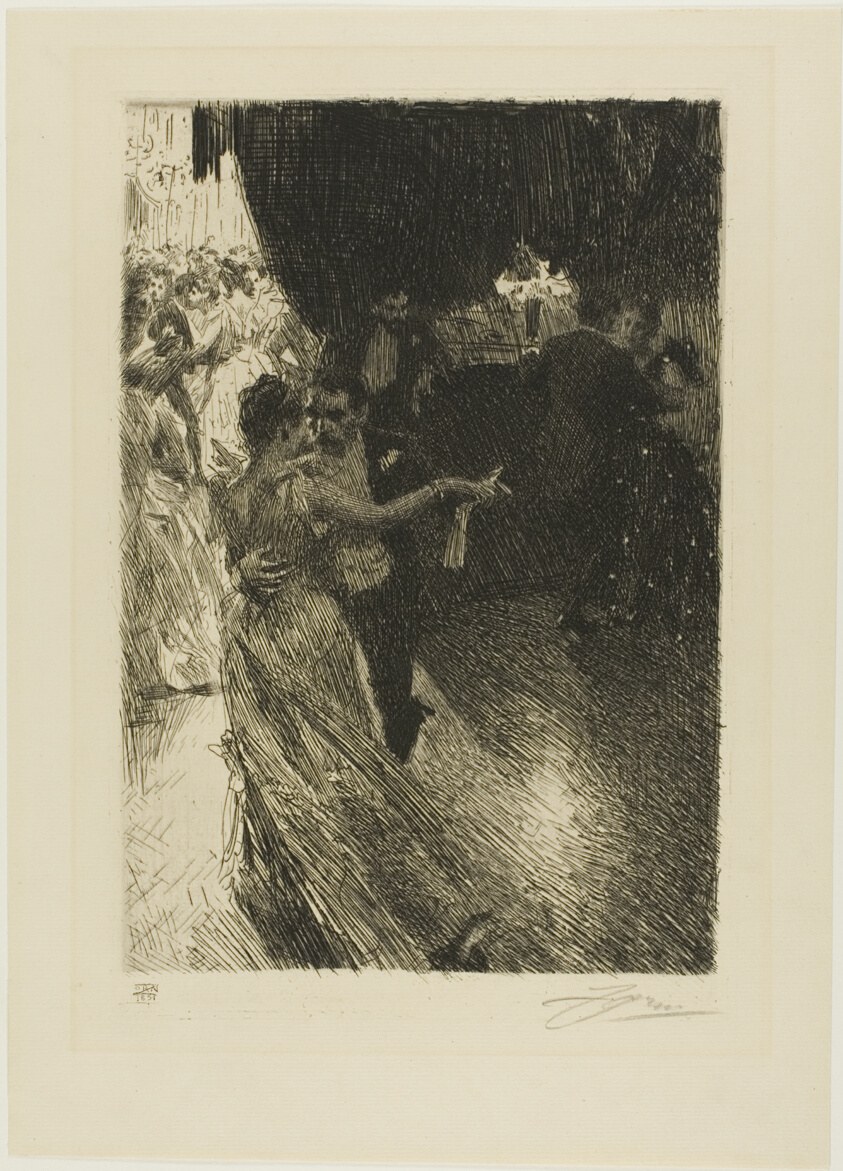
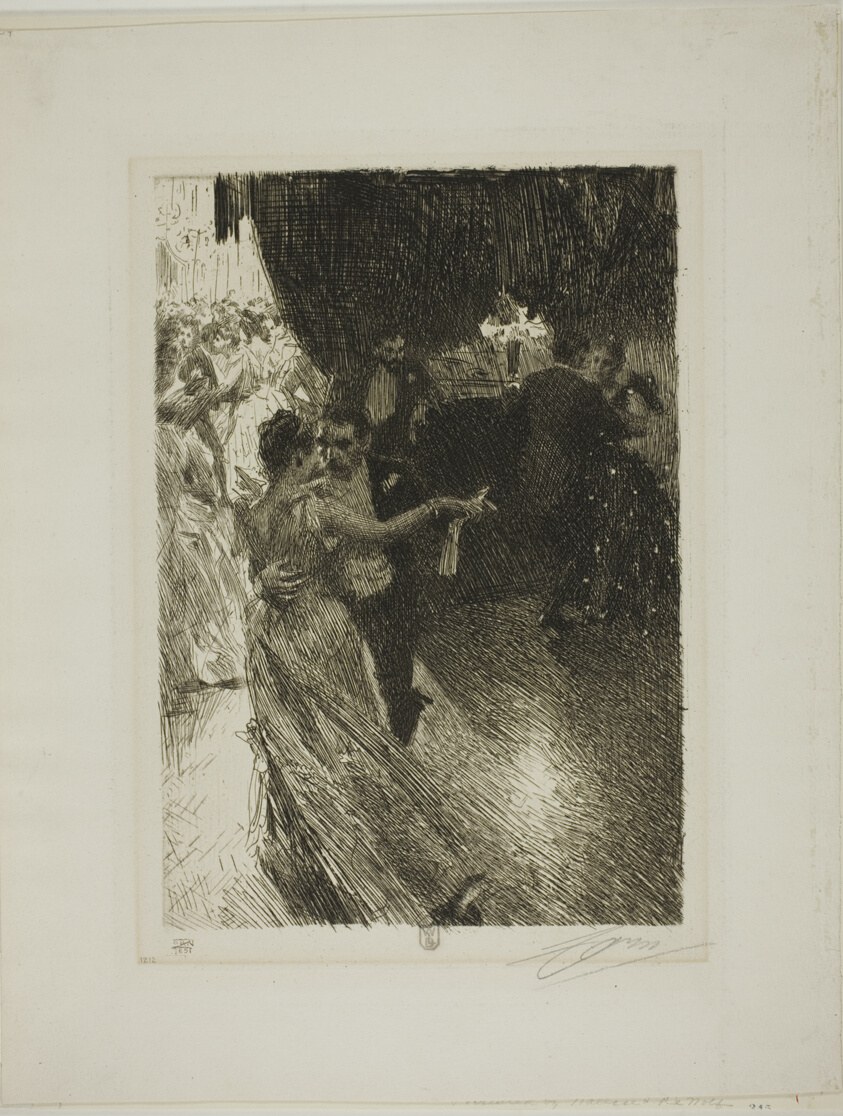
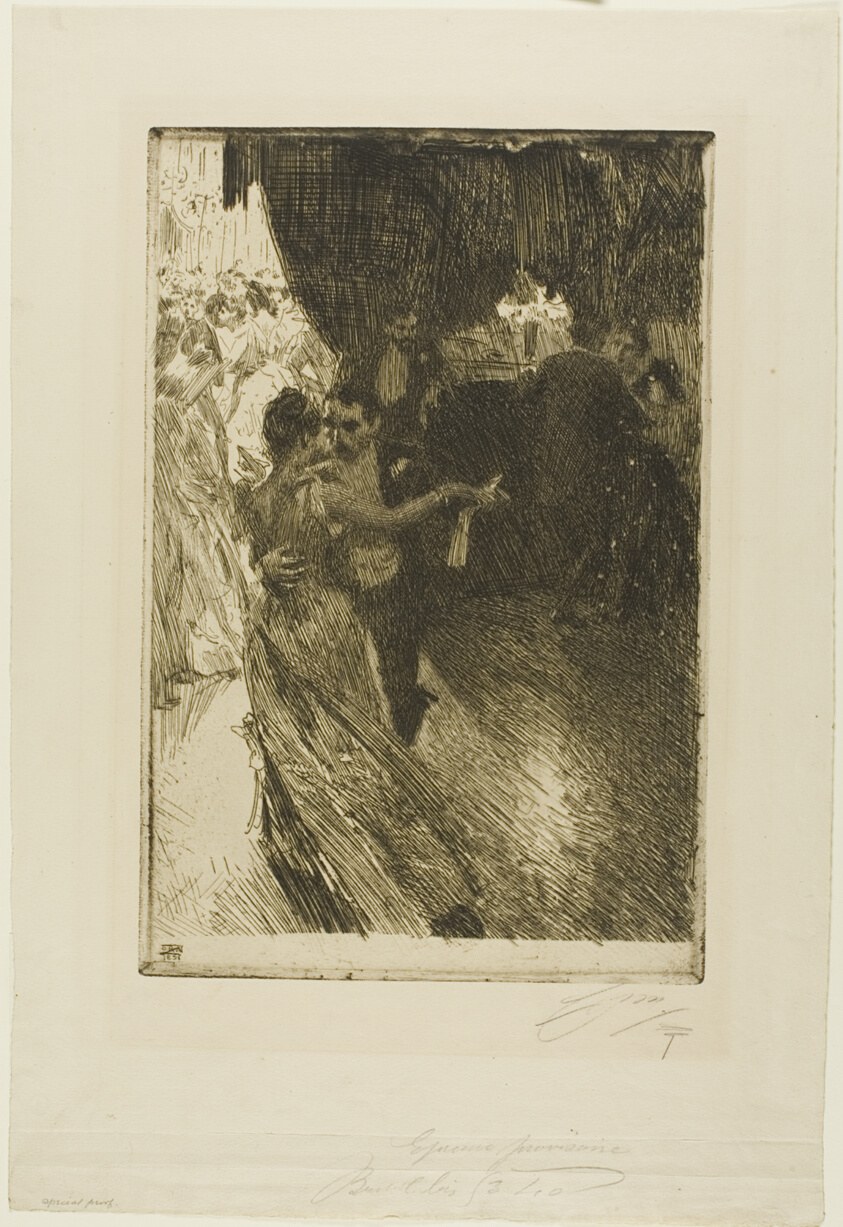
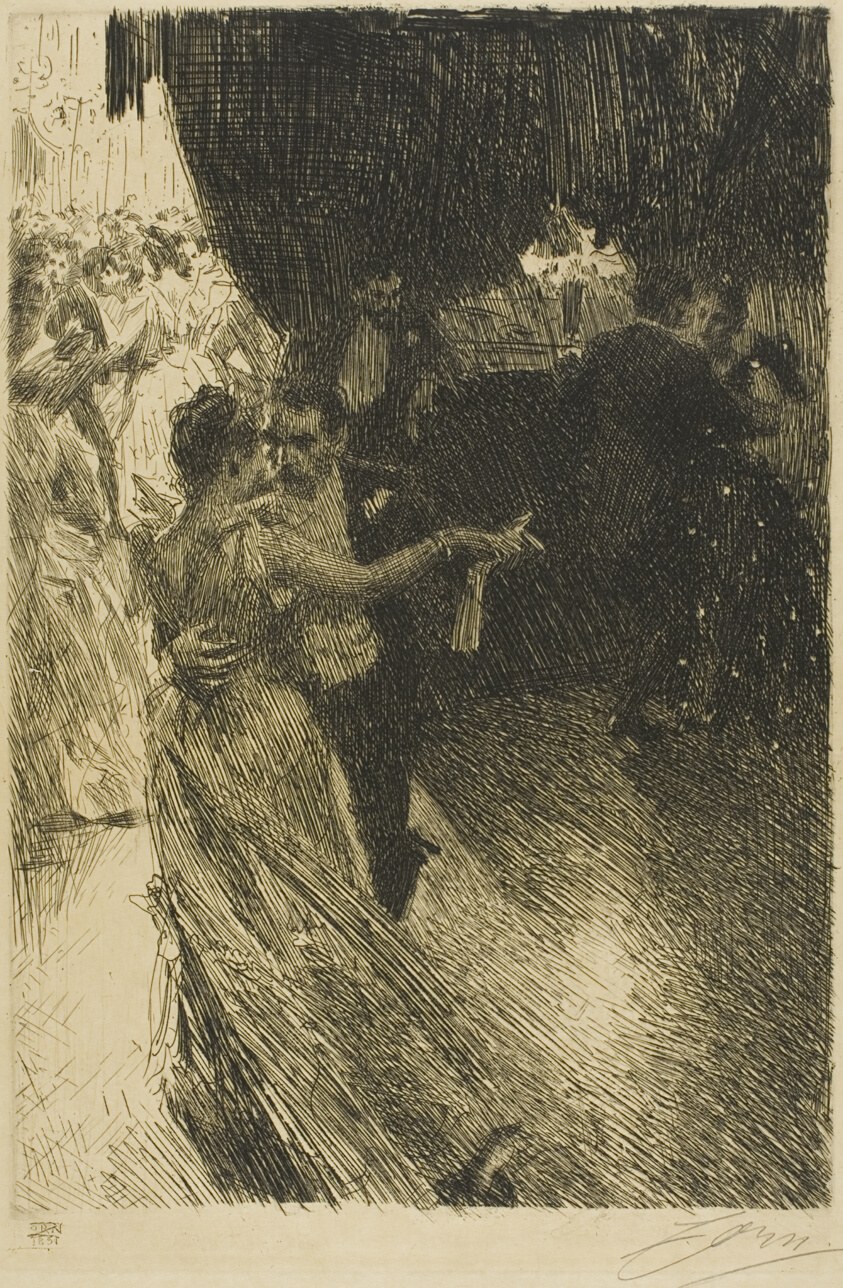
A man in dark formal dress and a woman in a high-waisted white neoclassical gown dance together against a pale green sky and sandy ground. The man, wearing what appears to be a dark coat and breeches, is tilted dramatically backward in an exaggerated pose, his body nearly horizontal. The woman, crowned with red ostrich feathers and wearing a simple white Empire-waist dress with a jeweled ornament at the bodice, supports him with one arm while striking a composed, upright pose. The composition is theatrical and satirical: the woman appears entirely in control while the man is helpless, his feet barely touching the ground. A small dog watches from the lower right. The lithograph's hand-colored palette—soft greens, flesh tones, and vivid red plumes—gives the scene a caricatural, print-room quality.
The dancing
The couple stand in close contact but with a marked power imbalance. The man's upper body is thrown backward in an arc that defies natural balance, with his weight supported entirely by the woman's grip. The woman maintains an upright, dignified posture, her arm extended to manage his weight. Their relative positions—her stability against his collapse—suggest the artist is commenting on the dance as much as depicting it. The woman's legs are positioned to support the turn; the man's are splayed or crossed in a way that emphasizes his loss of control.
The dance depicted
This depicts the waltz, the dance that revolutionized European ballroom practice in the early 1800s. The waltz introduced close partner contact and rapid turning, both of which scandalized observers and inspired satirical commentary and caricature. The exaggerated backward lean—known as a "promenade" position taken to absurd extremes—was a real feature of waltz technique but also a target of contemporary humor about the dance's apparent danger and impropriety. The title 'Waltzing in courtship' signals that this is courtship imagery, using the waltz as metaphor for romantic pursuit and the vulnerability it entails.
How it was made
This is a hand-colored lithograph, a mass-produced print medium that allowed rapid dissemination of satirical images to a broad audience. Lithography's ability to reproduce fine detail in drapery and gesture, combined with hand-coloring, made it ideal for social commentary. The technique was fast and economical enough to respond quickly to current events or fashions—in this case, the waltz craze itself. The soft ground tones and careful attention to fabric suggest a skilled hand, and the composition's theatrical framing indicates the print was designed for display in homes or print shops.
About this work
This is a satirical representation of the waltz at the height of its social controversy in the early 1800s. The waltz was the first ballroom dance to place couples in close embrace and rapid rotational movement, and it provoked intense moral and social debate across Europe. Conservative critics condemned it as improper and dangerous; advocates celebrated it as modern and liberating. This print captures that anxiety through caricature: the woman is competent and commanding, while the man is literally off his feet, overwhelmed. The image belongs in a dance archive because it documents how the waltz was understood—not merely as a technical innovation, but as a social and sexual disruption that redrew the rules of courtship and physical propriety.
How to look at it
Look first at the power dynamic: the woman is stable, the man is prostrate. This is intentional satire, not anatomically plausible—no waltz partner actually dances bent nearly double. The artist has frozen a moment of apparent crisis (the man's loss of control) to make a point about the waltz itself: it is not a rational exchange of equals, but a form of surrender or seduction. Notice the woman's face and posture: she is unmoved, almost indifferent to the drama of his collapse. The red feathers signal fashionable elegance; the small dog's watchful presence adds a note of comedy. The theatrical framing and extreme perspective amplify the satire: this is not reportage, but editorial commentary in visual form.
The period
The waltz emerged from German and Austrian folk traditions in the late 1700s and entered European ballrooms around 1800, reaching peak social controversy between 1810 and 1830. During this period, the waltz was condemned from pulpits and editorial pages for promoting impropriety—the close hold was seen as sexually suggestive, and the speed and rotation were thought to make women faint or men lose their heads. Satirical prints became a primary mode of public debate about the dance; caricaturists mocked both the waltz itself and the moral panic it provoked. This print sits within that tradition of social satire, using exaggeration and role reversal to comment on courtship, gender relations, and the anxiety surrounding new social forms.
Where it lives
The work is held in the New York Public Library collection. It appears to be an uncatalogued or lightly catalogued print, typical of the large holdings of satirical prints, fashion plates, and social commentary ephemera that passed into major public collections during the 19th and 20th centuries. Its survival in NYPL suggests it was preserved as a document of 19th-century social history rather than fine art.
Dance in this work
Questions about this work
Is this a real waltz position?
No—this is satire. The man's extreme backward lean is an exaggeration of the promenade position, which did involve some backward lean, but nothing like this. The artist has deliberately distorted the dance to make a social and moral point: that the waltz throws men off-balance and places them under women's control. Waltz technique in the period was vigorous and required balance from both partners; this print mocks the dance by showing the opposite.
Why was the waltz so controversial?
The waltz introduced two radical changes to ballroom dancing: close partner contact (the couple danced in an embrace rather than at arm's length) and rapid rotational movement (which made dancers dizzy and required a new technique). Conservatives saw it as sexually improper and physically dangerous, especially for women. Doctors warned that the speed and closed hold caused fainting; clergy condemned it as immoral. Satirists like the artist of this print used humor to voice these anxieties.
What does 'courtship' mean here?
In the early 1800s, ballroom dancing was a primary form of courtship—a socially sanctioned space where young men and women could touch and move together under supervision. The title 'Waltzing in courtship' signals that the waltz is being used as a metaphor for romantic pursuit and vulnerability. The image suggests that in courtship (and by extension, in the waltz), control is not equally distributed: one partner may find themselves helpless, dependent, overwhelmed.
More Waltz artwork