40 works in this view — arrow keys or swipe to move between them.
Dance in Art · 2019
The original Redowa waltz
Unknown artist
- Dance:
- Waltz
- Era:
- Early 1800s (Waltz Revolution)
- Source:
- New York Public Library
- Rights:
- Public domain — free to use, share and adapt.
- Recorded as:
- public_domain
The Redowa represents a specific moment in waltz evolution when the basic three-quarter turning dance was being elaborated with additional figures and faster tempos, driving technical innovation among social dancers. The explicit credit to Coulon and the assertion of an "original" version show how professional dancing masters used print culture to establish authority and market their teaching methods across the Atlantic world.
What you are looking at
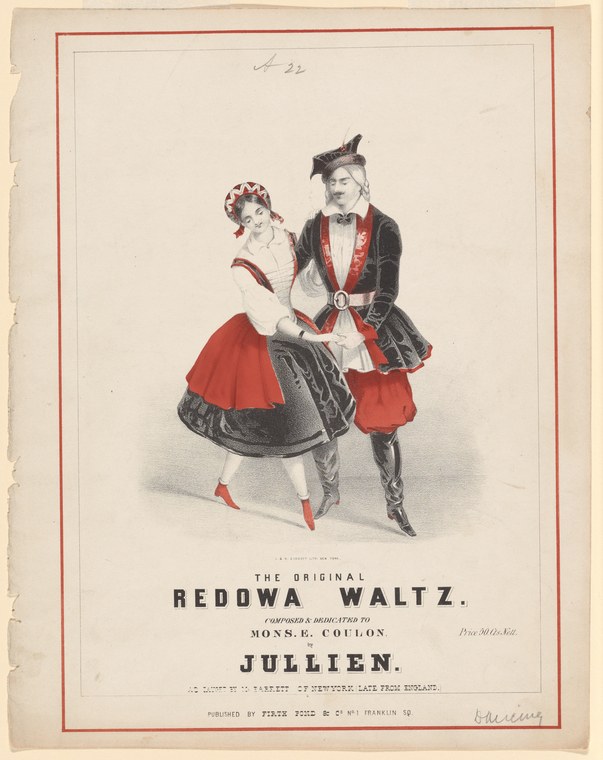
A hand-colored engraving presents a couple in full mid-waltz: a woman in a striking red skirt with black lace underskirts, a white bodice with red ribbon trim, and an ornate red and white headdress, faces the viewer while her partner, dressed in a dark jacket with red collar and cuffs and holding a feathered tricorn hat, guides her in the dance. The composition is tightly framed against a plain background, isolating the pair in a moment of intimate rotation. The woman's body leans slightly into the turn, her weight shifted onto the supporting leg, while her partner maintains an upright posture with his arm positioned to support her through the movement. The image is titled "The Original Redowa Waltz" and credits the dance to "Mons. E. Coulon" with the music by "Julien," establishing this as a published instructional or promotional image rather than a narrative scene.
The dancing
The couple is in closed ballroom position, with the man leading from his right side. The woman's body is angled in the characteristic spiral of a waltz turn, her free leg extended in a graceful line. The man's posture is formal and controlled, with his left arm raised to frame the woman's movement. Both dancers are rendered with anatomical precision—their legs show the weight distribution and footwork of the waltz, with the woman's right foot clearly forward and the man supporting the rotation from his grounded position. The hold is the standard European waltz frame of the mid-nineteenth century.
The dance depicted
This image documents the Redowa waltz, a variant of the Viennese waltz that emerged in the 1840s and gained rapid popularity throughout Europe and America. The Redowa (or Redowa-Galop) combined the three-quarter time of the waltz with a faster tempo and added turning figures that made it more complex than standard waltz steps. The credit to Mons. E. Coulon, a celebrated French dancing master, suggests this may have been his choreographic innovation or at least his authoritative version of the dance. The engraving's explicit claim to show "the original" Redowa indicates this was a competitive market for dance instruction and legitimacy—publishing a definitive version was a form of professional assertion.
How it was made
This is a hand-colored engraving, a reproductive print technique that allowed rapid dissemination of fashionable dance images. The linear framework of the engraving gives precise definition to the figures' outlines and positioning, while the hand coloring—particularly the vivid red of the woman's skirt and the subtle gradations in her headdress—adds visual appeal and distinguishes the couple's dress. The technique was ideal for instructional materials: the clarity of line made positions readable, while the coloring made the image attractive enough for commercial sale. Such prints circulated in sheet form and in music publications, reaching dancers and dancing masters across the Atlantic.
About this work
This is a promotional and instructional engraving documenting a specific, credited version of the Redowa waltz as taught by the Parisian dancing master E. Coulon in the mid-nineteenth century. The image preserves not just the visual spectacle of the dance but claims a particular authority for this rendering—the title's emphasis on "original" reflects the commercial and pedagogical competition among dancing masters to define authoritative versions of fashionable dances. The Redowa was a transitional form, faster and more elaborate than the basic waltz but still rooted in the same closed-position, turning framework. By depicting a single perfect moment of the dance rather than a sequence, the engraving serves as a frozen ideal for dancers to aspire to and learn from.
How to look at it
Observe the woman's body position in the turn: her weight is clearly committed to the supporting leg, with the free leg extended in a line that shows grace without rigidity. This was the ideal of the period—not the rigid geometric postures of later ballroom dance, but a supple, almost floating quality achieved through precise weight management. The man's upright frame and controlled arm position show the balance required to lead a turn at speed without losing posture. The headdress and dress are fashionable but not exaggerated, positioning this as a dance of refined society rather than theatrical spectacle. The image freezes the moment at the height of a turn, when the couple's rotation is most visible and most flattering—a moment chosen deliberately to show the dance at its most elegant.
The artist
The artist is not recorded in the catalogue. The print was published by Firth, Hall & Co in New York, suggesting it was a commercial music and dance publication. The engraving shows the technical precision and anatomical understanding typical of mid-nineteenth-century instructional dance imagery; the print's clarity and color work indicate a skilled engraver and colorist, though their names do not appear on the surviving impression.
The period
The Redowa emerged in the 1840s as the waltz was reaching the peak of its social dominance. The basic Viennese waltz, controversial in its closeness when it first appeared in the 1770s–80s, was by mid-century utterly normalized as the central ballroom dance. But as that happened, dancing masters and composers began inventing faster variants and hybrid forms—the Redowa-Galop, the Valse à Deux Temps, the Polka-Mazurka—to sustain novelty and market their expertise. The Redowa's addition of faster music and more elaborate turning made it appealing to dancers who had mastered the basic waltz and wanted to display greater technical skill. Simultaneously, the print trades were booming: instructional dance images were big business, published alongside or within sheet music, reaching an increasingly broad and geographically dispersed middle-class audience.
Where it lives
The print comes from the New York Public Library collection. It was published by Firth, Hall & Co, a New York music publisher active in the mid-nineteenth century, likely as a standalone instructional sheet or as part of a music publication accompanying the piece by Julien.
Dance in this work
Questions about this work
What is a Redowa waltz and how was it different from a regular waltz?
The Redowa was a faster variant of the Viennese waltz that emerged in the 1840s, typically danced at a galop tempo (faster than a standard waltz). While it kept the closed position and three-quarter turning framework of the waltz, it required more elaborate footwork and quicker weight shifts, making it a more challenging and showy dance for accomplished dancers. It represented the kind of innovation by which dancing masters kept fashionable dance fresh and gave themselves something new to teach and publish.
Who was E. Coulon and why does his name appear on this engraving?
Mons. E. Coulon was a celebrated French dancing master of the period. By the mid-nineteenth century, successful dancing masters built their careers partly through publication—they would publish instructional images and music for dances they claimed to have invented or refined, establishing their reputation and reaching students across a wider geography than their studio alone could support. Coulon's name on this print asserts his authority over the version shown.
How were instructional dance images like this used?
Such prints served multiple purposes: they were sold to dancers for home reference and practice, included in music publications so dancers could read the steps while their musician played the tune, and used by dancing masters as promotional materials to advertise their teaching. The hand coloring and attractive composition made them suitable for framing and display, reinforcing their commercial appeal.
More Waltz artwork