41 works in this view — arrow keys or swipe to move between them.
Dance in Art · 2020
If Orpheus first produced the waltz.
Unknown artist
- Medium:
- Lithograph
- Dance:
- Waltz
- Era:
- Early 1800s (Waltz Revolution)
- Source:
- New York Public Library
- Rights:
- Public domain — free to use, share and adapt.
- Recorded as:
- public_domain
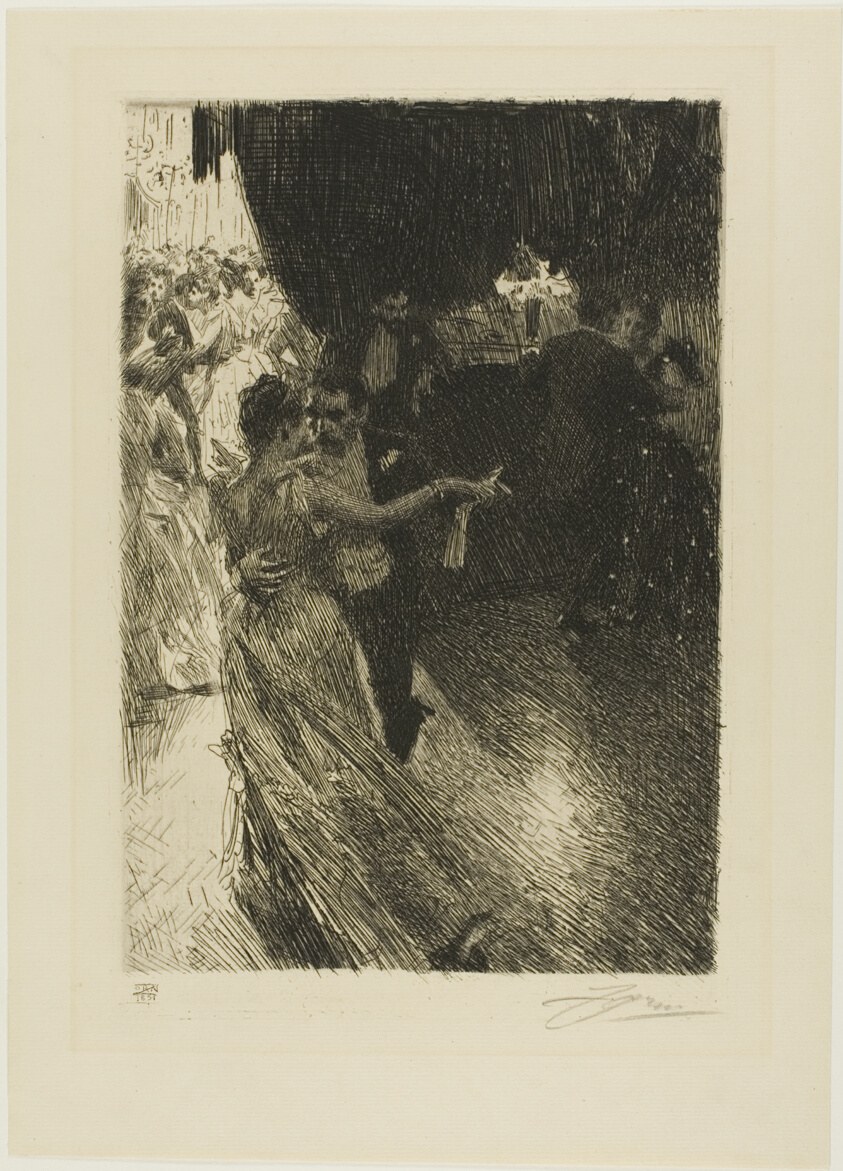
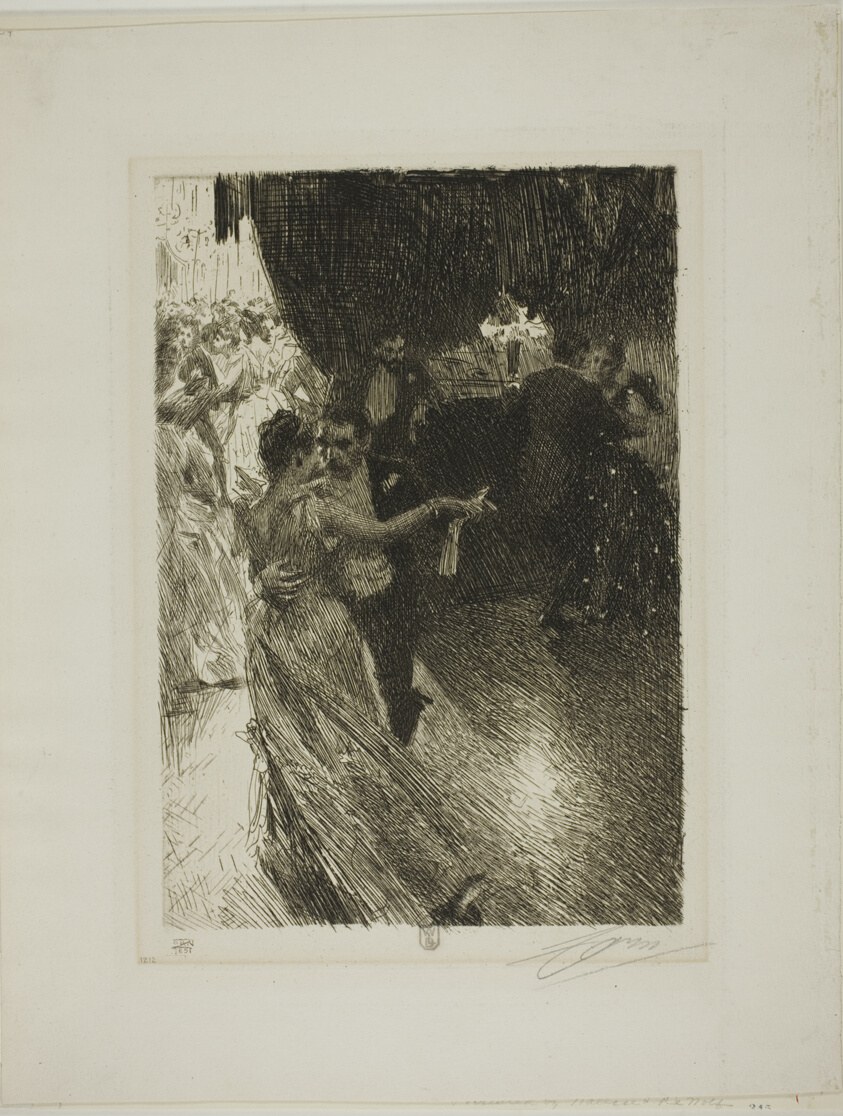
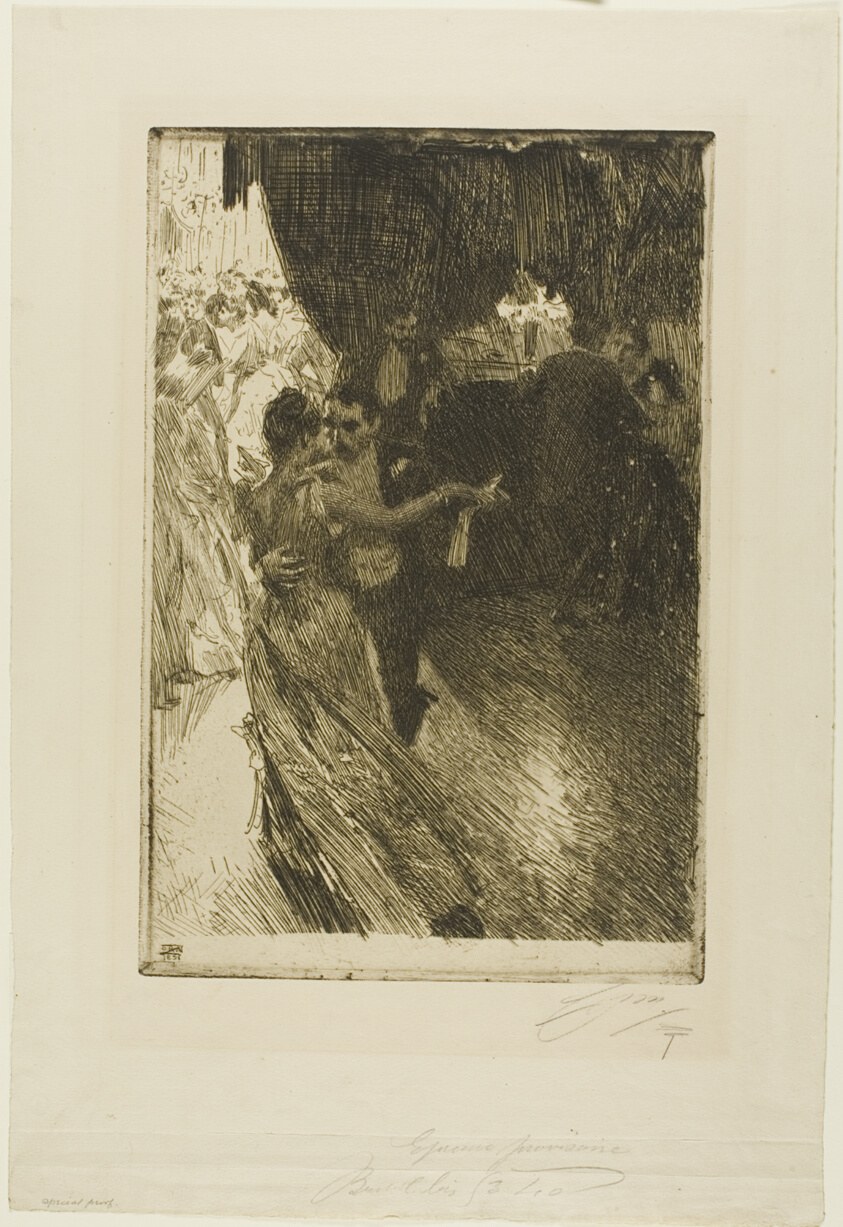
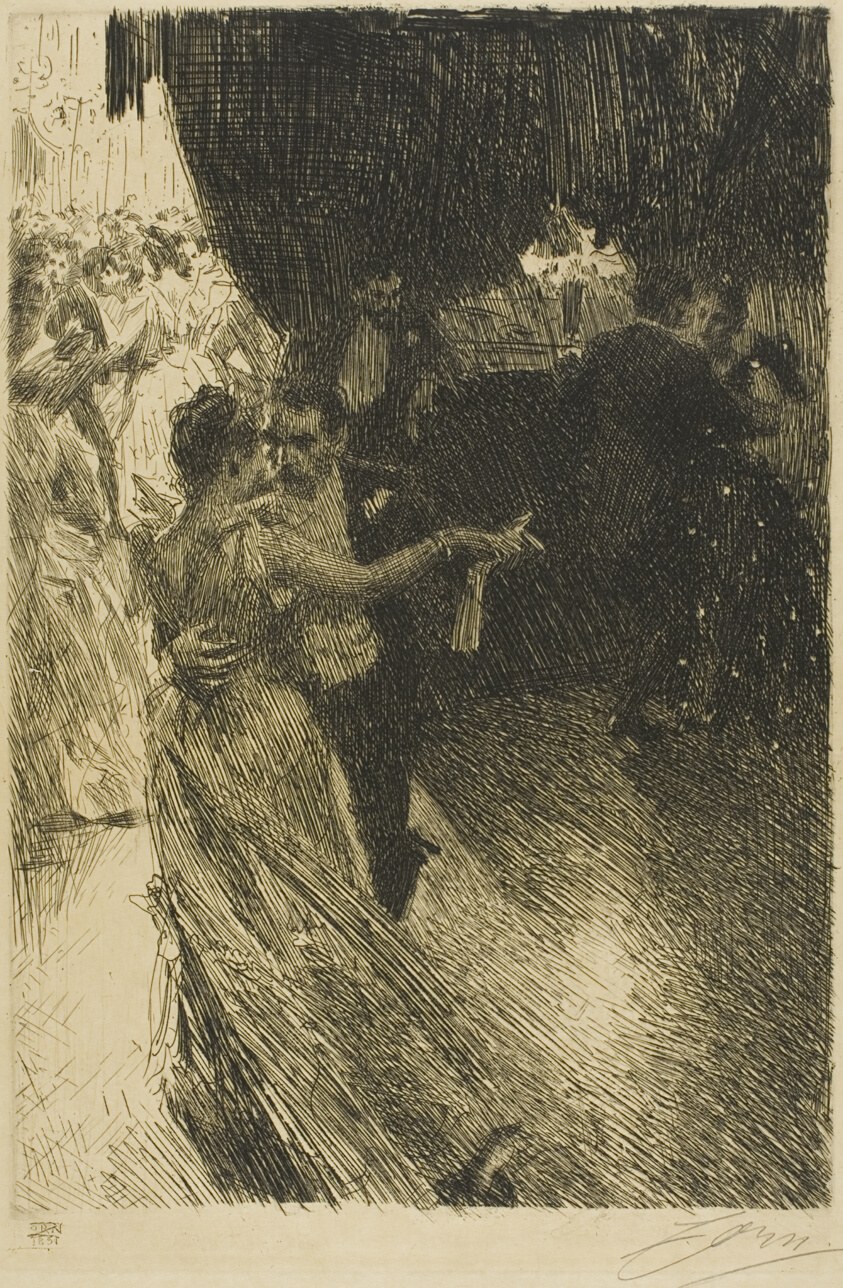
This work is a rare document of how the waltz—the most transformative dance of its era—was understood and discussed in its own time. It shows the dance being performed with anatomically and kinetically accurate detail, and it captures the cultural mythology that surrounded the waltz: the sense that it was a force of enchantment, a break with the past, and a kind of revolution. For dance historians, it offers evidence of how the closed hold, the turning frame, and the upright carriage appeared to a contemporary observer; for art historians, it demonstrates the use of allegory and classical reference as tools for satirizing modern social change.
What you are looking at
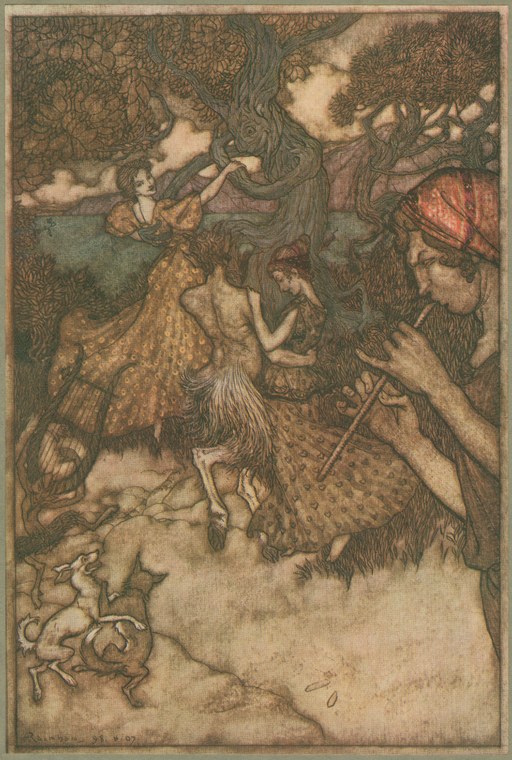
A fantastical allegorical scene in which Orpheus, the legendary musician, is depicted introducing the waltz to a gathering of mythological and supernatural figures. At the center, a classical male figure (Orpheus) plays a stringed instrument, his body in profile, surrounded by dancing nymphs and ethereal beings. The composition is dense with interlocking figures: women in flowing, patterned gowns swirl around him; winged cherubs or putti occupy the upper portion of the frame; satyrs and other woodland creatures populate the lower register. The entire scene is rendered in sepia tones with fine linear detailing characteristic of early 19th-century printmaking. The setting appears to be a sylvan or otherworldly realm, with foliage and atmospheric depth suggested through careful crosshatching and line work. The dancers' postures suggest movement and lightness—bodies leaning, skirts and drapery caught mid-motion—creating a sense of animated celebration around Orpheus's introduction of this new dance form.
The dancing
Multiple dancers are shown in various attitudes of motion, most notably women in high-waisted gowns typical of the Regency era, with their bodies angled to suggest rotation and lift. Several figures display the characteristic upright carriage and arm positions associated with early 19th-century ballroom dancing, with arms held at mid-height and bodies in a vertical line. The closest dancers show the skirts and train caught in mid-turn, suggesting the spinning motion central to waltz technique. One female figure in the foreground appears to be in a partnered position, leaning slightly away from an invisible or partially visible male partner, which is consistent with the waltz hold. The composition includes both engaged couples and solitary dancers, creating a mixed narrative of instruction and celebration.
The dance depicted
This is a satirical or fantastical depiction of the waltz, the revolutionary social dance that transformed European ballroom culture in the early 1800s. The waltz—a closed-hold, turning dance in triple time—was considered shocking and modern when it emerged, and this print appears to imagine a mythological origin story in which Orpheus himself (the supreme musician of classical legend) first 'produced' or introduced it. The conceit allows the artist to comment on the waltz's almost magical, transformative power, its connection to music and enchantment, and its role as a kind of cultural phenomenon. The title suggests this is speculative or ironic: what *if* the waltz came from Orpheus? The image itself confirms the waltz through the characteristic closed-hold positions, the upright frame, and the visible rotational motion of the skirts.
How it was made
This is a lithograph, a printmaking technique that uses oil and water repulsion on a stone surface to create an image. The technique was relatively new in the early 1800s and became the dominant medium for popular and satirical prints by the 1820s onwards. Lithography allowed for rapid circulation of images with subtle tonal gradations—note here the careful use of gray-brown washes and fine black linear work to create depth, texture in foliage, and the illusion of three-dimensional drapery and bodies. The medium's flexibility made it ideal for both artistic and commercial purposes, meaning this work could have been produced for a wide audience: collectors, dance enthusiasts, and the general public interested in commentary on fashion and social manners. The presence in the New York Public Library suggests this was a work of sufficient cultural interest to be preserved in an American institution.
About this work
This lithograph is a witty and learned commentary on the waltz craze of the early 19th century, using classical mythology as a framework for satirizing the dance's rapid rise and seemingly irresistible appeal. By crediting Orpheus—the musician whose power was so great he could move stones and tame wild beasts—with the introduction of the waltz, the artist suggests that this dance is not merely a fashion but a kind of enchantment, a force that transforms those who participate in it. The composition is rich with allegorical detail: the mix of classical deities, putti, and satyrs speaks to the waltz's role as a transgressive modern practice that nevertheless harks back to Arcadian freedom and natural pleasure. The work sits at the intersection of dance history, popular culture, and artistic satire, and it captures a pivotal moment when the waltz was still new enough to be controversial—shocking enough to merit mythological explanation.
For scholars and dancers, this print is a primary document of early 19th-century waltz culture. It shows not only how the dance was performed—the hold, the frame, the turning motion—but also how it was perceived and discussed. The use of classical references suggests an educated, literate audience, and the tongue-in-cheek tone indicates that by the time this print was made, the waltz's triumph was assured enough to be treated with humor. The image preserves the moment of the waltz's cultural triumph in a form that was itself modern and widely accessible.
How to look at it
Observe the moment the artist has chosen: not a static pose but a scene of animated motion, with bodies in various stages of the rotational movement that defines the waltz. Notice how the closest figures show the characteristic closed hold—one partner's arm around the other's waist, their bodies angled in relation to one another—and how the skirts and drapery are caught mid-turn, suggesting the rapid circular motion of the dance. Look at the contrast between the upright, vertical frame of the dancers and the dreamlike, swirling composition of the entire scene: the artist captures both the controlled, disciplined posture the waltz required and the sense of abandon and enchantment that surrounded it. The inclusion of classical figures and putti creates a visual argument: that this modern, controversial dance is connected to an eternal, mythological order.
The period
The waltz emerged in Vienna in the late 18th century and exploded across Europe in the early 19th, becoming the dominant social dance of the Regency and Romantic eras. By the 1810s-1830s, the waltz was the subject of intense cultural debate: moralists condemned it for its close hold and unseemly rotational motion, while fashionable society embraced it as the height of modernity and sophistication. Satirical prints and commentary on the waltz were common currency in the 1820s-1840s, and they often deployed classical or mythological references to make points about social change and propriety. This print likely dates to the height of waltz mania, when such imagery would have resonated with a public simultaneously intrigued and scandalized by the dance.
In the visual arts, the early 19th century saw a proliferation of lithographic prints that combined fine artistic technique with accessible, entertaining subject matter. Lithography made possible a kind of sophisticated popular art that could comment on fashion, manners, and social folly while remaining technically accomplished and aesthetically pleasing. The use of Orpheus—a classical figure associated with music, poetry, and the power to move all living things—as the supposed originator of the waltz is a clever inversion: the artist suggests that modernity itself has classical roots, and that the waltz's power is as mythic and irresistible as Orpheus's lyre.
Where it lives
This work is held by the New York Public Library, where it forms part of a collection of prints documenting early 19th-century culture, fashion, and social commentary. The presence of this image in an American library suggests it was either imported to the US during or shortly after its creation, or acquired later as a document of European cultural history. Lithographic prints of this kind were produced in runs and distributed commercially, so this was not a unique object but part of a broader discourse about the waltz.
Dance in this work
Questions about this work
Why use Orpheus to talk about the waltz?
Orpheus was the supreme musician of classical mythology, whose power was so great he could move stones, tame wild beasts, and even sway the gods themselves. By crediting him with inventing the waltz, the artist suggests the dance is not merely a fashion but a kind of irresistible force—almost magical in its power to transform those who dance it. The joke is also learned and sophisticated: using classical reference to elevate (or mock) a modern, controversial dance form.
What does this print tell us about how the waltz was danced?
The figures show the characteristic closed hold, the upright carriage, and the rotational motion that defined early 19th-century waltz technique. The way the skirts are caught in mid-turn, the positioning of the arms, and the angle of the bodies all confirm that the artist understood the waltz as a dance of vertical alignment and rapid, continuous rotation. This is accurate to contemporary descriptions and instruction manuals.
Was the waltz really controversial?
Yes. The waltz was shocking to many early 19th-century observers because it involved a close hold between partners, visible rotational motion, and a speed and freedom that broke with earlier ballroom etiquette. Moralists condemned it as improper; conservatives saw it as a sign of social decay. By the time this print was made, the waltz had already triumphed, but the cultural memory of its scandalous origins was fresh enough to be subject matter for satire.
What is a lithograph, and why does that matter?
A lithograph is a print made by drawing on a stone with a greasy substance and using the repulsion of oil and water to transfer the image. Lithography was new in the early 1800s and allowed artists to create prints that were more tonally subtle than earlier engraving techniques, and much faster to produce. This meant they could be widely distributed and were accessible to a broader audience than unique paintings or sculptures.
More Waltz artwork