49 works in this view — arrow keys or swipe to move between them.
Dance in Art
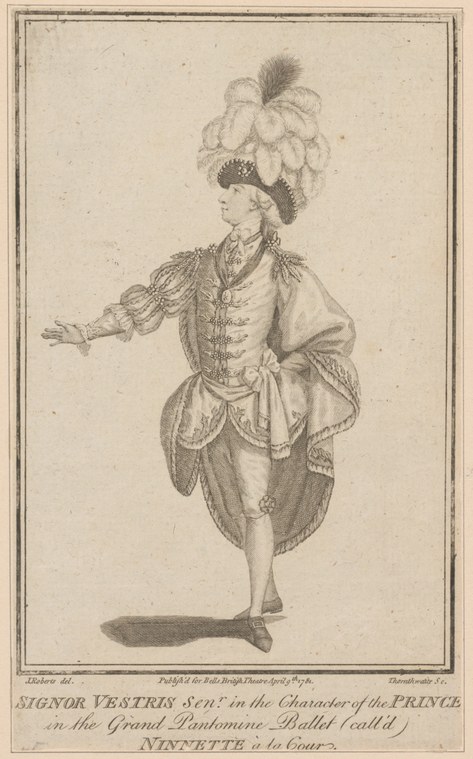
Signor Vestris Senr. in the character of the Prince in the grand pantomime [sic] ballet (call'd) Ninette à la cour
Unknown artist
- Collection:
- Prints depicting dance
- Source:
- New York Public Library
- Rights:
- Public domain — free to use, share and adapt.
- Recorded as:
- Public Domain
Vestris Senior was the most celebrated male dancer of his generation and the first to establish dance as an art requiring serious training and intellectual engagement. This print is rare evidence of how he looked on stage and how late 18th-century court ballet valued noble bearing and dramatic presence over technical display. For historians of dance and costume, it is a detailed document of what an elite dancer wore and how he carried himself during this transitional period between court dance and Romantic ballet.
What you are looking at
A single male dancer in elaborate 18th-century court dress is shown in profile against a plain background, his body caught mid-gesture in a pose of theatrical refinement. He wears a richly decorated justaucorps (close-fitting coat) with ornate embroidery and buttons, breeches, silk stockings, and heeled shoes; his hair is styled in the fashion of the period and crowned with a tall feathered plume. His left arm extends outward in an expressive gesture while his right arm is positioned near his body; his legs show the turnout and refined stance characteristic of court dance of the period. The print's inscription identifies him as Signor Vestris Senior in the role of the Prince from the pantomime ballet *Ninette à la cour*. The figure occupies the centre of the composition with ample white space around him, emphasizing his solitary presence and the importance of his costume and carriage.
The dancing
A single dancer stands in a position of display rather than action, with weight distributed evenly and legs turned outward in first or second position. The extended left arm and the angle of his body suggest a moment of courtly address or presentation—a pose meant to project authority and elegance rather than demonstrating technical virtuosity. His upright carriage and the precision of his stance indicate training in the deportment required of court dancers. The figure is rendered as a study in aristocratic bearing: the body is elongated and refined, the limbs arranged with geometric clarity.
The dance depicted
This is a portrait of a dancer in character rather than a representation of choreographed movement. Vestris Senior was performing in *Ninette à la cour*, a pantomime ballet that combined narrative and dance in the style of the late 18th century. The print documents the costume and appearance of a principal dancer in a specific role, preserving evidence of how a celebrated performer presented himself on stage. The pose suggests the kind of noble, measured gesture that characterized court ballet and pantomime of the period—more about elegant presentation and dramatic character than about footwork or turns.
How it was made
This is an engraving, rendered in fine lines with careful attention to the texture of fabric and the ornament of the costume. The technique allowed for precise detail in the embroidery, buttons, and lace, making it a valuable document of period dress. Engravings of this type were distributed to audiences and patrons, serving as souvenirs of celebrated performances and as evidence of a dancer's fame and status. The inscription at the base suggests this was a commercially produced print, likely sold in London theatres or through print shops.
About this work
This is a portrait engraving of Signor Vestris Senior, one of the most celebrated male dancers of the late 18th century, shown in his costume for the pantomime ballet *Ninette à la cour*. The work documents both the appearance of a star performer and the conventions of court ballet costume and deportment at the end of the Georgian era. Vestris was a defining figure of his time—the founder of a dynasty of dancers—and this print is a record of his stage presence and the esteem in which he was held. The engraving preserves not a moment of choreography but an image of aristocratic refinement and theatrical display, showing how the ballet of the period valued elegance, costume, and the dancer's ability to embody a character with authority and grace.
How to look at it
Attend to the precision of the costume and the care taken to render each detail of embroidery and ornamentation—this is what made Vestris a figure of aristocratic refinement on stage. Notice the pose: it is not a moment caught in rapid movement, but rather a deliberate presentation, the kind of noble stance that was the foundation of court ballet training. The profile view and the empty space around the figure emphasize the dancer's isolation and importance; this is a portrait of a star, not a record of a scene. The artist has chosen to present Vestris not in action but in repose, embodying the controlled elegance that was the ideal of his era.
The artist
The engraver is not recorded in the catalogue, but the print bears the mark of professional theatrical printmaking of the London stage. Prints of celebrated performers were a standard commercial product in 18th-century London, serving as publicity for both the dancer and the theatre. The quality of the engraving and the detail of the costume suggest this was a commission of some importance, likely authorized by Vestris himself or by the theatre management.
The period
Vestris Senior performed at the height of the 18th-century ballet d'action movement, when pantomime ballets that told stories were replacing the purely decorative ballets of the earlier Baroque. By the 1770s and 1780s, when this print likely dates, male dancers were beginning to be valued for character and dramatic presence as much as for technical prowess, though the two were seen as inseparable. This engraving dates to a period when prints of famous performers were a major form of theatrical promotion and when the dancer's costume and appearance were understood as part of the art form itself.
Where it lives
The print is held in the New York Public Library's collection of prints depicting dance. It is a commercial theatrical print, likely produced in London in the late 18th century and distributed to audiences as a souvenir or promotional object.
Dance in this work
Questions about this work
Who was Signor Vestris Senior?
Gaetano Vestris (1728–1808) was an Italian-born dancer who became the most celebrated male dancer of the late 18th century, performing in London and Paris. He was known for his noble bearing, his dramatic presence, and his technical skill, and he founded a dynasty of dancers that included his son Auguste. He was a major figure in the development of the ballet d'action and was celebrated across Europe.
What was *Ninette à la cour*?
A pantomime ballet, likely French in origin, that combined narrative and dance in the style of the late 18th century. Vestris performed the role of the Prince in this ballet, a leading part that would have showcased his dramatic presence and refinement. The title suggests a story involving a character named Ninette and a court setting, typical of the comic or sentimental narratives of late 18th-century ballet.
Why are there no signatures or dates on this print?
The engraver is not recorded, and the print carries only an inscription identifying the dancer and the role. This was typical of commercial theatrical prints of the period, which were produced quickly for distribution to audiences and were often unsigned or signed only by the publisher. The absence of a date makes it impossible to pinpoint the exact year of production, though the style of the costume and the inscription suggest the 1780s or 1790s.
What does the pose tell us about how male dancers trained?
The turned-out legs, the upright carriage, and the refined positioning of the arms reflect the training system of court ballet, which emphasize verticality, turnout, and the projection of noble bearing. The extended arm and composed gesture show that male dancers were expected to embody aristocratic refinement and dramatic presence, not merely technical agility. This was the ideal against which male dancers were measured in the late 18th century.
More dance artwork





