49 works in this view — arrow keys or swipe to move between them.
Dance in Art
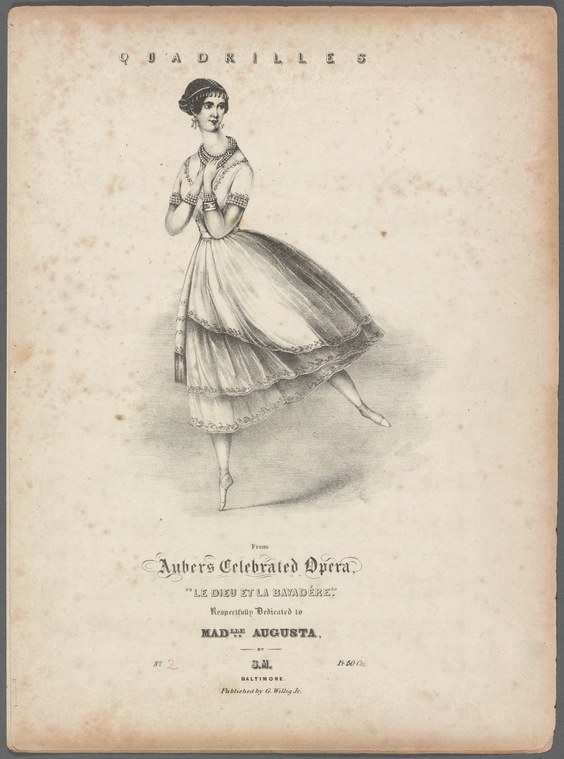
Quadrilles from Aubers celebrated opera, "Le dieu et la bayadére," respectfully dedicated to Madlle. Augusta, by S.M.
Unknown artist
- Collection:
- Prints depicting dance
- Source:
- New York Public Library
- Rights:
- Public domain — free to use, share and adapt.
- Recorded as:
- Public Domain
This print is a primary document of how Romantic ballet presented the 'oriental' dancer to European audiences, and it preserves the costume and movement vocabulary of a canonical work at the moment of its creation. For historians of dance, opera, and visual culture, it reveals how the bayadère became a stock theatrical type and shows the influence of early nineteenth-century Orientalism on bodily presentation and dress.
What you are looking at
A single female dancer is depicted in three-quarter view against a plain background, posed mid-movement in a moment of balletic suspension. She wears a romantic-era costume: a fitted bodice with short puffed sleeves trimmed in decorative bands, and a voluminous skirt of gauze or similar diaphanous material that extends to mid-calf, layered to show depth and movement. The skirt is caught in mid-swirl, its folds rendered in careful shading to convey lightness and motion. Her posture is upright and elegant, with one leg extended behind or to the side in a position suggesting the vocabulary of classical dance. The figure is rendered in fine linear detail typical of theatrical prints of the period, with particular attention to the drapery and the delicate construction of the costume. The composition is spare and focused, placing the dancer as the sole subject against an unmarked ground.
The dancing
The dancer stands on what appears to be one supporting leg with the other extended, suggesting an attitude or arabesque position. Her arms are held with grace, one raised and one lowered in a pose suggesting balance and control. The body demonstrates the upright carriage and turned-out positioning expected in early nineteenth-century theatrical dance. Her head is turned gracefully, completing a line of elegant extension from foot to fingertip.
The dance depicted
This is a quadrille or quadrille-related theatrical dance, most likely from the ballet or balletic interludes of Auber's 1830 opera *Le dieu et la bayadère*. The costume and pose align with the Romantic ballet vocabulary of the 1830s, and the theatrical presentation—a single dancer posed for a print—suggests this was a notable solo or featured role. The figure style and the delicate, ethereal quality of the costume are consistent with the bayadère (temple dancer) character type that became popular in Parisian opera-ballet of this period, though the dress here is more European balletic than authentically Indian.
How it was made
This is a wood engraving or fine steel engraving, as evidenced by the crisp linear hatching, the tonal gradation achieved through parallel lines, and the overall print quality. The fineness of the line and the delicacy of the shading suggest a skilled engraver working from a theatrical design or costume sketch. The technique allowed for wide circulation among theatregoers and the middle class, making this both a souvenir of a specific performance and a record of contemporary fashion and theatrical taste. Such prints were distributed and sold independently and bound into illustrated theatrical annuals.
About this work
This print documents a featured dance role from Auber's 1830 opera *Le dieu et la bayadère*, one of the major works of the Romantic opera era. It serves as both a theatrical souvenir and a fashion record, preserving the costume design and the aesthetic ideals of early Romantic ballet as it appeared on the Paris Opera stage. The dedication to Mademoiselle Augusta personalizes it further—she was likely the original performer or a celebrated interpreter of the role, making this a record of a specific dancer's achievement. The work belongs to the rich tradition of theatrical prints that document the history of dance through costume and pose rather than narrative scene.
How to look at it
The engraver has frozen a moment of elegant suspension—the dancer is not mid-action but posed in a moment of poise and balance that showcases both her control and the beauty of her costume. Note the careful attention to the transparency and movement of the skirt: the engraver has used parallel lines and careful shading to suggest the weight and flow of the gauze without losing the sense of lightness. The pose itself is a display of the turned-out, upright carriage that distinguished theatrical dance from social dance and that became the hallmark of Romantic ballet. The dedication and theatrical pedigree signal that this was not merely a fashion print but a record of a celebrated performance and a celebrated performer.
The artist
The artist is not recorded in the catalogue, but the print bears the mark of a professional theatrical print workshop, likely Parisian. The engraving's quality and the dedication suggest it was commissioned or published by the opera house or a commercial theatrical print publisher such as Martinet (whose mark appears on the print). Such prints required a skilled engraver working from costume designs or live observation, and they were part of the professional infrastructure supporting operatic performance in the 1830s.
The period
This print dates to the era of Romantic ballet's emergence, when French opera and ballet dominated European theatrical life. Auber's opera premiered in 1830, a moment when 'oriental' themes—bayadères, almées, harems—were becoming fashionable subjects in both high art and popular entertainment, fueled by Orientalist painting, literature, and colonial interest. The 1830s also saw the rise of the ballerina as a celebrated public figure and the consolidation of the vocabulary and aesthetic of Romantic ballet: pointe work, ethereal costuming, supernatural or exotic themes, and the fetishization of the female dancer's body and skill. Theatrical prints like this one were crucial to spreading these ideals and making them accessible to a paying public beyond the opera house itself.
Where it lives
This print is part of the NYPL's collection of prints depicting dance. It was likely published in the 1830s as a theatrical souvenir and entertainment print, distributed to the opera-going public and collected by enthusiasts of dance and fashion. The presence of a commercial publisher's mark suggests it was a commercial product rather than a unique or limited print.
Dance in this work
Questions about this work
What is a bayadère and why did it matter in 1830s ballet?
A bayadère is a Hindu temple dancer—or rather, a European fantasy version of one. In the 1830s, when Orientalism was at its height, the bayadère became a stock character in opera and ballet, representing exotic sensuality and spectacle. Auber's opera and the ballets that accompanied it were part of a broader trend in which European artists used 'oriental' themes to explore fantasy, danger, and eroticism at a distance. The costume shown here—the filmy skirt and fitted bodice—is entirely European balletic dress, not authentically Indian, but it was what audiences understood as 'oriental' and exotic.
How do I know this is a quadrille rather than some other dance?
The title tells us this is a quadrille from the opera, and the costume and pose are consistent with theatrical quadrilles and balletic dances of the period. The term 'quadrille' was used broadly in early nineteenth-century opera to describe group dances and featured dance numbers, not just the specific four-couple dance form. The solo posed presentation here suggests this was a celebrated moment or a solo variation rather than the quadrille in its social-dancing sense.
Was Mademoiselle Augusta a real dancer? What do we know about her?
The dedication suggests she was a celebrated performer known enough to lend her name to published theatrical prints. Beyond that, the catalogue record does not confirm her identity or career details. Such dedications were common marketing practices—prints were sold both as theatrical souvenirs and as celebrity merchandise, with the dancer's name a draw for buyers. She may have been the original performer or a celebrated interpreter of the role.
How were prints like this circulated and who bought them?
Theatrical prints were sold at the opera house itself, at print sellers' shops, and through subscription. They were affordable to the middle class and served as souvenirs of memorable performances, fashion references, and collectible art. They were often bound into scrapbooks or theatrical annuals, and they circulated widely enough to shape public taste and memory of performances. This particular print's publisher's mark and professional quality suggest it was a commercially successful product.
More dance artwork





