49 works in this view — arrow keys or swipe to move between them.
Dance in Art
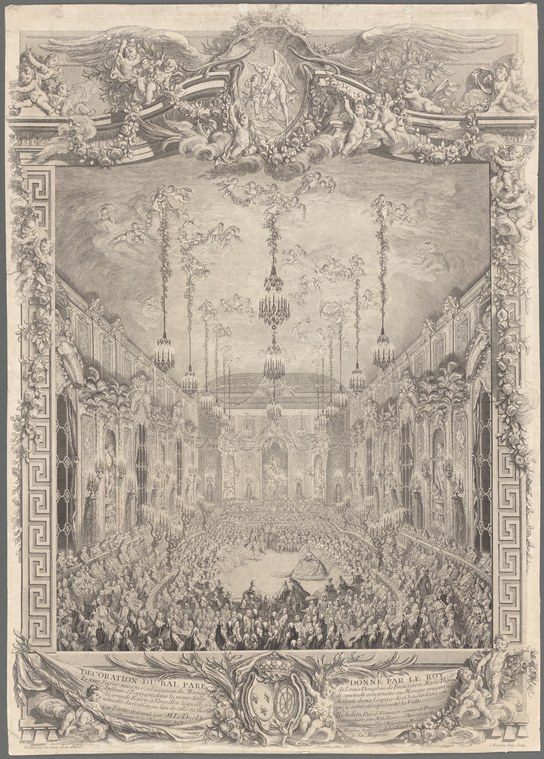
Decoration du bal paré donné par le roy
Unknown artist
- Collection:
- Prints depicting dance
- Source:
- New York Public Library
- Rights:
- Public domain — free to use, share and adapt.
- Recorded as:
- Public Domain
This image is one of the few surviving visual records of how a major court ball was organized spatially and socially. It shows the relationship between the architecture of power, formal dress, and social dance; for a ballet historian, it documents the context from which theatrical ballet emerged. The engraving's circulation in print form also tells us how important such occasions were to the cultural memory of the court and nation.
What you are looking at
This is an engraved view of a grand formal ball in an ornate palace interior, likely 18th century. The composition is theatrical and architectural: a vast rectangular hall recedes toward a distant wall, its barrel vault ceiling hung with crystal chandeliers that cast light across the scene. The walls are decorated with Corinthian pilasters and elaborate gilt ornamentation. Hundreds of figures fill the floor—a dense crowd of nobles in formal dress, their bodies turned toward the center or distributed in small groups. In the foreground, several couples stand in close formation; the women wear wide panniers and formal gowns, the men in court dress. The gathering is ordered but animated; a few central figures appear to be moving or in conversation while the mass of attendees observes or participates in the social event. An ornamental cartouche at the bottom holds an inscription. The entire scene is framed by a decorative border of scrollwork, putti, and allegorical ornaments celebrating the festivities.
The dancing
The figures are depicted in formal court dress appropriate to 18th-century royal protocol: women in low-cut gowns with full panniers that extend the silhouette horizontally, men in tailored coats, breeches, and stockings. Posture is upright and dignified throughout. Those nearest the viewer stand in conversational groupings or poised as if about to move, with arms held in the relaxed but restrained manner of courtly behavior. The depth and scale of the crowd suggests this is a *fête* or formal assembly rather than an active dance in full progress; few figures show the exaggerated movement or leg extension that would indicate vigorous dancing, though the composition and setting imply organized social movement and paired interactions.
The dance depicted
This depicts a formal *bal paré*—a dressed or state ball held at the royal court. Such balls were structured social and political occasions at which dancing occurred in prescribed forms (likely minuets, contredanses, or quadrilles), interspersed with promenade, conversation, and observation. The inscription indicates this is a specific royal event, probably under Louis XIV or Louis XV. The image captures the ball as spectacle and ceremony rather than kinetic movement; it documents the gathering itself, the dress code, the architecture that framed such occasions, and the hierarchical social choreography of court attendance. The formal crowd and palatial setting suggest court dance of the early-to-mid-18th century, though no individual dance phrase is frozen in movement.
How it was made
This is an engraving or possibly etching, identified from the fine line work, the dramatic use of cross-hatching for shadow and depth, and the layered tonal registers visible throughout. The technique allowed the artist to render intricate architectural detail, the ornamental frame, and the mass of small figures with precision. The elaborate allegorical border suggests this was a commemorative or celebratory print, likely published for circulation among the court nobility or the educated public interested in court ceremony. Engravings of this scale and finish were expensive to produce and distribute, implying a significant audience and official or semi-official status.
About this work
This engraved record of a royal *bal paré* documents court spectacle and the visual culture of 18th-century French monarchy. It is not a narrative of dance action but a portrait of dance as social and political theater—a moment when the court assembled in full dress, in a space built to reflect royal power, to participate in rituals of movement and interaction that affirmed hierarchy and aesthetic refinement. The work sits between art (the ornamental border and allegorical figures) and historical document (the precise rendering of architecture and dress). For dancers and historians, it reveals the scale of court balls, the role of dress and architecture in framing dance, and the way contemporary artists chose to memorialize such occasions not as action but as ordered spectacle.
How to look at it
Attend to the architecture first: the vault, the chandeliers, the walls. These are not mere backdrop but are as much the subject as the figures. Then notice the distribution of the crowd—dense in the middle distance, thinning toward the sides, ordered but not regimented. Look at the foreground figures to see the formality of dress and posture; the artist has chosen not to show vigorous movement but rather the gravity and ceremony of the occasion. The ornamental border frames the scene as a historical record worthy of commemoration; it elevates the ball from mere entertainment to an event of cultural importance.
The period
Court balls of the 17th and 18th centuries were among the most formal and elaborate social institutions of the ancien régime. They served as stages for the display of wealth, power, and aesthetic refinement, and were carefully controlled in protocol and movement. By the early-to-mid-18th century, when this print was likely made, the minuet had become the dominant formal dance of the court ball, followed by contredanses and quadrilles. The balls were documented in prints and written accounts because they were events of state significance. This engraving belongs to a tradition of court ceremonial prints that circulated to celebrate and immortalize royal magnificence.
Where it lives
Held in the New York Public Library's collection of prints depicting dance. This is a commemorative engraving of royal court ceremony, part of the documentary and celebratory print tradition of the 18th century.
Dance in this work
Questions about this work
Is this an actual ball, or an invented scene?
The inscription at the bottom (partially legible in engraved text) indicates this records a specific royal ball. However, like all formal commemorative prints, it likely idealized the scene—it is a portrait of the occasion as it ought to appear, rendered with all the ceremony and order proper to royal magnificence. The architecture and dress are accurate; the density and perfection of the arrangement may be artistic convention.
What dances would have been performed at such a ball?
By the 18th century, the minuet was the presiding formal dance, followed by contredanses (set dances for couples in lines), quadrilles, and other group dances. The ball would have opened with a processional or ceremonial minuet, then moved through set dances. This print does not freeze a specific dance phrase; it shows the assembly in which such dances took place.
Why did 18th-century artists choose to depict balls as crowds rather than showing dancers in action?
Court balls were first and foremost political and social ceremonies. Showing the crowd, the dress, and the architecture conveyed the magnificence and order of the court itself. Individual dance movements mattered less to the viewer's eye than the spectacle of the whole occasion—the assembled nobility, the wealth displayed in dress and setting, and the formal harmony of the event.
More dance artwork





