49 works in this view — arrow keys or swipe to move between them.
Dance in Art
Festivities and spectacles
Unknown artist
- Collection:
- Prints depicting dance
- Source:
- New York Public Library
- Rights:
- Public domain — free to use, share and adapt.
- Recorded as:
- Public Domain
This image is rare evidence of how early modern court entertainment was documented and disseminated. It shows that dance and spectacle were not merely performed events but were recorded in print and distributed as status symbols, allowing us to reconstruct not only the movements and costumes but also the social and architectural frameworks in which they took place. For dancers and historians, it reveals the courtly context and the blending of dramatic action, costume, and audience participation that shaped the development of ballet and theatrical dance.
What you are looking at
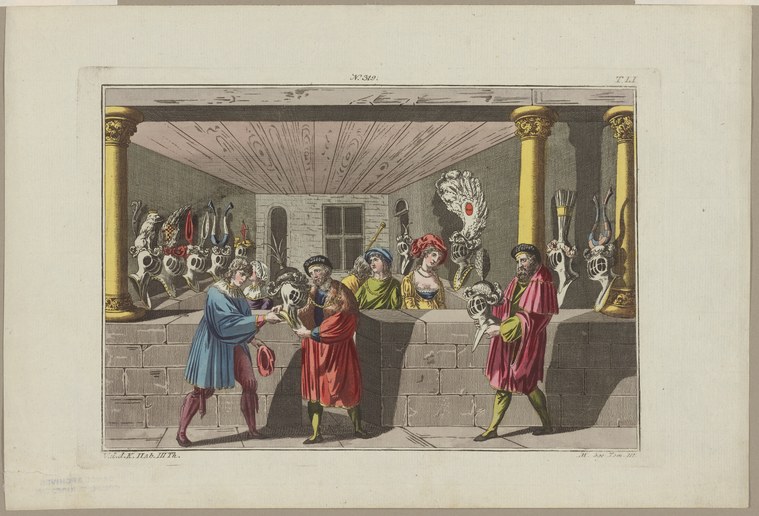
A formal interior space with classical architecture frames a theatrical spectacle. Tall gilded columns support a coffered ceiling, and the scene is divided into foreground action and a viewing gallery. In the middle distance, figures in rich period dress—reds, blues, and yellows—gather around what appears to be a raised platform or stage. The composition suggests a court or ceremonial performance space. In the background, an upper gallery contains dozens of spectators, their faces and figures rendered smaller to indicate depth, watching intently. The engraving's fine detail and hand-coloring create a sense of pageantry and formal occasion, with light entering from the right.
The dancing
Three principal figures occupy the foreground in animated stance: one in blue-gray on the left, one in red in the center, and one in yellow-green on the right. Their postures suggest conversation or demonstration rather than synchronized dance—they appear to be gesturing, perhaps exchanging objects or addressing one another. Their spacing is loose and frontal, typical of court presentation or entertainment. The background figures in the gallery lean forward and gesture with evident interest, some holding objects aloft (possibly masks or ceremonial items). The overall impression is of spectacle and display rather than coordinated partner dance.
The dance depicted
This engraving most likely depicts court entertainment or pageantry from the 16th or 17th century, possibly a masquerade, intermezzo, or court ballet moment. The formal setting, the distinction between performers and an elevated audience, and the apparent element of costume or mask-work suggest a theatrical entertainment rather than social dancing. The gestures of the central figures hint at dramatic action or presentation—possibly the offering of something, or a formal greeting. Without inscription or clearer visual evidence of specific footwork or hold, the dance identity cannot be firmly established, but the context points toward historic-baroque court entertainment.
How it was made
This is a hand-colored engraving, a reproductive technique that allowed wide circulation of fashionable court scenes in the 16th–17th centuries. The engraver's fine parallel line-work creates depth and tone, particularly in the architectural elements and drapery. Hand-coloring (applied after printing, likely by workshop assistants) adds immediacy and luxury to the image. The technique was ideal for documenting court spectacles for an educated audience across Europe, serving both as a record and as a fashionable souvenir of expensive entertainments. The precision of the architectural rendering and the careful composition suggest a professional workshop and a patron of some standing.
About this work
This hand-colored engraving documents a moment of court spectacle or theatrical entertainment, most likely from the Renaissance or early Baroque period. The formal interior setting, the distinction between a performing space and an elevated gallery of spectators, and the rich costumes and apparent ceremonial objects all point to a carefully choreographed court performance—possibly a masquerade, ballet, or intermezzo. The work records not just the dance or action itself, but the whole apparatus of court entertainment: the architecture, the costume, the social hierarchy of viewing, and the blend of music, spectacle, and movement that characterized these occasions. The engraving's precision and hand-coloring mark it as a luxury document, circulated among courts and collectors across Europe to celebrate the wealth and cultural ambition of the patron.
How to look at it
Attend first to the spatial organization: the artist has created a clear distinction between the foreground action and the background gallery, using perspective and scale to establish social hierarchy. The three central figures are caught in a moment of presentation or exchange—notice their facing positions and open gestures, which suggest address rather than dance in the modern sense. Look at the masks and objects held aloft in the gallery: these hint at the ceremonial or masquerade elements of the entertainment. The formal architectural frame—the columns, the coffered ceiling—is as important as the figures; it establishes that this is a court performance, not a street or folk event. The hand-coloring adds information about costume and rank that the engraving alone might not convey.
The period
This engraving belongs to a well-established tradition of documenting court spectacles and entertainments in the 16th and 17th centuries. The Renaissance and early Baroque courts of Italy, France, and the Holy Roman Empire staged elaborate intermezzos, ballets, and masquerades as expressions of power and cultural sophistication. These events were increasingly recorded in engravings and etchings, which circulated among courts and formed a visual archive of courtly life. The formal perspective, the architectural precision, and the careful distinction between performers and audience reflect the growing codification of court ceremony during this period. Hand-colored engravings like this one were luxury objects, functioning as both documents and fashionable souvenirs.
Where it lives
This work belongs to the NYPL's collection of prints depicting dance. It is catalogued as 'Festivities and spectacles' with no recorded artist or date, typical for many reproductive prints of the period that circulated widely and were often attributed generically.
Dance in this work
Questions about this work
What kind of dance is this?
The image does not show recognizable ballroom or social dance. It more likely depicts a court entertainment such as a masquerade, ballet, or intermezzo—a theatrical spectacle combining movement, music, costume, and dramatic action. The formal setting, the distinction between performers and spectators, and the presence of objects or masks all point to staged pageantry rather than social dancing.
Who performed in these entertainments?
Court entertainments of this period were typically performed by professional musicians, dancers, and actors hired by or attached to the court, often alongside courtiers themselves. The elevated gallery of spectators suggests an exclusive audience of rank and status—possibly the court itself, or invited guests from other princely houses.
Why was this scene engraved and colored by hand?
Hand-colored engravings were luxury items, circulated among courts and collectors as records of expensive, prestigious entertainments. They served both as documentation and as fashionable souvenirs, allowing distant courts to learn of the artistic and financial resources of their rivals. The cost and effort of coloring by hand made these objects valuable gifts and status symbols.
How does this differ from dance images from later periods?
Later dance images tend to focus more narrowly on movement and gesture, often documenting specific steps or partner work. This engraving is equally interested in the architecture, the costume, the social organization of the space, and the spectacle as a whole—reflecting an earlier conception of dance as part of a larger courtly ceremony rather than a discrete art form.
More dance artwork





