42 works in this view — arrow keys or swipe to move between them.
Dance in Art · 2019
Sylphiden. Polka
Unknown artist
- Medium:
- Lithograph
- Dance:
- Polka
- Era:
- Late 1800s (Victorian Ballroom)
- Source:
- New York Public Library
- Rights:
- Public domain — free to use, share and adapt.
- Recorded as:
- public_domain
The *Sylphiden Polka* documents the nineteenth-century democratization of Romantic ballet imagery, showing how the ethereal, elite world of theatrical ballet influenced and merged with popular social dance. For dance historians, it reveals how the polka—typically a spirited, grounded social dance—was reimagined in the image of Romantic ballet's weightless, supernatural ideal, reflecting changing tastes in Victorian entertainment and the status of dance in middle-class culture.
What you are looking at
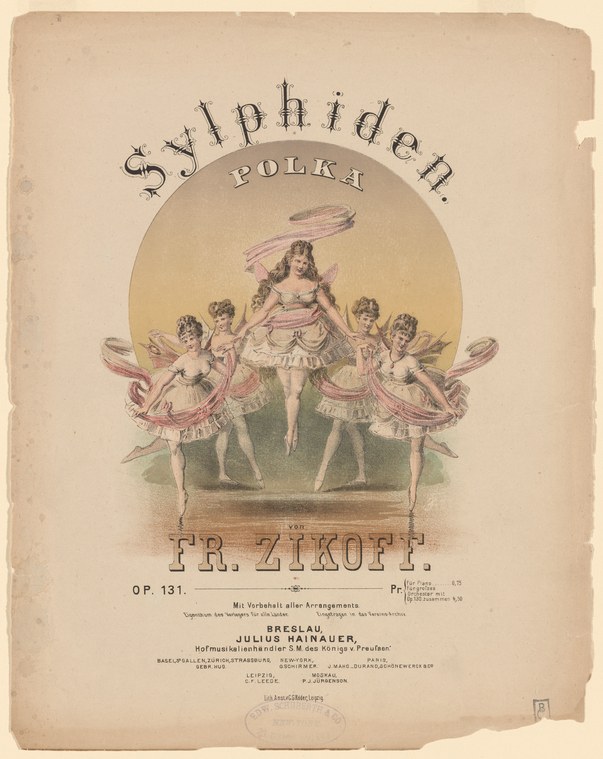
A lithographic poster for a polka titled *Sylphiden* (The Sylphides), composed by Fr. Zikoff, presents a fantastical vision of the Romantic ballet sylph motif. At the center stands a mature female dancer in a classical pose, wearing a pale tutu with pink ribbon detail and a headdress with a long streamer. She is surrounded by four younger dancers in identical costumes, arranged symmetrically on either side—two to her left and two to her right. All five figures are depicted mid-movement in attitudes of ethereal grace, with raised arms and extended legs suggesting the weightless, otherworldly quality central to Romantic ballet aesthetics. The composition is set against a warm, peachy-gold background that creates an almost dreamlike atmosphere. The dancers appear to float rather than stand, their bodies arranged in a harmonious composition that emphasizes the synchronized, corps-de-ballet arrangement. The theatrical framing and decorative typography suggest this is promotional material for a stage work or a popular dance piece for the concert or ballroom.
The dancing
The five dancers display the characteristic port de bras and épaulement of classical ballet, with arms held in graceful curves and bodies elongated through the torso. The central figure stands in a commanding pose with arms raised, while the surrounding dancers mirror her attitude with coordinated limbs and extended legs suggesting an elevated développé or attitude position. All figures maintain vertical alignment through the spine, typical of ballet training, and their lighter-than-air poses—with minimal contact with the ground—emphasize the sylph mythology of weightless spirits. The compositional symmetry, with the lead dancer centered and the corps arranged in pairs on either side, demonstrates understanding of classical ballet's visual harmony and the role of the soloist within the ensemble.
The dance depicted
The *Sylphiden Polka* is a nineteenth-century theatrical piece that adapts the Romantic ballet tradition—particularly the iconic *La Sylphide* (1832)—into the polka, a popular social dance of the Victorian era. The title explicitly references the sylph, the central figure of Romantic ballet, and Zikoff's composition appears designed for either theatrical performance or as a parlor piece for accomplished dancers. The image depicts the visual language of Romantic ballet—the elongated lines, the ethereal costume, the grouped formation—translated into a polka structure. This represents a common nineteenth-century practice of creating hybrid entertainment pieces that brought theatrical ballet aesthetics to popular and social dance contexts. The prominence of the lead sylph figure surrounded by attendant dancers suggests a theatrical choreography incorporating both hierarchical and ensemble elements.
How it was made
This is a lithograph, a stone-based printing technique that allowed for the rapid, affordable mass production of sheet music covers and theatrical posters in the nineteenth century. Lithography enabled the subtle gradations of tone visible in the background—the warm wash of color that creates the dreamlike atmosphere—and the fine detail work in the dancers' costumes and facial features. The technique made this piece accessible to a broad middle-class audience interested in both music and dance, as lithographed sheet music covers were distributed widely and often collected. The presence of printing marks and publisher information (Julius Hainauer, Breslau) indicates this was a commercial publication intended for retail circulation, likely accompanying a musical score for piano or small ensemble.
About this work
The *Sylphiden Polka* is a nineteenth-century lithographed sheet music cover that visualizes the fusion of Romantic ballet aesthetics with the popular polka dance. Created by Fr. Zikoff and published in Breslau by Julius Hainauer, the work presents five dancers in ethereal classical ballet poses arranged in a symmetrical composition that emphasizes grace, lightness, and supernatural beauty—the defining characteristics of the sylph in Romantic dance tradition. This piece exemplifies how theatrical ballet conventions permeated popular entertainment and domestic music-making in the Victorian era, allowing affluent amateurs and professional dancers alike to engage with the spectacle and artistry of the stage through accessible social dance forms. The image survives as evidence of the cultural appetite for dance imagery and the commercial networks through which dance aesthetics reached the broader public.
How to look at it
Observe the artist's choice to freeze the dancers in an attitude of sustained weightlessness rather than the vigorous, grounded movement typical of polka steps. The elongated vertical lines of the bodies, the raised arms, and the extended legs all emphasize ascension and grace rather than the rotational energy or bouncing quality characteristic of authentic polka movement. Note the careful symmetry of the composition—the central soloist elevated by the surrounding corps—which mirrors the structure of Romantic ballet rather than the egalitarian partnership of social dancing. This reveals the tension at the heart of the work: an attempt to marry the ethereal visual language of theatrical ballet with a popular, energetic social dance form.
The artist
Fr. Zikoff is identified as the composer on the cover, but little is recorded about his broader practice or life. His presence among the holdings of the New York Public Library, along with the professional Breslau publication, suggests he was an active composer of popular dance music in the mid-to-late nineteenth century. The use of the Romantic ballet sylph as a subject for a polka composition reflects a common practice among nineteenth-century music composers of adapting theatrical material and iconic imagery for the domestic music market.
The period
The mid-to-late nineteenth century saw a profound transformation in how ballet was consumed and represented. While Romantic ballet had flourished in the 1830s-1840s through works like *La Sylphide* and *Giselle*, its imagery and ethos persisted well into the Victorian era through prints, photographs, and popular music. Simultaneously, the polka had emerged as the dominant social dance of the 1840s-1860s, spreading rapidly across Europe and America as a symbol of modernity and accessibility compared to the formality of the waltz. The convergence of these two phenomena—the enduring appeal of Romantic ballet imagery and the popularity of the polka—produced hybrid works like the *Sylphiden Polka*, which allowed consumers to engage with the glamour and artistry of theatrical dance through a form suited to ballroom or parlor performance. This period also witnessed the rise of mass-produced dance imagery through lithography, making theatrical spectacle widely available to the middle classes.
Where it lives
This lithograph is held in the New York Public Library's collection and is identified as a late nineteenth-century sheet music cover. Such items were typically published with musical scores and distributed through music sellers and retailers across Europe and America, making them common artifacts of domestic musical life among the educated middle classes.
Dance in this work
Questions about this work
What is a sylph in ballet?
A sylph is a supernatural spirit or ethereal creature from romantic poetry and mythology, popularized in ballet through the 1832 work *La Sylphide*. The sylph became the defining figure of Romantic ballet, embodying ideals of weightlessness, mystery, and unearthly beauty. Sylphs were typically portrayed in white tutus, often in corps formations surrounding a principal sylph, as seen in this lithograph.
How does a polka differ from ballet?
The polka is a lively, couple-based social dance characterized by quick steps, rotational movement, and a bouncing quality. Ballet is a theatrical art form emphasizing turned-out limbs, vertical alignment, and precise technique. This work fuses the sylph imagery and ethereal aesthetic of ballet with the polka form, creating a hybrid theatrical-social dance piece.
Who was Fr. Zikoff?
Limited biographical information survives about Fr. Zikoff beyond his work as a composer of popular dance music in the nineteenth century. His publication by the Breslau firm Julius Hainauer suggests he was an established composer working in Central Europe during the mid-to-late 1800s. The *Sylphiden Polka* is among the works that document his engagement with fashionable dance subjects.
Why publish ballet imagery with polka music?
In the nineteenth century, Romantic ballet imagery held tremendous cultural prestige and glamour, while the polka was the most fashionable social dance. Publishing sheet music covers with ballet imagery elevated the status of popular dance music and made theatrical spectacle accessible to amateur musicians and dancers. This marketing strategy reflected and reinforced the public's appetite for dance imagery across both theatrical and domestic contexts.
More Polka artwork