49 works in this view — arrow keys or swipe to move between them.
Dance in Art · 2019
Ancient dancing
Unknown artist
- Medium:
- Source:
- New York Public Library
- Rights:
- Public domain — free to use, share and adapt.
- Recorded as:
- public_domain
This work reveals how the 19th-century ballet world understood and represented its relationship to antiquity — not through historical accuracy but through aesthetic idealization. The engraving's precision and classical vocabulary make it valuable evidence of how 'ancient' dance was performed and imagined during the Romantic era, and how the female body was positioned as the bearer of classical virtue.
What you are looking at
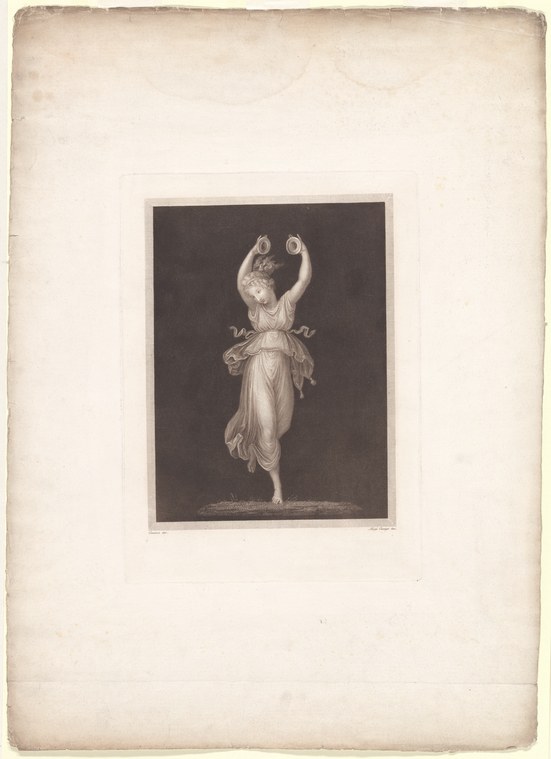
A single female figure stands alone against a dark background, her body elongated and graceful in a classical contrapposto stance. She wears flowing drapery that swirls around her legs and trails behind her; the fabric is rendered in fine white lines that suggest both movement and classical sculpture. Her arms are raised above her head in a pose of elevation or exultation, the hands nearly touching. The figure appears to float or hover slightly above a thin baseline, and the entire composition is rendered as a fine engraving or etching, with the figure emerging luminously from the black ground. The work has the aesthetic of neoclassical design, evoking both ancient sculpture and the theatrical ideal of the dancing body.
The dancing
A single dancer with weight poised upward, arms lifted symmetrically overhead in a balanced, self-contained frame. The body shows no partnering and no weight transference — the pose is symmetrical and held, not caught in the act of traveling or turning. The elongation of the limbs and the delicate articulation of the hands suggest training in classical movement vocabulary. The drapery falls from the waist and legs, framing rather than restricting the body's line.
The dance depicted
This appears to represent an idealized figure from Romantic or early classical ballet, or possibly a dancer from the ancient Greek tradition as reimagined through the neoclassical aesthetic. The symmetrical arm position, the upward orientation, and the emphasis on verticality are consistent with classical ballet vocabulary, but the work's title 'Ancient dancing' and its sculptural quality suggest it may depict a figure inspired by ancient Greek or Roman dance — or more likely, a 19th-century artist's vision of such dancing filtered through the ballet tradition. The raised arms and sustained posture suggest a pose of apotheosis or celebration rather than a moment of active traveling.
How it was made
This is an engraving or etching, executed with fine parallel lines and careful tonal control to create luminosity against the dark ground. The technique allows for precise rendering of form and drapery while maintaining a classical graphic aesthetic. The refined, contemplative quality of the line work suggests this was a work of some ambition and technical skill, likely intended for a cultured audience familiar with classical art and dance. The medium was well-suited to circulation as a print, allowing multiple copies to be distributed among collectors and artists.
About this work
This neoclassical engraving depicts an idealized dancing figure inspired by ancient sources but rendered through 19th-century artistic and balletic conventions. The work belongs to a rich tradition of artists using dance to explore classical form and the sublime — treating the body as an extension of sculptural principles. The elevation of the dancer and the weightless quality of the pose suggest both artistic aspiration and the balletic ideal of transcendence. As a print in the NYPL collection, it represents how dance imagery circulated among educated audiences in the 19th century, serving simultaneously as artistic study, dance documentation, and embodiment of classical taste.
How to look at it
The artist has chosen a moment of stillness and elevation rather than traveling or turning — the dancer is suspended at an imagined peak of the movement, arms gathered overhead. Notice how the drapery is rendered to suggest both weight and weightlessness; the fabric falls naturally but seems to float with the dancer. The symmetry of the pose and the complete self-containment (no reaching outward, no relationship to an external space) ask you to read this not as a snapshot of actual dancing but as an idealized form, a visual argument about what dancing at its most refined might express.
The period
This work belongs to the neoclassical and early Romantic periods of the 19th century, when European dance and visual art were intensely engaged with reimagining ancient Greek and Roman culture. The Romantic ballet (1830s–1860s) incorporated classical themes and poses into its movement vocabulary, while visual artists of the era treated the dancing body as an ideal form through which to explore proportion, grace, and the sublime. Engravings and lithographs of dancers and dance scenes were popular among patrons and performers alike, serving as a bridge between the stage and the drawing room.
Where it lives
The work is held in the New York Public Library collection. It is catalogued simply as 'Ancient dancing' with no artist or date recorded, suggesting it may have entered the collection as a loose print or as part of a larger collection of theatrical or artistic material.
Dance in this work
Questions about this work
Is this a real dancer or an imagined figure?
It appears to be an idealized figure — the work is titled 'Ancient dancing' but was almost certainly made in the 19th century, filtered through neoclassical taste and balletic training. The artist has used the conventions of classical sculpture and ballet to create a vision of what ancient dancing might have looked like, rather than depicting an actual historical practice.
What dance style is shown here?
The raised arms, verticality, and elongated line are consistent with classical ballet vocabulary, but the work's emphasis on stillness, symmetry, and sculptural form suggests it is meant to represent a more generalized 'ancient' or ideal dancing body rather than a specific technique.
Why was this engraved and printed?
Engravings of dance scenes and figures were popular among educated collectors, performers, and artists in the 19th century. They served both as artistic studies and as a way to circulate and celebrate idealized images of dancing and the classical body among a wide audience.
More dance artwork