10 works in this view — arrow keys or swipe to move between them.
Dance in Art · 2019
Spanish dancing
Unknown artist
- Medium:
- Dance:
- Spanish/Flamenco
- Source:
- New York Public Library
- Rights:
- Public domain — free to use, share and adapt.
- Recorded as:
- public_domain
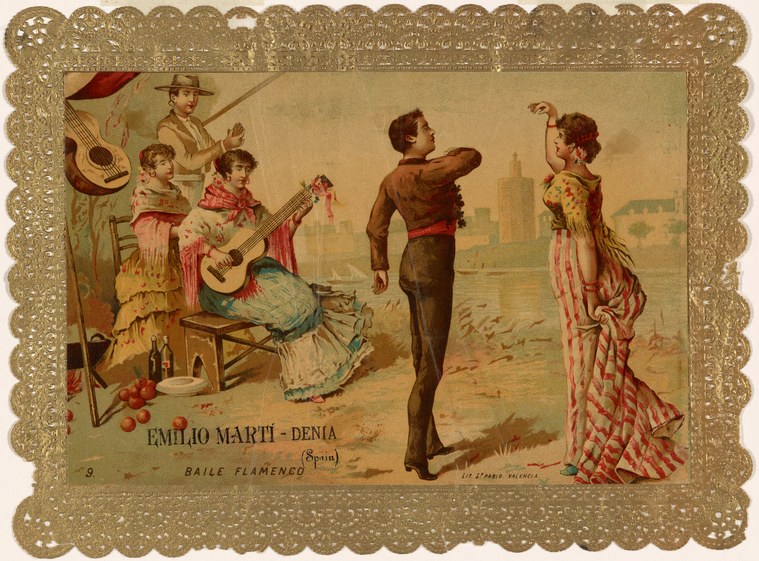
This print documents flamenco at a pivotal moment when the dance was being packaged for international consumption and distribution, showing the exact gestures, costumes, and social arrangements that defined flamenco performance for European and American audiences of the era. For historians of flamenco, it provides visual evidence of early 20th-century performance style and the gendering of the dance; for print historians, it exemplifies the chromolithographic trade in Spanish and orientalist imagery.
What you are looking at
A chromolithograph vignette depicts a flamenco dance lesson or performance in Spain, framed by an ornate gilt lace border. On the left, a musician in a wide-brimmed hat holds a large guitar while watching the action; beside him stand two younger figures in ruffled pink and yellow dresses, one of whom plays a smaller guitar. On the right, a man in a dark suit with a red sash gestures expressively, his body turned away from the viewer, while a woman in an elaborate pink and white striped dress with voluminous skirts performs, her posture and arm positions suggesting active movement. The background shows a hazy Spanish town or city with church spires and warm ochre tonality. The print's decorative border and theatrical composition suggest this is a souvenir or promotional image, likely from the late 19th or early 20th century.
The dancing
The male dancer's frame shows the characteristic Spanish posture of flamenco—his torso inclined, arms expressive and away from his body, weight on the balls of his feet in a readied stance. The female dancer opposite him strikes a dynamic pose with her body twisted, one arm raised and extended, the other positioned to manage her full skirts; her weight is clearly distributed for active footwork. The two younger figures are posed as observers or apprentices rather than active dancers. The composition creates an intimate performance space focused on the central couple's interaction.
The dance depicted
This depicts flamenco, specifically a social or theatrical performance moment from Spain's tradition. The title credits 'Emilio Martí - Denia,' suggesting this may document or celebrate a specific dancer or regional style. The woman's voluminous gathered skirts, the man's use of his arms as counterbalance, and the presence of both guitar and audience figures suggest this captures a moment of baile flamenco—likely one of the celebratory or romantic forms such as Alegrías or Tangos. The theatrical staging and the print's commemorative framing indicate this is documenting the performance tradition as entertainment rather than a casual moment.
How it was made
This is a chromolithograph, a color printing process that allowed fine detail and subtle color gradation to be reproduced affordably and in quantity. The delicate lace border is printed as an integral part of the design, and the warm palette—terracottas, pinks, creams, and gold—is characteristic of the chromolithographic process. The technique allowed this image to circulate widely as a souvenir, perhaps purchased by travelers to Spain or by enthusiasts of Spanish culture. The ornamental border elevates the central image to the status of a keepsake or decorative art.
About this work
This is a late 19th-century chromolithographic souvenir print documenting Spanish flamenco performance, attributed via its inscription to a dancer or company associated with Denia. The image captures both the technical virtuosity and the theatrical presentation of flamenco as an entertainment form, showing the characteristic postures, dress, and social context of the dance. The elaborate decorative border indicates the print's role as a commercial product for the tourist and souvenir trade, yet it serves as valuable documentation of how flamenco was presented to international audiences during a period when Spanish dance was becoming fashionable in Europe and beyond.
The work belongs in a gallery of dance in art both as a record of flamenco practice and as evidence of how 19th-century popular prints shaped perception of non-European dance traditions. It shows the dance in a specific moment—neither raw tradition nor avant-garde reinvention, but the commercialized performance idiom that made flamenco internationally recognizable.
How to look at it
Attend first to the woman's pose: the twist of her torso, the position of her arms, and the way her full skirts are arranged suggest she has just executed or is about to execute rapid footwork—the artist has frozen a moment of potential energy rather than static display. Note the man's posture opposite her: his frame mirrors hers in intensity but differs in gesture, suggesting the flirtatious or competitive dynamic that characterizes duet flamenco. The musicians and younger figures frame the action, emphasizing that flamenco is a collective social practice, not a solo exhibition. The decorative border signals that this is a mass-produced keepsake, not a fine art original—it was made to be owned, displayed on a wall or in an album, and shared as a marker of taste or travel.
The artist
The inscription 'Emilio Martí - Denia' likely identifies either the dancer depicted or the company associated with the port town of Denia on Spain's Costa Blanca. Without further research, the maker of the print itself cannot be confirmed; chromolithographs of this type were often produced by commercial printing houses across Europe and signed by the subject or promoter rather than the printer. The ornamental border style and hand-tinted appearance are consistent with late 19th-century Parisian or German lithographic production, suggesting international rather than purely Spanish manufacture.
The period
This print dates to the height of European fascination with Spanish and Islamic aesthetics—the period of Orientalism in Western visual culture (roughly 1870s–1920s). Flamenco was being actively promoted as a tourist attraction and cultural commodity, with Spanish dancers and musicians touring European capitals. Simultaneously, the chromolithographic process was at its technical and commercial peak, making it possible to produce color images of exceptional quality at reasonable cost. The print reflects both the demand for Spanish exotica and the printing industry's ability to satisfy it with affordable, collectable souvenirs.
Where it lives
The print is part of the New York Public Library collection. It is catalogued simply as 'Spanish dancing' without attribution to a specific printer or publisher, suggesting it entered the collection as a generic example of late 19th-century Spanish dance imagery rather than as a documented historical artifact.
Dance in this work
Questions about this work
Is this a portrait of a real dancer?
The inscription 'Emilio Martí - Denia' suggests the print documents or celebrates a specific performer or company, but without further research it cannot be confirmed whether the figures are literal portraits or generic types dressed to represent Spanish flamenco dancers. Chromolithographic prints of this era often blended both documentary and promotional purposes.
What is the date of this print?
The catalogue record provides no date. The style, technique, and aesthetic suggest late 19th or very early 20th century (roughly 1880s–1920s), when chromolithography was at its peak and Spanish flamenco was fashionable in Europe, but this cannot be confirmed without technical analysis or publisher information.
Why is there a lace border?
The ornamental border is integral to the design and was printed as part of the chromolithographic process. It elevates the central image to the status of a keepsake or decorative art object, suggesting this was marketed as a premium souvenir rather than a newspaper illustration or casual ephemera. The border is typical of late 19th-century commercial prints intended for framing or placement in albums.
What kind of flamenco is this?
The setting, the presence of musicians, and the dynamic poses of the central couple suggest this is likely a performance of one of the celebratory or romantic flamenco forms such as Alegrías, Tangos, or Seguiriyas—forms typically danced between partners and accompanied by live guitar. The theatrical framing indicates this is flamenco as entertainment rather than a traditional or ceremonial context.
More Spanish/Flamenco artwork