49 works in this view — arrow keys or swipe to move between them.
Dance in Art · 2015
Dancing Couple
Unknown artist
- Medium:
- Source:
- New York Public Library
- Rights:
- Public domain — free to use, share and adapt.
- Recorded as:
- public_domain
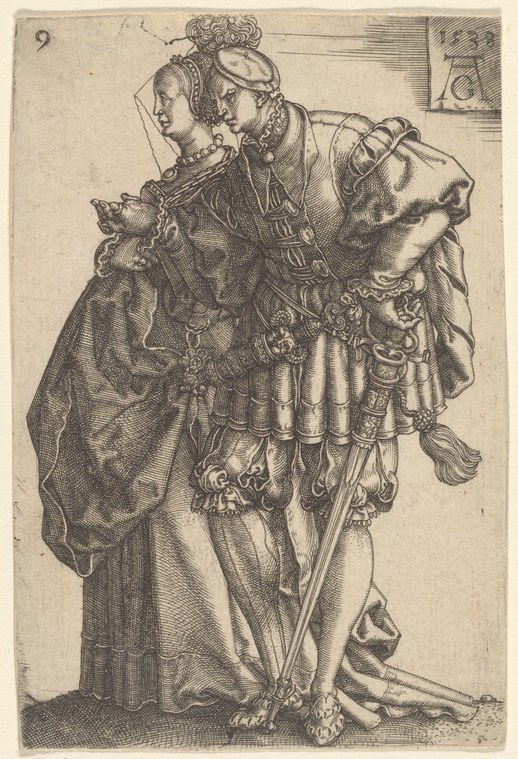
This engraving is evidence of partner acrobatics in the Renaissance court tradition, showing a specific pose that demonstrates the physical demands placed on male dancers and the vulnerability expected of female performers. The image is a rare surviving document of how supported lifts and dips were actually executed and valued in early modern dance spectacle.
What you are looking at
An engraving depicts a single male dancer in Renaissance costume supporting a female dancer who leans back dramatically in his arms. The man wears fitted hose, a doublet with decorative slashing, and a feathered hat; the woman wears an elaborate gown with a long train, a jeweled headdress, and a pearl necklace. He stands firmly planted, one arm supporting her across the back while she reclines nearly horizontal, her body weight entirely dependent on his strength. The composition is vertical and tightly framed against a plain background, focusing all attention on the geometric relationship between the two bodies and the precarious balance of the pose. The engraving technique allows fine detail in the fabric textures and decorative elements while the strong outlines give the figures sculptural presence. This is not a moment of social courtship dance but a demonstration of physical virtuosity and control—a theatrical or display piece rather than a participatory one.
The dancing
The male dancer supports his partner in what appears to be a near-horizontal dip or lift, bearing her entire weight with one supporting arm while the other steadies her torso. His legs are straight and braced for stability, his posture upright and commanding. The woman's body is nearly recumbent, her arms hanging, her legs extended, creating a clear dependent relationship. The hold is intimate but asymmetrical: his is active and controlling; hers is passive and trusting. This is partner acrobatics, not social dance.
The dance depicted
The image shows partner acrobatics or adagio work—a theatrical display of strength and balance rather than recreational dancing. The woman's near-horizontal recline supported by the man's single arm, combined with the formal Renaissance dress and presentation, suggests this is a court entertainment or theatrical display piece. Such virtuosic supported poses were common in Renaissance court spectacles and early modern theatrical entertainment, where dance merged with acrobatics and display. The specific pose—a dramatic dip or recline at an extreme angle—became a signature moment in partner acrobatics and was repeated in ballroom dancing traditions centuries later, but this engraving captures it in an early theatrical context.
How it was made
This is an engraving, likely created by metalpoint or etching, a medium that allowed fine detail and wide circulation in the 16th century. The technique's precision captures the elaborate costume details and the careful anatomical construction of the pose. Engravings of this scale and subject were commonly produced as standalone prints or as illustrations for dance manuals, making them accessible to a broad educated audience across Europe. The print survives in the New York Public Library collection, suggesting it was valued enough to be preserved and circulated.
About this work
This engraving documents an acrobatic partnered pose within a courtly or theatrical context, likely from the 16th century. The formal dress, virtuosic execution, and theatrical framing mark it as a display of skill for an elite audience rather than social recreation. The image captures a moment when dance, acrobatics, and courtly spectacle were not yet clearly separated; the pose itself—a dramatic supported recline—would become a signature moment in ballroom and theatrical partnering traditions for centuries to come. It belongs in a dance history collection because it shows how early modern display dancing worked: physically demanding, asymmetrical, dependent on one partner's strength and another's trust.
How to look at it
Look first at the geometry of the pose: the near-horizontal line of the woman's body creates an extreme angle of recline that would be impossible without the man's focused strength. Notice how the engraver has rendered his legs—straight and braced—to emphasize the effort required. The woman's passivity is conveyed through her limp arms and extended legs; she is entirely given over to his control. This is the opposite of egalitarian partnership; it is a demonstration of male strength and female trust, presented as spectacle. The costume detail—the elaborate gown, the jeweled headdress—emphasizes that this is a formal, courtly event, not street or recreational dancing.
The artist
The artist is not recorded in the source information. The engraving's style, subject matter, and technique suggest it was produced in the 16th century, likely in Northern Europe. The level of detail and the choice to document a specific dance pose indicates the artist was familiar with court entertainment or had access to dance instruction materials.
The period
In the 16th century, Renaissance courts across Europe valued dance as a primary form of elite entertainment and courtship ritual. Dance masters like Domenico da Piacenza and Thoinot Arbeau documented steps and patterns in written manuals, but visual prints like this one show how theatrical and acrobatic virtuosity was pushed beyond the social dances of the ballroom. Partner work in this period emphasized the male dancer's strength and the female dancer's grace and dependence; asymmetrical roles were fundamental to the aesthetic. The engraving format allowed such images to circulate among the educated elite, including other dance masters and patrons planning court entertainments.
Where it lives
The work is held by the New York Public Library, which acquired it as part of a collection of historical prints. It is catalogued as a print without further attributional or dating information, suggesting it was classified as a documentary visual source rather than a named artistic work.
Dance in this work
Questions about this work
Is this a social dance or a theatrical performance?
This is theatrical display or court entertainment. The extreme recline, the emphasis on the man's strength, and the formal costume indicate this is a virtuosic demonstration piece, not a dance that social partners would perform together in a ballroom. It shows how Renaissance court spectacle merged dance, acrobatics, and physical display.
What is the pose called?
In modern ballroom or partner dance terminology, this would be a dip or a dramatic recline. In the Renaissance context, it would have been part of the courtly display tradition. The specific name used in 16th-century dance manuals is not clear from the image alone, but the pose itself—a supported near-horizontal lean—became a signature moment in partner dancing traditions.
How do we know this is from the Renaissance and not earlier or later?
The engraving technique, the style of costume (the doublet with slashing, the feathered hat, the cut of the gown), and the aesthetic of the composition all point to the 16th century. The formal precision and the choice to document a specific partnered pose also suggest the Renaissance dance manual tradition, when dance masters began to record and systematize court dances.
What does this tell us about gender roles in Renaissance dance?
The image makes explicit what Renaissance dance manuals often only imply: the male dancer's role was to be strong, stable, and in control; the female dancer's role was to be graceful, dependent, and trusting. The asymmetry of the pose—his effort, her passivity—was fundamental to the aesthetic and to courtly understandings of male and female bodies.
More dance artwork